20 francs 1944
Market Prices
16 salesAbout This Note
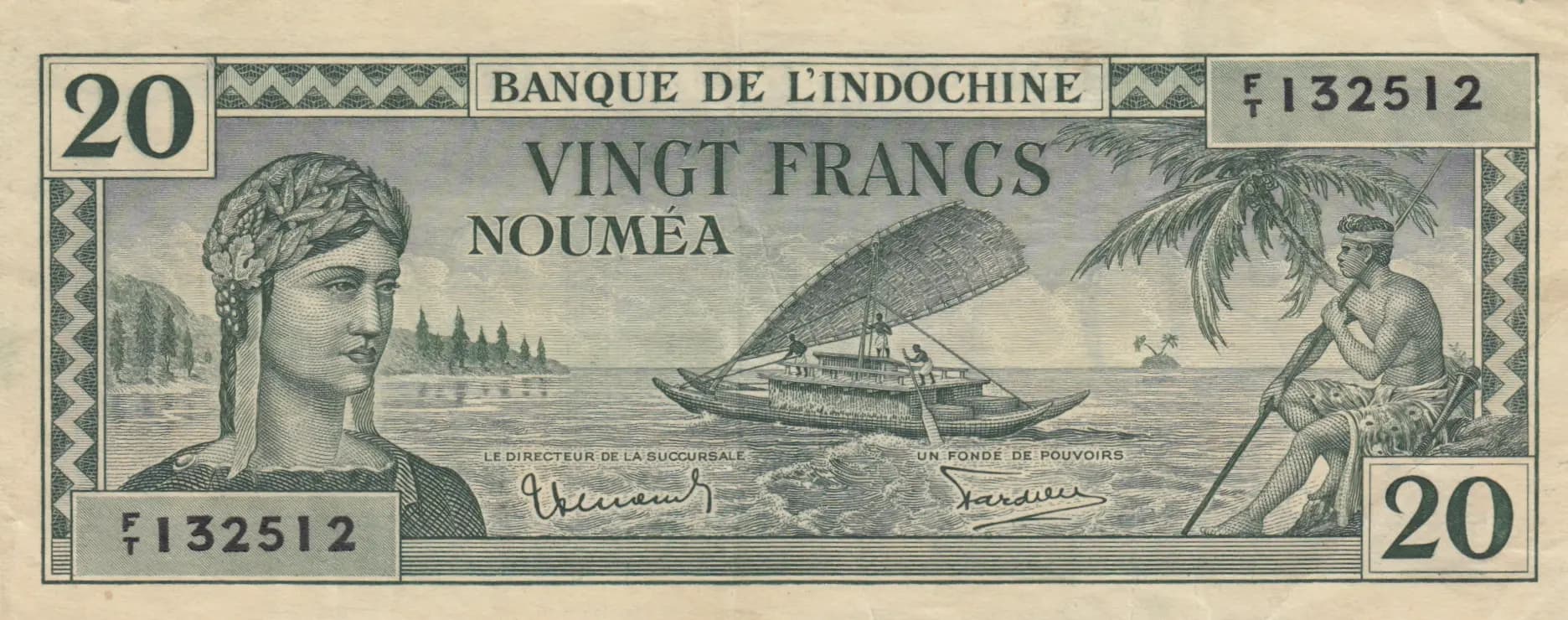
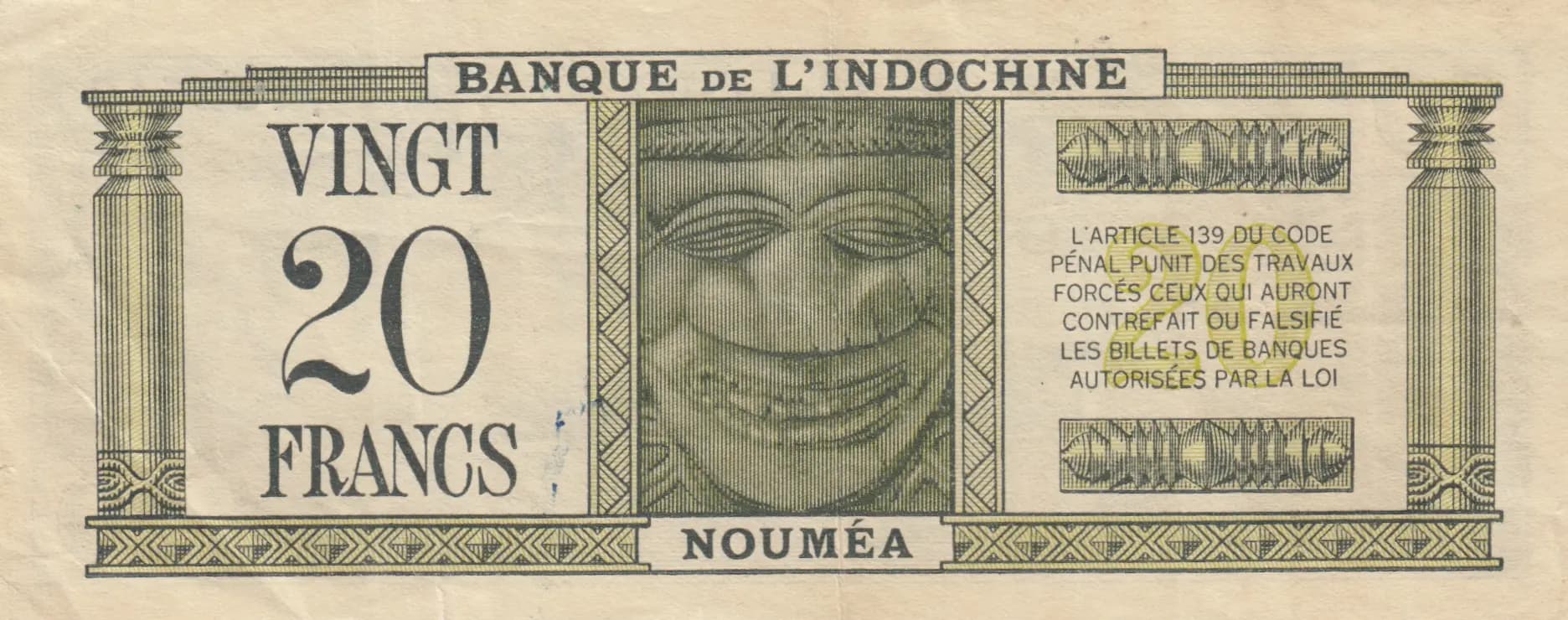
This is a visually striking 1944 Banque de l'Indochine 20 Francs note from New Caledonia, presenting the French colonial Pacific in elegant engraved detail. The front showcases a classical female portrait with an elaborate braided hairstyle alongside a traditional outrigger canoe with indigenous paddler, while the reverse displays a large ornamental face or mask rendered in fine parallel-line engraving. The note exhibits excellent condition with sharp, clear printing throughout and no visible wear, making it an attractive example of this wartime French colonial currency.
Common. The 1944 New Caledonia 20 Francs note remains common in numismatic circulation. eBay auction data provided shows consistent sales in the $13–$61 range for VF specimens over a period spanning 2012–2020, with catalog values (as of 2016) listing VF examples at $25 and UNC at $90. These moderate, stable price points and the frequency of sales evidence indicate regular availability in the collector market. This note was not recalled, was issued during a period of ongoing French colonial administration, and has no known print run restrictions, all factors supporting a common designation.
Issued during World War II in 1944, this banknote reflects the geopolitical complexities of the Pacific War period, when New Caledonia remained under French control and served as an important Allied position. The imagery—combining classical European aesthetics (the female portrait) with indigenous Pacific elements (the outrigger canoe, paddler, and decorative mask)—typifies the colonial-era design philosophy of the Banque de l'Indochine, presenting metropolitan France's cultural authority alongside ethnographic representations of its overseas territories. The legal warning against counterfeiting on the reverse underscores the note's official wartime status as authorized legal tender.
The front of this note presents a harmonious composition balancing European and Pacific colonial aesthetics. The left side features a classical female portrait—possibly representing Marianne or a generic allegorical figure of France—rendered in profile with an elaborate braided hairstyle, demonstrating the fine engraver's skill in capturing realistic facial features and elaborate coiffure. The central scene depicts a traditional double-outrigger canoe under sail on calm water, with forested coastline (featuring coniferous trees) receding into the background and a prominent palm tree on the right margin, establishing the tropical Pacific setting. An indigenous figure in traditional dress stands on the right holding a paddle, representing the local populations of New Caledonia. The entire composition is framed by decorative geometric borders featuring triangular and diamond motifs characteristic of Art Deco-influenced security design. The reverse is dominated by a large stylized face or ornamental mask in the center, rendered entirely through fine parallel-line engraving that creates tonal variation and three-dimensionality. Ornamental columnar designs flank this central element, and the same geometric border patterns frame the upper and lower edges. The dual design approach—ethnographic imagery on the obverse, abstract ornamental masking on the reverse—reflects the visual language of 1940s French colonial currency.
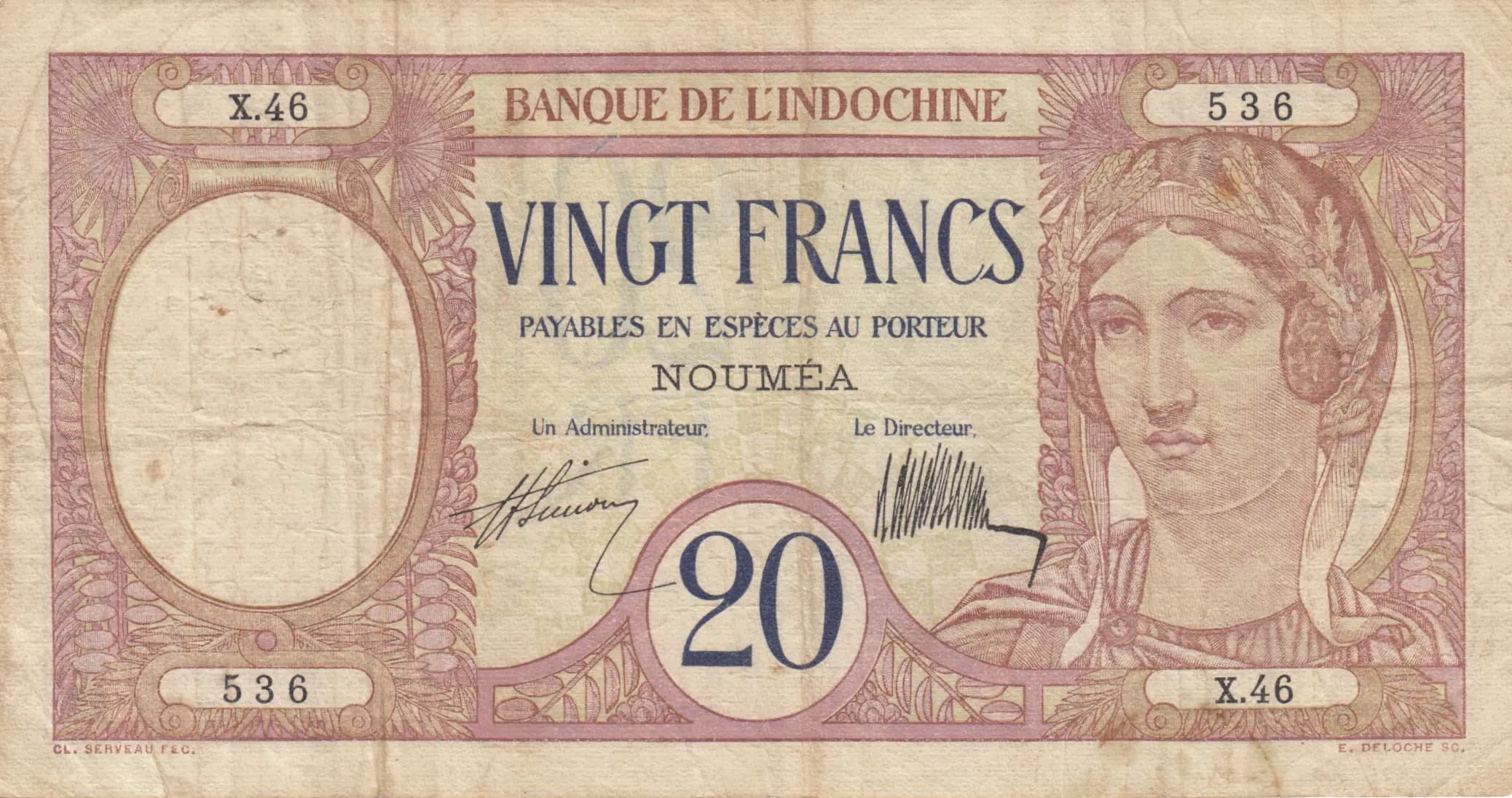
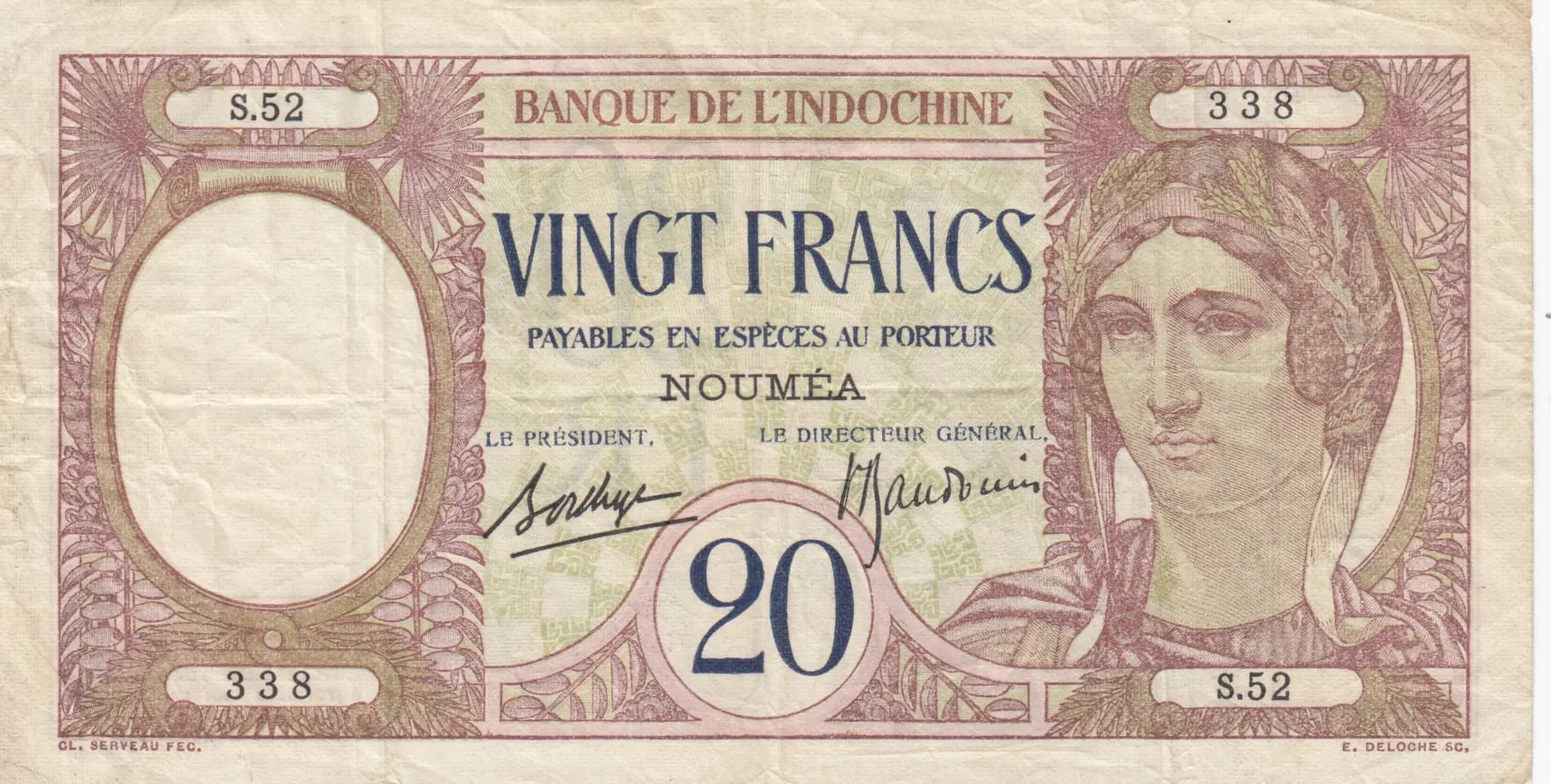
Front side: 'BANQUE DE L'INDOCHINE' (Bank of Indochina), 'VINGT FRANCS NOUMÉA' (Twenty Francs Noumea), 'LE DIRECTEUR DE LA SUCCURSALE' (The Director of the Branch), 'UN FONDE DE POUVOIRS' (An Authorized Representative), denomination '20' (Twenty) appears twice. Serial number 'F132512' is visible. Back side: 'BANQUE DE L'INDOCHINE' (Bank of Indochina), 'VINGT' (Twenty), 'FRANCS' (Francs), 'NOUMÉA' (Noumea), denomination '20' (Twenty). Legal warning: 'L'ARTICLE 139 DU CODE PÉNAL PUNIT DES TRAVAUX FORCÉS CEUX QUI AURONT CONTREFAIT OU FALSIFIÉ LES BILLETS DE BANQUES AUTORISÉES PAR LA LOI' (Article 139 of the Penal Code punishes forced labor those who will have counterfeited or falsified banknotes authorized by law).
The note was produced using intaglio (engraved line) printing, evidenced by the fine parallel-line work throughout, particularly visible in the facial details, the ornamental mask on the reverse, and the intricate border patterns. The sharp clarity of the geometric motifs and the precise serial numbering indicate professional security printing by Banque de l'Indochine's established engraving facilities. No evidence of multiple color passes is visible; this appears to be single-color (black ink on cream/beige paper) security printing with the color variations created purely through engraved line density and spacing.
The observed specimen bears the serial number F132512 and carries signature lines for 'LE DIRECTEUR DE LA SUCCURSALE' (Branch Director) and 'UN FONDE DE POUVOIRS' (Authorized Representative), consistent with the standard P-49 issue. The PMG Population Report identifies two catalogued variants for this Pick number (P-49 and P-49s), with the 's' suffix typically indicating specimen notes or notes with overprints. The present note appears to be a standard P-49 circulation example with no visible overprints. The condition grade of VF (Very Fine) is consistent with the visual observations of minimal wear and sharp engraving throughout.