500 francs 1969
Market Prices
4 salesAbout This Note
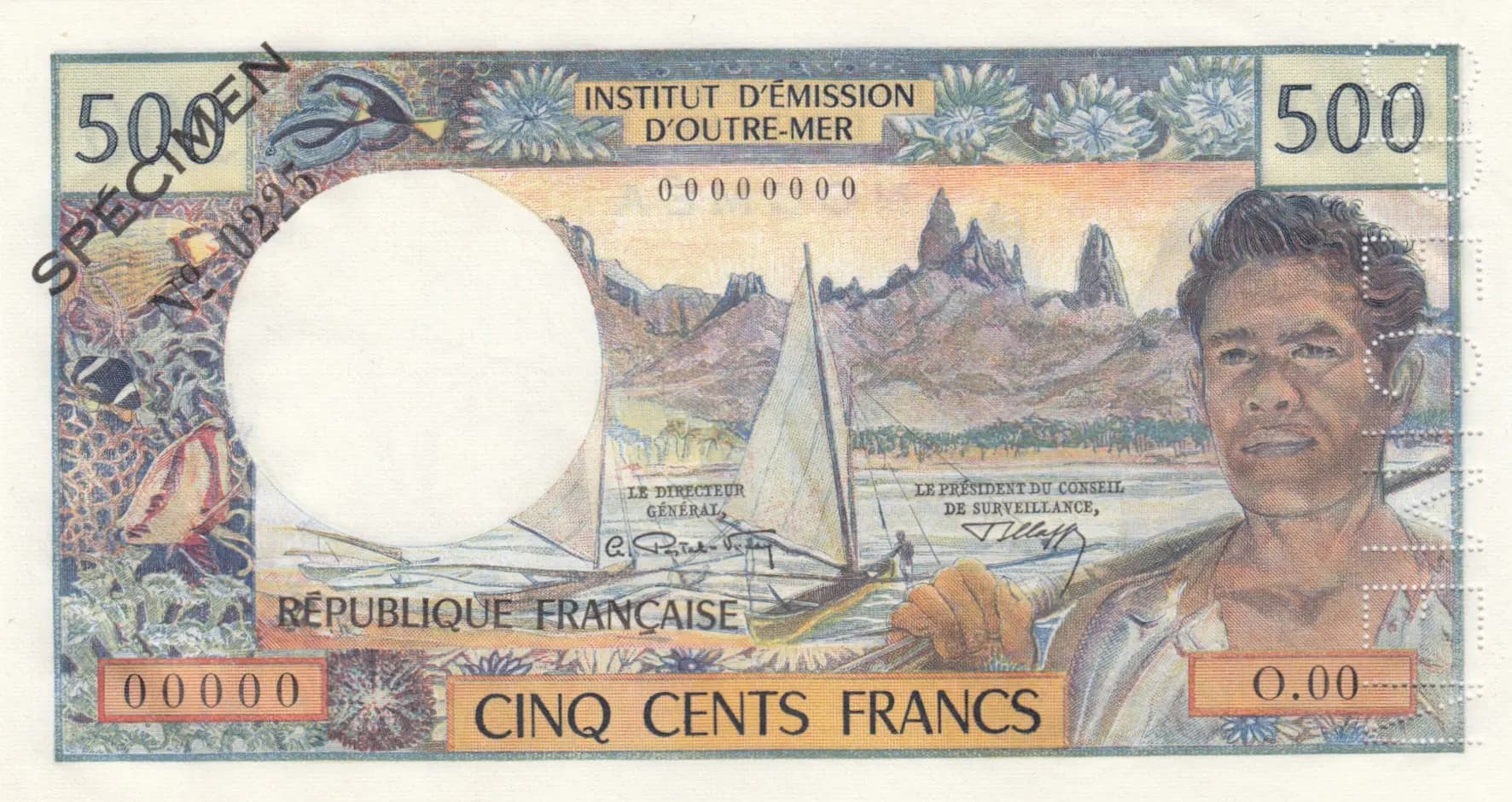
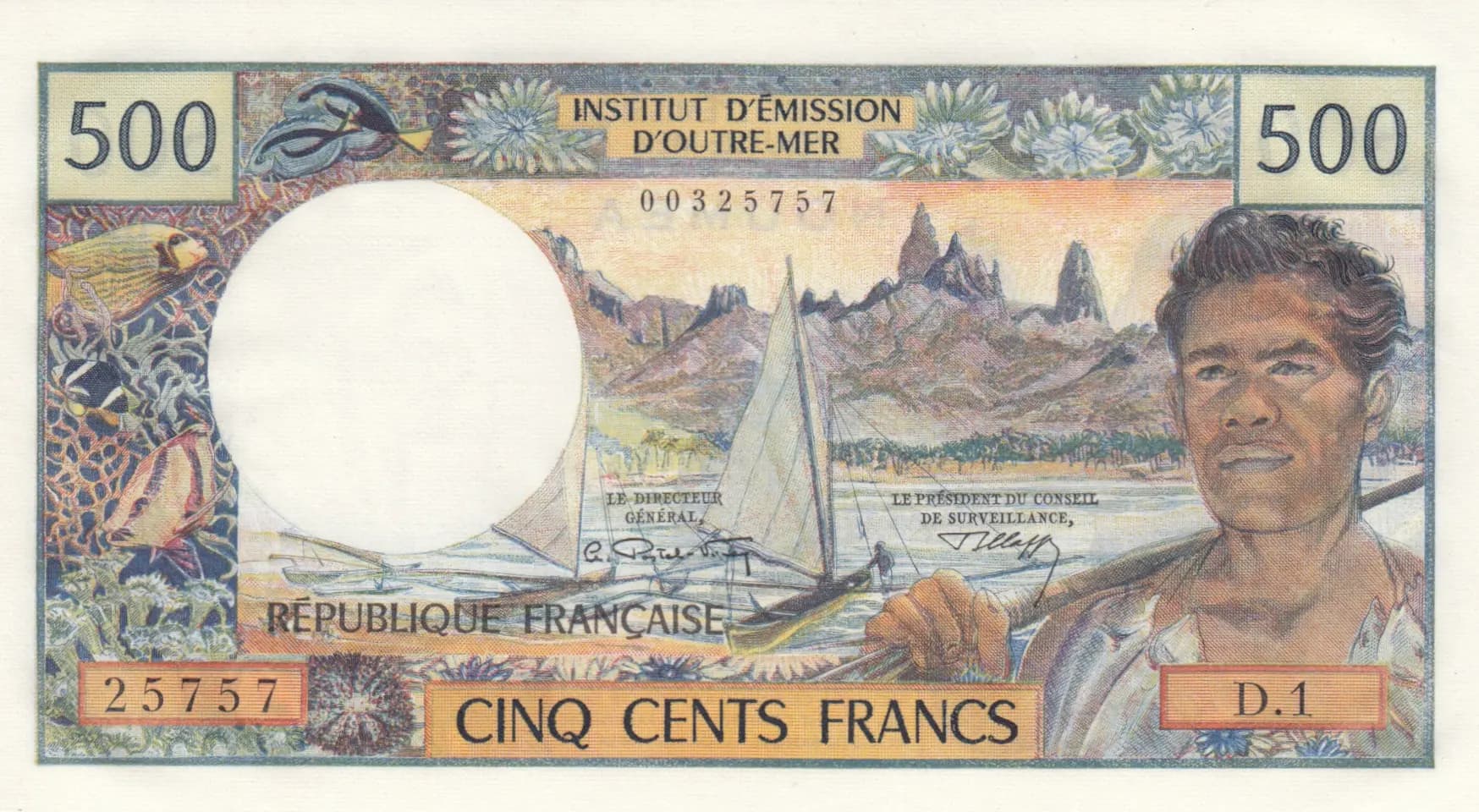
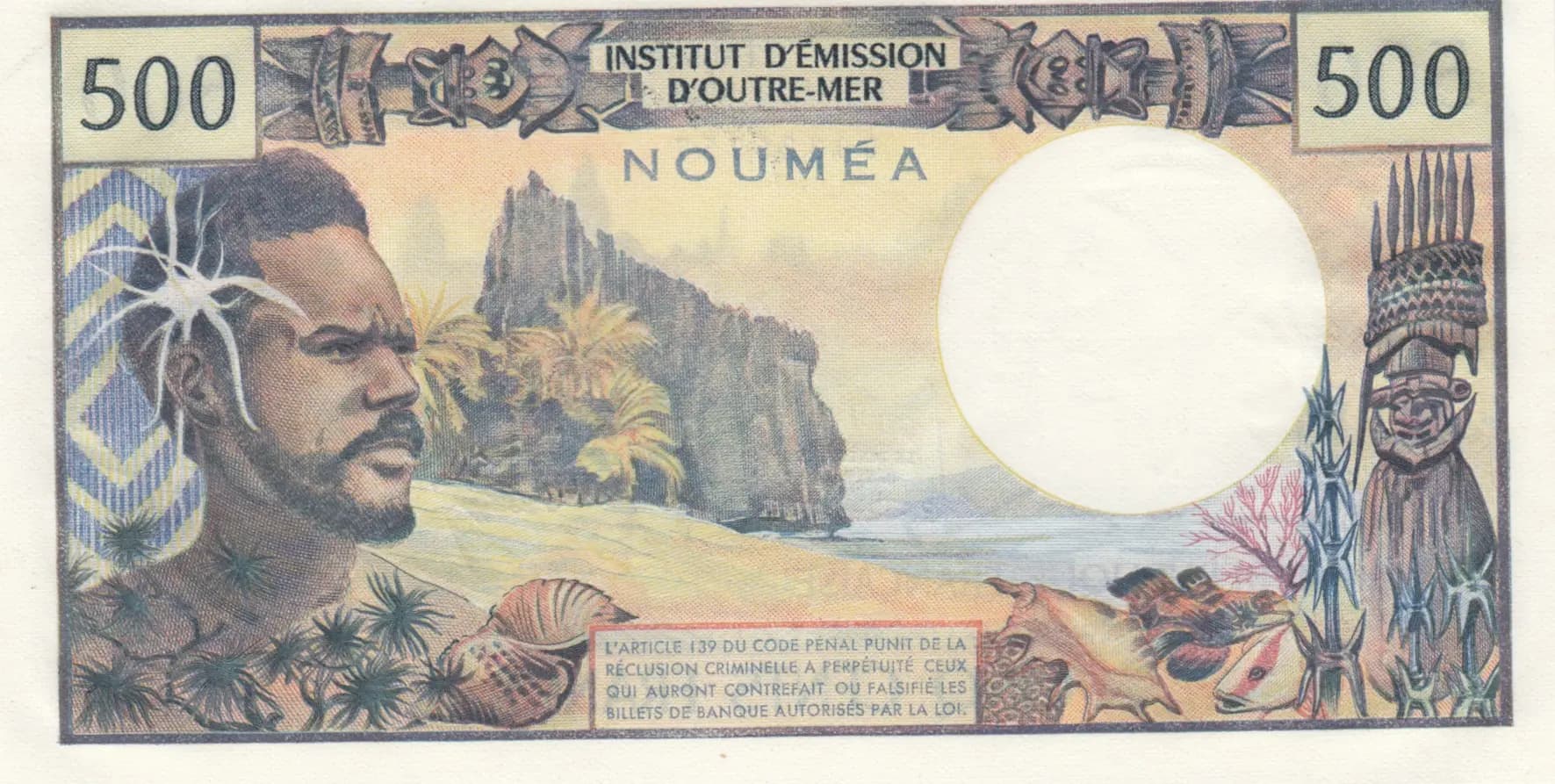
This is an uncirculated 1969 New Caledonian 500 francs note issued by the Institut d'Émission d'Outre-Mer, graded in pristine condition with no visible wear, creases, or stains. The note features a distinctive design with a fisherman portrait on the front and a bearded man in profile on the back, complemented by vivid tropical imagery including coastal landscapes, sailing vessels, palm trees, and indigenous Melanesian cultural elements such as a tribal mask. The vibrant multicolor printing with cream, blue, green, brown, and coral tones, combined with the fine engraving detail and dual watermark areas, exemplifies the sophisticated security features typical of French Pacific territorial currency from this era.
Common. The 1969 500 francs New Caledonian note is regularly encountered in the collecting market, with eBay transaction data showing consistent sales between $1.95 and $50 USD depending on condition, and catalog values of $125 for UNC specimens indicating reasonable availability. The note was issued during a stable period with likely substantial print runs to meet circulation demands in New Caledonia. No evidence of short print runs, recall notices, or scarcity factors elevates this to rare status.
Issued during a period when New Caledonia remained under French colonial administration, this note reflects the blend of French governance and Pacific island identity through its bilingual French inscriptions and prominent display of Nouméa, the capital. The depicted coastal landscapes, maritime imagery (the sailing boat and bay scenes), and indigenous Melanesian cultural symbols (the tribal mask and totem) on the reverse represent New Caledonia's geographic position and indigenous heritage during the late 1960s, a transitional period before the territory moved toward greater autonomy in subsequent decades.
The obverse features a portrait of a fisherman positioned on the right side, reflecting the maritime economy of New Caledonia, with a large white circular watermark area dominating the center-left. A scenic coastal landscape with mountains and a traditional sailing boat on blue water occupies the left portion, framed by decorative marine and floral elements including stylized fish and coral motifs. The reverse displays a bearded man in left-facing profile on the left side, with the city name 'NOUMÉA' prominently centered, accompanied by another circular watermark area. The reverse design incorporates a dramatic coastal cliffscape rising from water, tropical vegetation including palm trees, and a distinctive tribal mask or totem figure with geometric Melanesian patterns on the right side, along with coral and sea urchin-like decorative elements emphasizing the island's natural heritage and indigenous culture.
FRONT: '500' (denomination), 'INSTITUT D'ÉMISSION D'OUTRE-MER' (Overseas Issuing Institute), '00325757' and '25757' (serial numbers), 'République FRANÇAISE' (French Republic), 'CINQ CENTS FRANCS' (Five Hundred Francs), 'LE DIRECTEUR GÉNÉRAL' (The General Director), 'LE PRÉSIDENT DU CONSEIL DE SURVEILLANCE' (The President of the Supervisory Board), 'D.1' (designation code). BACK: '500' (denomination), 'INSTITUT D'ÉMISSION D'OUTRE-MER' (Overseas Issuing Institute), 'NOUMÉA' (city name and mint location), 'L'ARTICLE 139 DU CODE PÉNAL PUNIT DE LA RÉCLUSIÓN CRIMINELLE À PERPÉTUITÉ QUICONQUE CONTREFAIT OU FALSIFIÉ LES BILLETS DE BANQUE AUTORISÉS PAR LA LOI' (Article 139 of the Criminal Code punishes with life imprisonment anyone who counterfeits or falsifies banknotes authorized by law).
Intaglio/engraved printing, characteristic of 1960s French banknote production by the Banque de France's security printing division. The fine detail work visible in the portraits, intricate border ornaments, and security patterns—including the dual watermark areas and multiple serial number applications—are consistent with high-security engraved banknote production standards. The sharp registration of colors (cream, blue, green, brown, orange, and coral) and the precision of the decorative elements confirm professional banknote engraving techniques typical of Institut d'Émission d'Outre-Mer notes produced during this period.
This specimen is cataloged as Pick 60a, identified by signature variant #1 ('Sign. #1'). The PMG population report indicates five known signature varieties exist for this denomination and date (P-60a through P-60e), with P-60a representing the first signature variant. The serial number observed (00325757) falls within the standard range for regular circulation issues. No date variations are noted as the issue is dated ND (No Date) 1969-1989, representing a long-lived series.