50 centimes 1943
Market Prices
21 salesAbout This Note
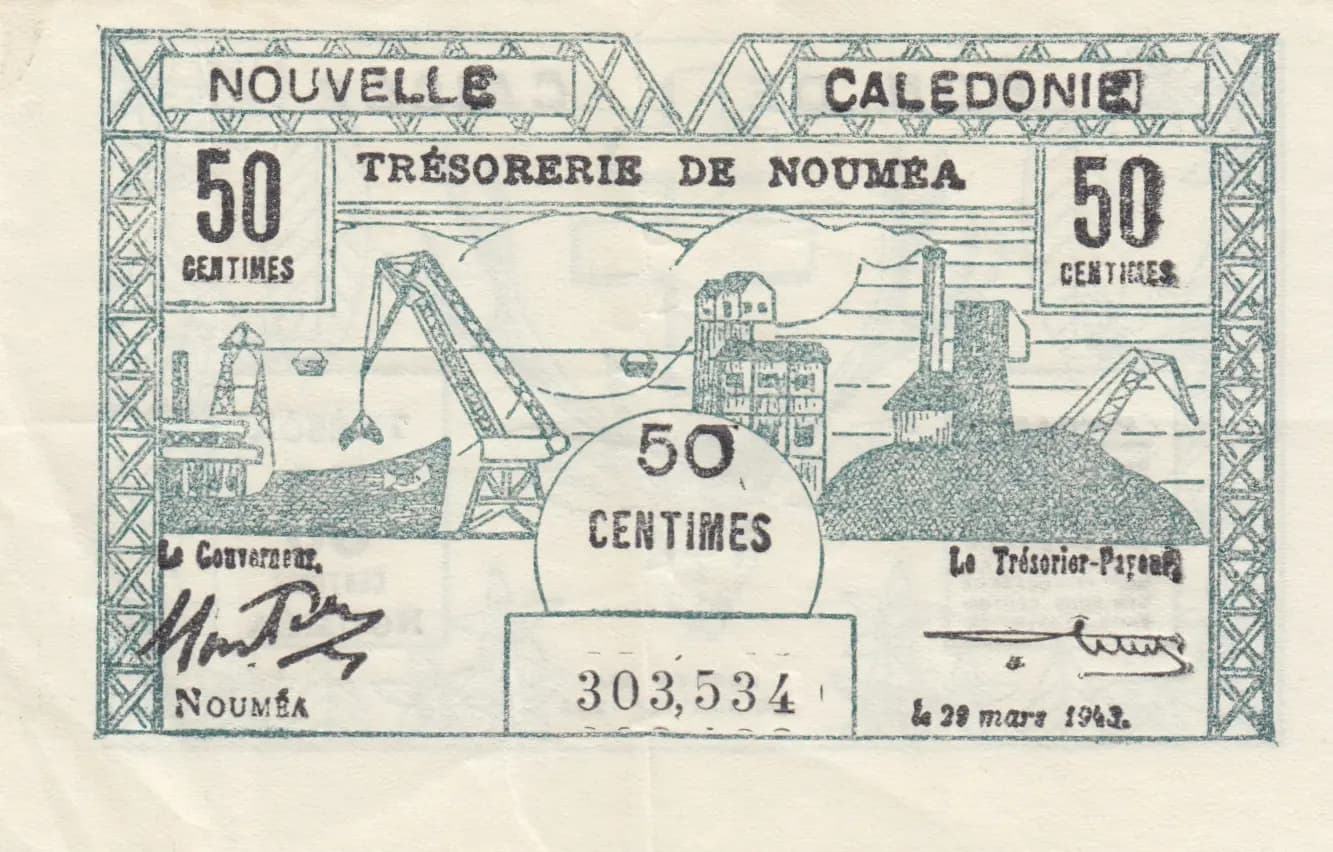
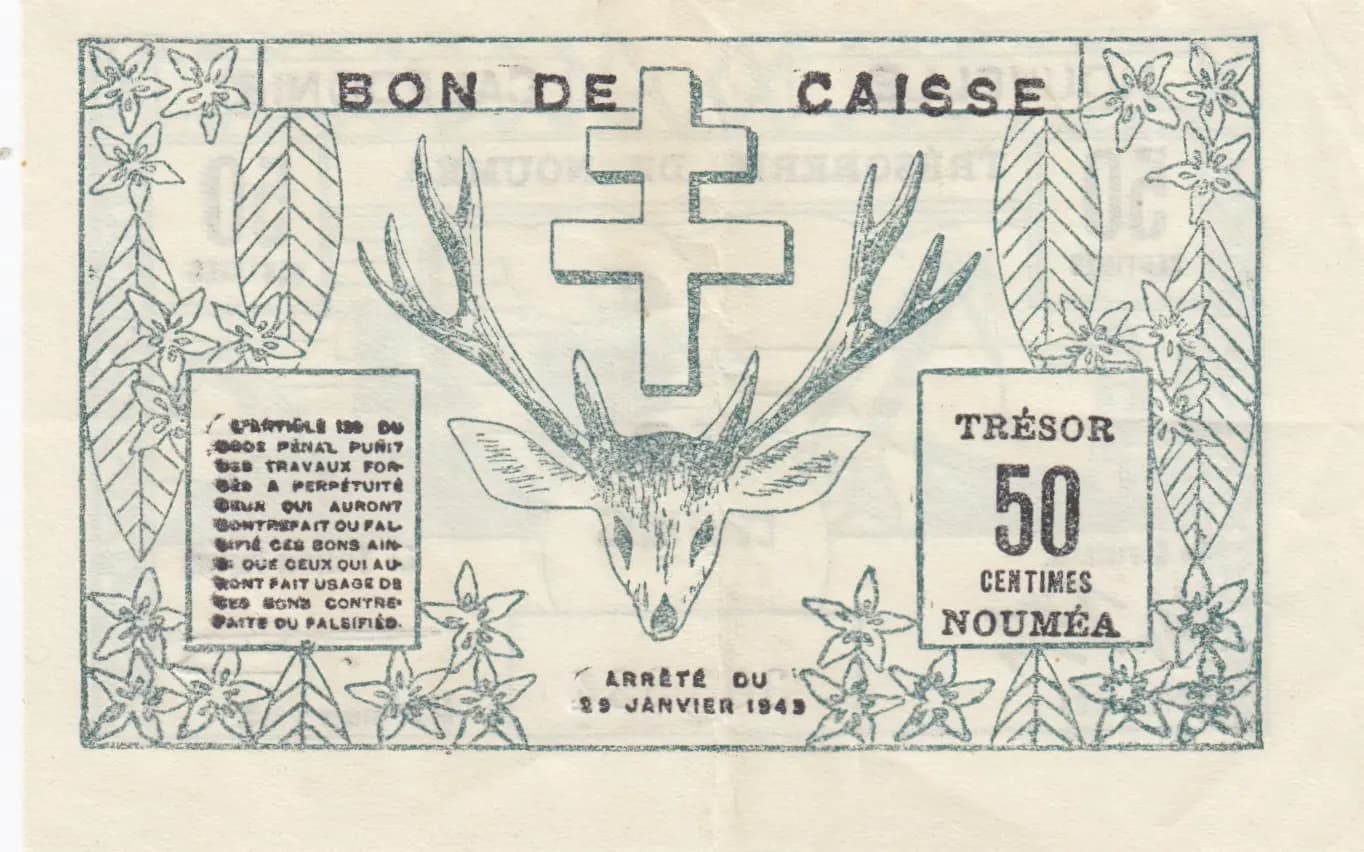
This New Caledonian 50 centimes note from 1943 presents a striking industrial-themed design reflecting wartime economic activity, with a prominent mining crane and processing facilities dominating the obverse. The note displays the patina typical of an 80-year-old banknote, with visible foxing and yellowing throughout, consistent with the assigned VF grade. The reverse features the symbolic Free French Cross (Lorraine Cross) surrounded by botanical ornamentation, cementing this note's historical significance during the Free French administration of the Pacific territory.
Common. eBay auction data demonstrates consistent market activity with numerous sales of this Pick number across multiple condition grades, with UNC examples regularly selling in the $15-$30 range and lower grades (F-VF) trading at $5-$10. The VF-graded example under review falls within the typical price range for this grade ($5-$10 based on 2013-2020 comparable sales), indicating robust collector demand but without scarcity premium. The catalog valuation of $6 VF (2016 reference) further confirms this as a common circulation issue despite its wartime origin.
Issued by the Trésorerie de Noumea on 29 January 1943, this note represents New Caledonia's wartime emergency currency during Free French control of the Pacific. The obverse's prominent depiction of mining infrastructure—featuring an excavating crane and industrial buildings—reflects the colony's strategic importance as a nickel and chromium producer supporting the Allied war effort. The reverse's prominent Lorraine Cross symbolizes the Free French movement under Charles de Gaulle, underscoring the note's role as an instrument of territorial sovereignty during the occupation of mainland France.
The obverse features an allegorical industrial scene representative of New Caledonian wartime production capacity, centered on a large excavating crane with mining infrastructure including processing buildings and structures positioned to the right, with mountainous terrain in the background. This imagery directly relates to the colony's crucial nickel mining operations supporting the Allied cause. The denomination appears thrice—upper left, upper right, and within a central circle—employing multiple placement as an anti-counterfeiting measure. The reverse displays the Cross of Lorraine (Croix de Lorraine), the emblem of Free France, as the dominant central motif, flanked by ornamental botanical elements including flowering branches and leafy flourishes that provide decorative framing. A decorative geometric border featuring repeating diamond and cross patterns frames both sides. The note is printed primarily in teal/cyan and black on cream/off-white paper stock.
Front: 'NOUVELLE CALEDONIE' (New Caledonia), '50 CENTIMES' (50 centimes, appearing three times), 'TRESORERIE DE NOUMEA' (Treasury of Noumea), 'Le Gouverneur' (The Governor), 'Le Tresorier-Payeur' (The Treasurer-Paymaster), 'Noumea', serial number '303,534', date 'le 29 mars 1943' (29 March 1943). Back: 'BON DE CAISSE' (Cash voucher), 'TRESOR' (Treasury), '50 CENTIMES NOUMEA', 'ARRÊTE DU 29 JANVIER 1943' (Decree of 29 January 1943), and the legal warning 'L'ARTICLE 23 DU DECRET PUNIT LES TRAVAUX FORCES A PERPETUITE CELUI QUI AURAIENT CONTREFAIT OU FALSIFIE CES BONS AINSI QUE CEUX QUI AURAIENT USAGE DES BILLETS FAUX CONTREFAIT OU FALSIFIES' (Article 23 of the decree punishes with forced labor in perpetuity those who would counterfeit or falsify these vouchers as well as those who would use counterfeit or falsified notes).
The note employs letterpress and intaglio printing techniques typical of 1940s security banknote production. The geometric precision of borders, clarity of text, and consistent ink coverage suggest professional security printing, characteristic of notes issued under French territorial administration. The two-color scheme (teal/cyan and black) is produced through standard multi-pass printing methodology common to French colonial currency of this era. The printer information is not explicitly visible in the inscriptions analyzed.
The observed specimen is dated 'le 29 mars 1943' on the front and 'ARRÊTE DU 29 JANVIER 1943' on the reverse, representing a note issued under the decree of 29 January 1943 with signatures dated 29 March 1943. The catalog references note a related issue with date 'L. 15.07.1942' (Pick P-51), indicating multiple date variants exist within this denomination. Serial number '303,534' is visible on the obverse. The PMG population report indicates one variant exists for the P-54 base number, though multiple date variants appear to have been issued. The absence of professional grading marks on this particular note suggests it represents an ungraded circulation specimen.