50 centimes 1942
Market Prices
14 salesAbout This Note
This New Caledonian 50 Centimes Treasury Bond from July 1942 presents an interesting wartime emergency currency issued by the Trésorerie de Nouméa during the Japanese occupation period. The VF-graded note exhibits the typical aging characteristics of 1940s paper currency—foxing, yellowing, and light creasing—while maintaining good ink clarity on both industrial and symbolic designs. The presence of the Free French Lorraine cross on the reverse underscores this note's significance as a symbol of French territorial resistance during WWII.
Common. The secondary market data provides clear evidence of availability: eBay records show consistent sales of this Pick-51 variant in VF condition at $8–$18 across multiple transactions from 2011–2021, with catalog valuations listing VF at $6 (2016 baseline). Notes regularly trading in double-digit dollar ranges in modest auction competition indicate healthy supply. While 1942 wartime emergency currency from French Pacific territories has collector interest, print runs were substantial enough to supply a functioning territory, and no historical evidence suggests limited or recalled mintage. The PMG population report indicates at least one catalogued variant, consistent with common-note frequency.
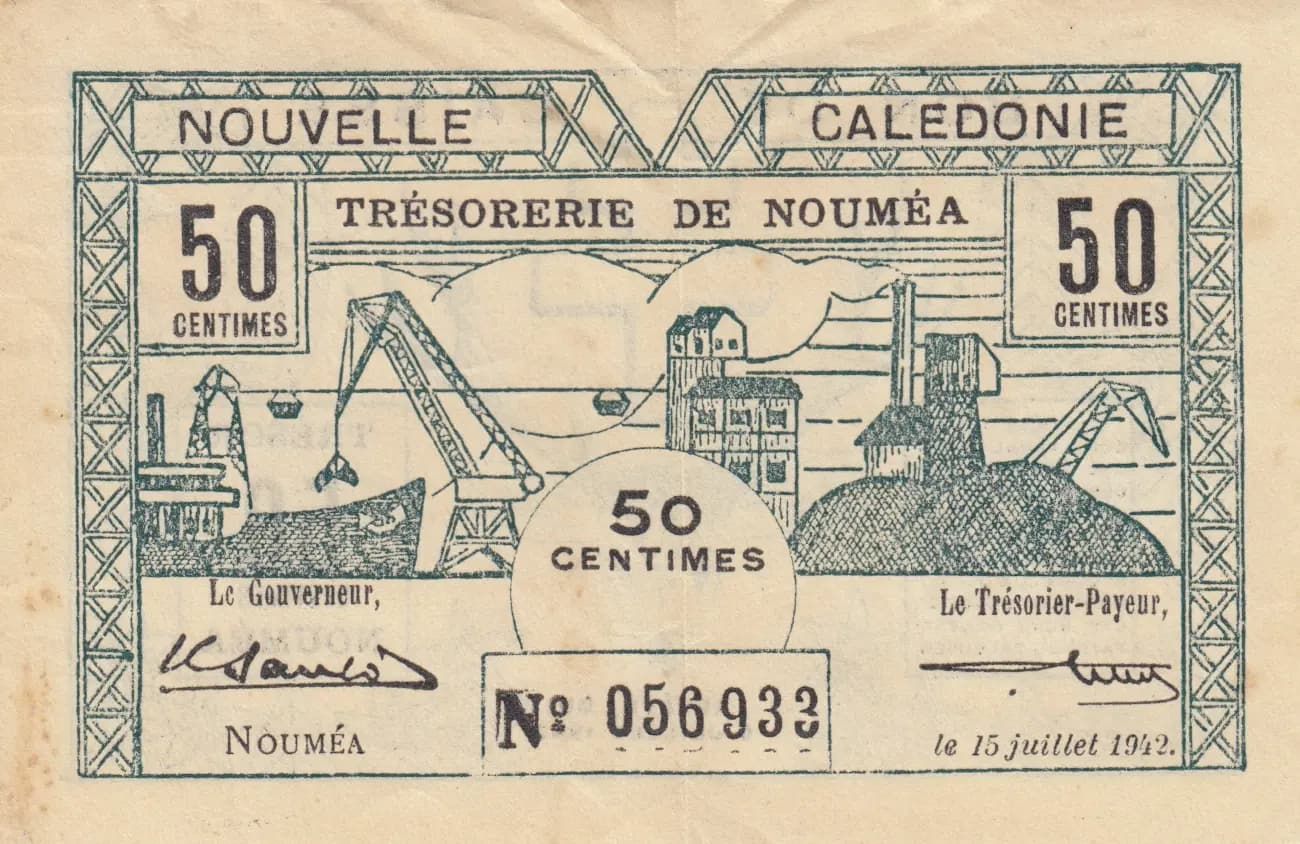
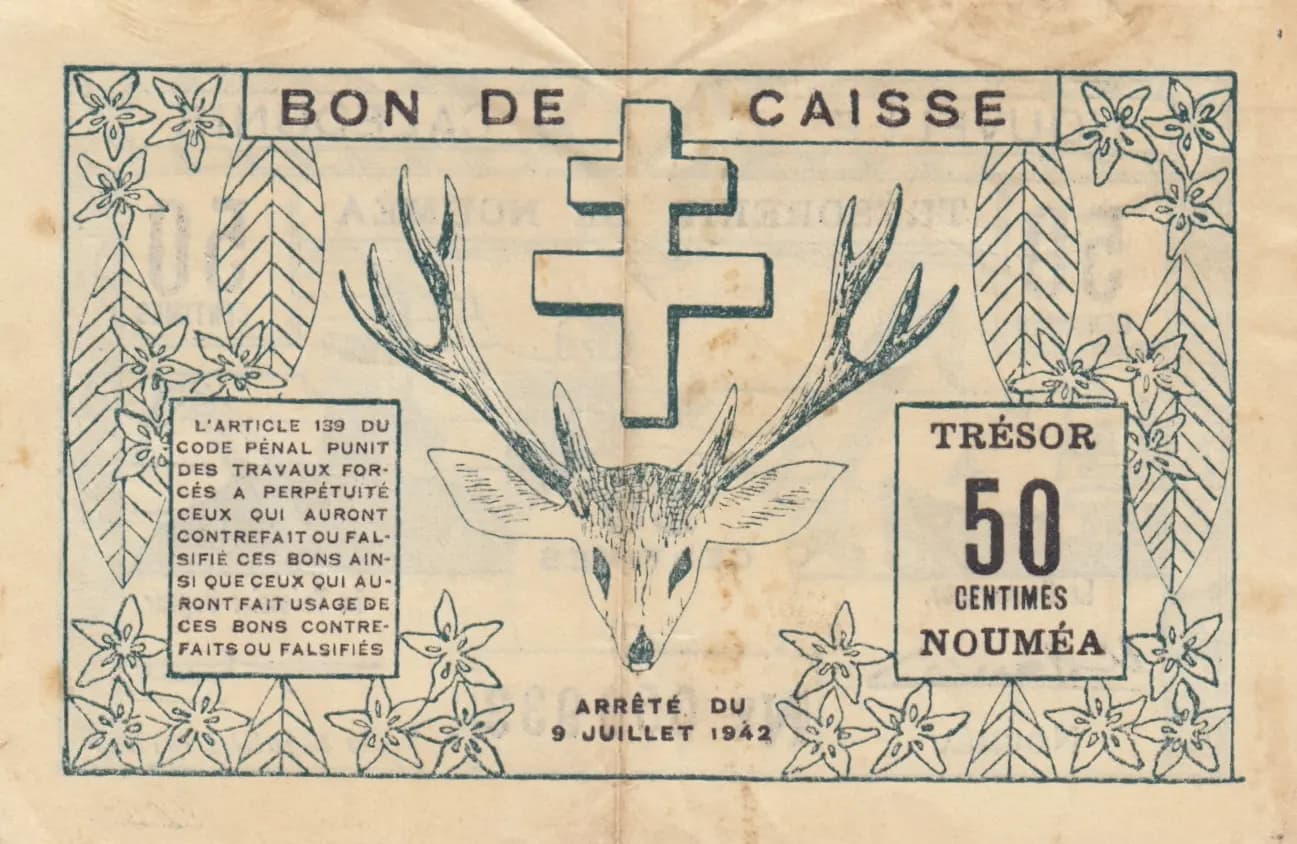
Issued during the Japanese occupation of the Pacific and Free French administration of New Caledonia, this 1942 bond reflects the territory's role as a strategic Allied stronghold. The obverse design emphasizing industrial infrastructure—mining equipment, docks, and factories—illustrates New Caledonia's economic importance, particularly nickel mining operations vital to the war effort. The reverse's prominent Lorraine cross (Cross of Lorraine), symbol of Free France under de Gaulle, reinforces the political context of this emergency currency, issued by decree on July 9, 1942, and dated July 15, 1942.
The obverse features an industrial scene depicting New Caledonia's economic base: a multi-story industrial building, mining excavation equipment, cranes, and dock infrastructure rendered in teal/dark blue ink, representing the territory's nickel mining and port operations critical to Allied logistics. A decorative geometric border with diagonal lattice pattern frames the composition. The reverse displays the Cross of Lorraine (also called the Free French cross), a double-armed cross symbol prominently associated with Charles de Gaulle's Free French movement, flanked by stylized botanical and floral designs. The cross represents the Free French administration's control of New Caledonia during this period. Both sides are printed on cream-colored paper with consistent color scheme. The note classification as 'BON DE CAISSE' (Treasury Bond/Cash Voucher) indicates this was emergency currency rather than standard banknotes.
FRONT SIDE: 'NOUVELLE CALEDONIE' (New Caledonia) | 'TRÉSORERIE DE NOUMÉA' (Treasury of Nouméa) | '50 CENTIMES' (50 Centimes, appears three times) | Serial number 'N° 056933' | 'Le Gouverneur,' (The Governor) | 'Le Trésorier-Payeur,' (The Treasurer-Paymaster) | 'Nouméa' | 'le 15 juillet 1942' (July 15, 1942). BACK SIDE: 'BON DE CAISSE' (Treasury Bond/Cash Voucher) | 'TRÉSOR' (Treasury) | '50 CENTIMES' (50 Centimes) | 'NOUMÉA' (Nouméa) | 'L'ARTICLE 139 DU CODE PÉNAL PUNIT DES TRAVAUX FORCÉS A PERPÉTUITÉ CEUX QUI AURAIENT CONTREFAIT OU FALSIFIÉ DES BONS AINSI QUE CEUX QUI AURAIENT FAIT USAGE DE CES BONS CONTREFAITS OU FALSIFIÉS' (Article 139 of the Penal Code punishes with hard labor in perpetuity those who would have counterfeited or falsified these bonds as well as those who would have made use of these counterfeit or falsified bonds) | 'ARRÊTÉ DU 9 JUILLET 1942' (Decree of July 9, 1942).
Letterpress/relief printing on cream-colored paper stock, typical of 1940s currency production. The note exhibits characteristics consistent with period printing methods: uniform teal/dark blue ink application, crisp text and border definition, and the mechanical precision of letterpress for both geometric borders and symbolic elements. No advanced security features are visible, which is consistent with emergency wartime currency practice. The specific printer/security printer for Pick-51 is not documented in standard references, though these notes were produced under French colonial treasury authority in Nouméa.
This specific specimen is identified as Pick-51, issued July 15, 1942 (per 'le 15 juillet 1942' inscription), with serial number 056933. The catalog data notes a related variety as Pick-54 (dated January 29, 1943, also issued by Trésorerie de Nouméa), indicating that the July 1942 issue constitutes the first variety of this denomination in this series. No overprints or signature variants are observed on this specimen. The serial number suggests mid-range production sequencing rather than early or late issue scarcity.