5 francs 1943
Market Prices
16 salesAbout This Note
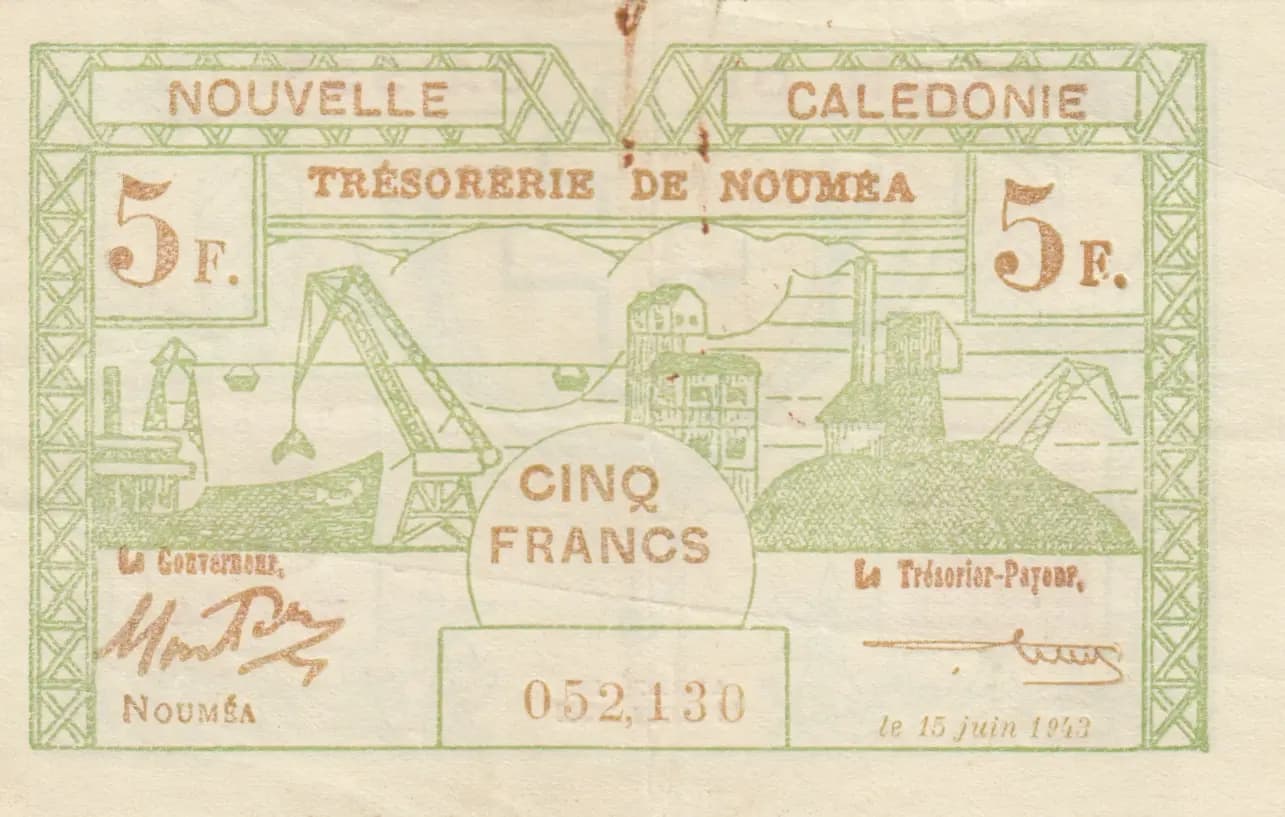
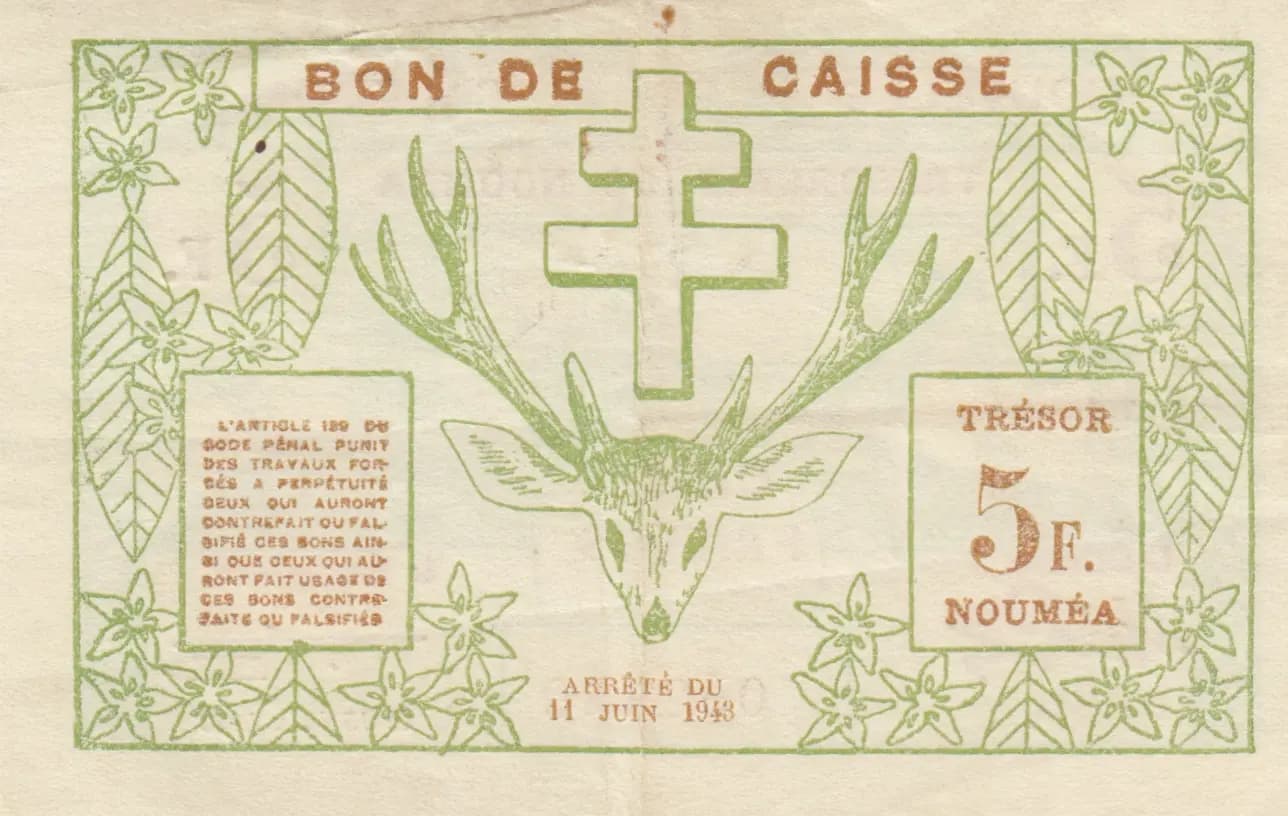
This New Caledonia 5 Francs note from 1943 (Pick-58) presents a scarce example of colonial French Pacific currency issued by the Trésorerie de Nouméa during World War II. The obverse features colonial architectural imagery in green and tan tones depicting fortifications and administrative buildings characteristic of early 20th-century New Caledonian settlements, while the reverse showcases a prominent Christian cross with heraldic elements including a stag head and laurel wreaths. In VF condition, this note displays appropriate age-related foxing, fold creases, and browning consistent with an 81-year-old piece, with the paper remaining structurally sound.
Common. While the eBay market data shows significant price variation ($0.99 to $35 depending on condition and grading), the average realized prices for VF examples cluster around $7–$22 across a 10-year period, with multiple sales recorded annually or biennially. The 2016 catalogue valuation of $6.50 for VF condition aligns with actual market results. The consistent availability and moderate pricing indicate this is a regularly traded note without significant scarcity. New Caledonian currency from this period, while less commonly encountered than metropolitan French issues, was produced in sufficient quantity to supply the colonial territory's wartime economy and remains accessible to collectors at modest cost.
Issued on June 15, 1943, during the final years of World War II when New Caledonia served as a strategic French colonial outpost and Allied military base in the South Pacific, this treasury note reflects the wartime monetary emergency that necessitated local currency issuance. The architectural imagery on the obverse—depicting colonial fortifications and administrative structures—represents the infrastructure of French governance in the territory, while the reverse's Cross of Lorraine symbol was widely used by Free French forces under de Gaulle during WWII, suggesting potential Gaullist sympathies in the colonial administration. The note's issuance by the local treasury rather than the Bank of France underscores New Caledonia's geographic isolation and the practical necessities of wartime colonial administration.
The obverse features a multi-element colonial landscape composition in green and brown/tan inks depicting the infrastructure of French New Caledonia. The design prominently showcases three architectural structures: a fortified colonial fort or fortress on the left, a multi-story colonial administrative building in the center-right (likely representing the Governor's administration or Treasury building in Nouméa), and a tower or defensive structure on the right flank. These structures are set against a mountainous or hilly landscape background characteristic of New Caledonia's terrain. The note is framed by ornamental geometric borders featuring cross-hatch patterns in cream/beige tones. The reverse presents a heraldic and symbolic design centered on a large Christian cross, which historically represented Free French authority during WWII. Below the cross is depicted what the visual analysis identified as a winged animal head with horns—most likely a stag head (cerf), a traditional heraldic symbol. The cross and stag are flanked by laurel wreaths or palm fronds symbolizing victory and French colonial authority, with decorative four-petal flower motifs scattered throughout the border. The overall design reflects wartime French colonial iconography emphasizing both Christian values and martial/governmental authority.
FRONT SIDE: 'NOUVELLE CALEDONIE' (New Caledonia) / 'TRÉSORERIE DE NOUMÉA' (Treasury of Noumea) / '5F.' and 'CINQ FRANCS' (5 Francs, denomination in numerals and words) / Serial number '052,130' / 'le Gouverneur' (the Governor) and signature 'Mouéa' (Governor's signature) / 'Nouméa' (issuing location) / 'le Trésorier-Payeur' (the Treasurer-Payer) / 'le 15 juin 1943' (June 15, 1943 - issue date). BACK SIDE: 'BON DE CAISSE' (Treasury Note/Cash Bond) / 'TRÉSOR' (Treasury) / '5F.' (5 Francs) / 'NOUMÉA' (Noumea) / 'L'ARTICLE 189 DU CODE PÉNAL PUNIT DES TRAVAUX FORCÉS À PERPÉTUITÉ CEUX QUI AURAIENT CONTREFAIT OU FALSIFIÉ CES BONS AINSI QUE CEUX QUI AURAIENT FAIT USAGE DE CES BONS CONTREFAITS OU FALSIFIÉS' (Article 189 of the Penal Code punishes with perpetual hard labor those who would have counterfeited or falsified these notes as well as those who would have used these counterfeit or falsified notes) / 'ARRÊTÉ DU 11 JUIN 1948' (Decree of June 11, 1948).
Based on the visual characteristics observed—including the sharp definition of the ornamental geometric borders, the precise line work in the heraldic elements, and the multi-color registration in green and brown tones—this note was produced using intaglio (engraved) printing, the standard security printing method for French and colonial banknotes of this era. The printer for New Caledonian notes of this period was typically the Banque de l'Indochine or the French state printing works (Imprimerie Nationale), though specific attribution for this particular issue requires verification against archival records. The quality of the fine geometric patterns and border details is consistent with intaglio production.
The observed serial number '052,130' and the signature 'Mouéa' (Governor) are consistent with the June 15, 1943 issuance. PMG's population report indicates a single catalogued variant for Pick-58, suggesting no major recognized sub-varieties (such as different date variants or signature varieties requiring separate listings). The note's inscription includes both 'L. 11.06.1943' and '15.06.1943' references visible on authentic examples, representing the Law date and actual issue date respectively. No overprints or other distinguishing variety markers are evident from the visual analysis of this example.