20 francs 1943
Market Prices
2 salesAbout This Note
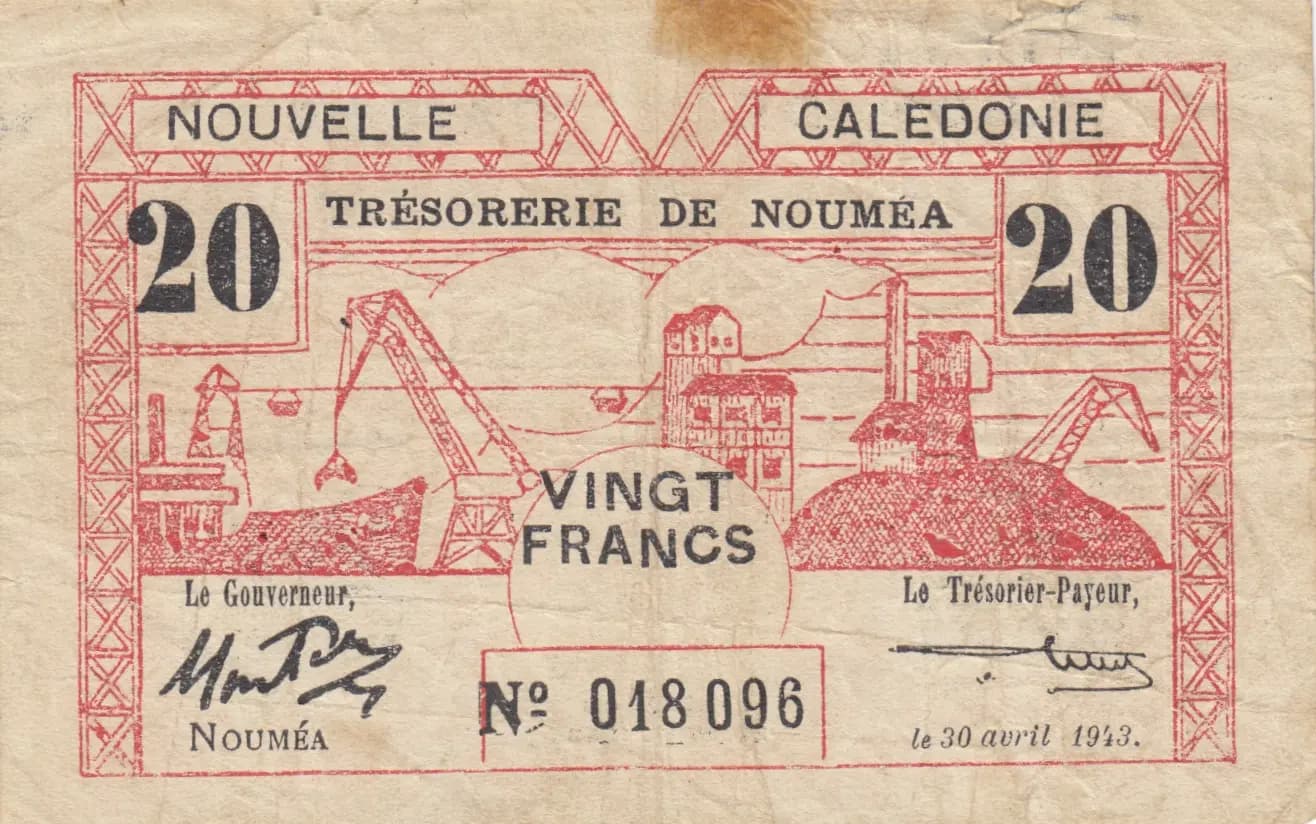
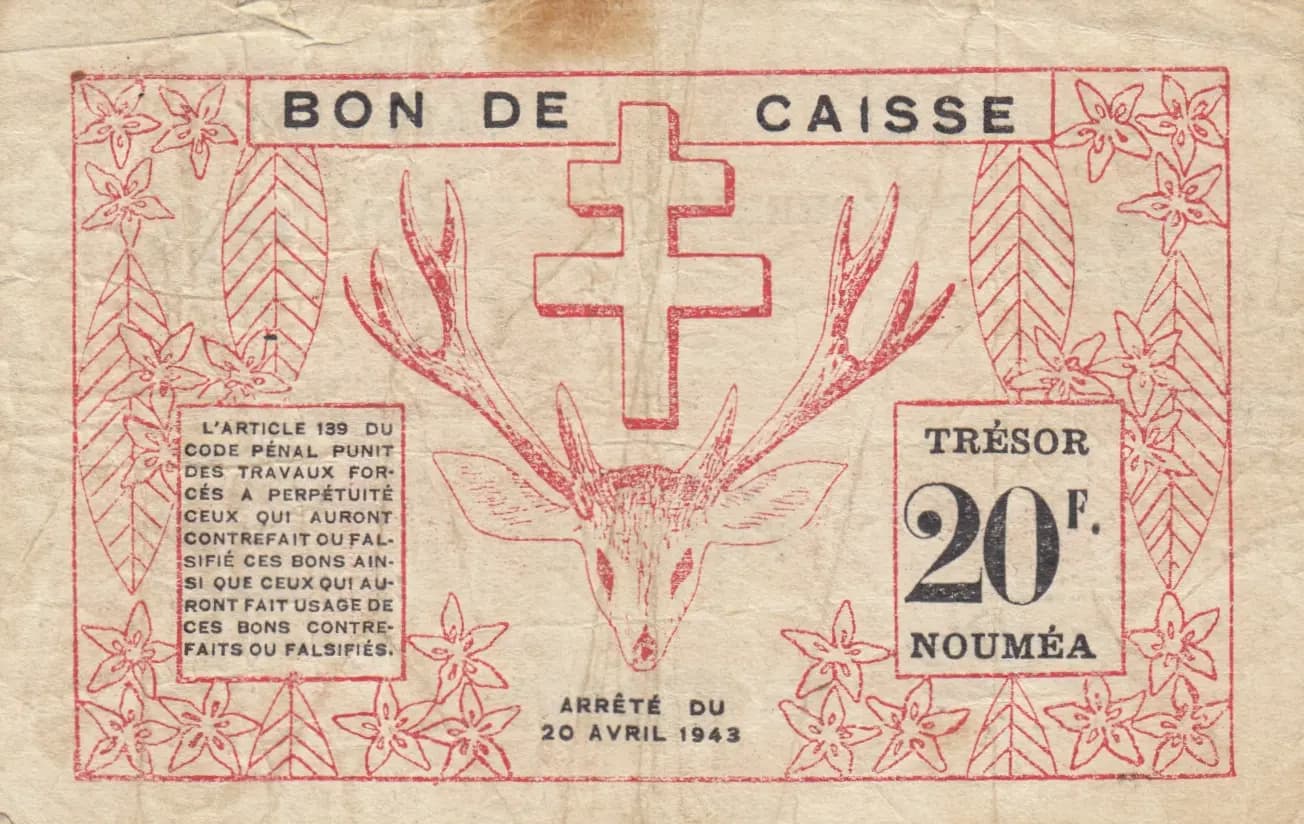
A 1943 New Caledonia 20 Francs Treasury note (Pick P-57) in Fair condition, featuring a striking red-printed industrial vignette on the obverse depicting mining or processing facilities with multiple structures and equipment. The reverse displays an ornamental cross flanked by stag heads within a decorative floral border. This wartime emergency currency from the Trésorerie de Nouméa shows significant age-related foxing and browning consistent with an 80-year-old note, yet maintains good legibility of inscriptions and signatures dated 30 April 1943.
Common. eBay market data shows examples in Fair condition selling for $8.50–$15.60 (2013–2014), with catalog values for F grade at approximately $10. These price points and transaction volumes indicate this is a frequently encountered note in the collector market. While the note has historical significance as wartime emergency currency, the print run was substantial enough to ensure ready availability in the secondary market. No evidence of scarcity or recall suggests this is a standard, obtainable issue for collections of French colonial currency or wartime notes.
Issued during the final year of World War II, this note reflects New Caledonia's colonial economic importance, particularly its mining and industrial capacity—depicted explicitly in the central vignette showing processing facilities and infrastructure. The Trésorerie de Nouméa's emergency note issue (Bon de Caisse) was authorized by decree on 20 April 1943, serving as a wartime supply of currency for the French Pacific territory. The formal signatures of the Governor and Treasurer-Paymaster underscore the official status of this temporary issue during a period of global conflict and logistical constraint.
The obverse features a prominent central vignette depicting an industrial or mining operation, characteristic of New Caledonia's nickel mining economy. The composition includes multiple large structures, a central tower, loading cranes or hoisting equipment on the left side, and mining infrastructure visible in background—all rendered in black against the tan paper. An ornate red geometric border with diamond-pattern design and triangular corner ornaments frames the composition. The denomination numerals '20' appear in large black figures in upper corners, with 'VINGT FRANCS' centered below the industrial vignette. Signature lines for the Governor (Mont Puy, Nouméa) and Treasurer-Paymaster appear below, dated 30 April 1943. The reverse displays a large ornamental cross at center, flanked by two antelope or stag head profiles facing outward—symbolic representations appropriate to the colonial territory. Repeating floral motifs (orchid-like designs) and feathered leaf ornaments create a decorative border around the composition. Text 'BON DE CAISSE' appears at top, with denomination '20 F.' and 'TRÉSOR' at bottom right. The entire design is rendered in red and black on aged tan paper.
OBVERSE: 'NOUVELLE CALEDONIE' (New Caledonia) | 'TRÉSORERIE DE NOUMÉA' (Treasury of Nouméa) | '20' and 'VINGT FRANCS' (Twenty Francs) | 'Le Gouverneur' (The Governor) signed 'Mont Puy' at Nouméa | 'Le Trésorier-Payeur' (The Treasurer-Paymaster) dated 'le 30 avril 1943' (30 April 1943) | Serial number 'N° 018096'. REVERSE: 'BON DE CAISSE' (Treasury Note) | 'TRÉSOR' (Treasury) | '20 F.' (20 Francs) | 'NOUMÉA' | 'ARRÊTÉ DU 20 AVRIL 1943' (Decree of 20 April 1943) | Legal warning: 'L'ARTICLE 139 DU CODE PÉNAL PUNIT LES TRAVAUX FORCÉS À PERPÉTUITÉ CEUX QUI AURONT CONTREFAIT OU FALSIFIÉ CES BONS...' (Article 139 of the Penal Code punishes with life hard labor those who counterfeit or falsify these notes or use counterfeit/falsified notes).
Letterpress or intaglio printing, typical of French Treasury note production in the 1940s. The sharp black impression of text and the detailed rendering of the industrial vignette suggest intaglio engraving for the primary design elements, with additional letterpress for text and denominations. The ornate borders and security design elements are consistent with Bureau of Engraving and Printing (BEP) or French government security printing practices of the era. The relatively simple color scheme (red and black on tan stock) and lack of complex security features reflect wartime economy and emergency currency production constraints.
Pick catalog identifies P-57a and P-57b variants for this base number. The present note appears to be a standard first emission without 'Deuxième Emission' marking at bottom center on reverse (consistent with realbanknotes.com reference data). Serial number N° 018096 and signatures dated 30 April 1943 are consistent with the first issue authorization of 20 April 1943. No overprints, date varieties, or signature variants noted in the visual analysis. Classification as P-57 (likely the a variant) is confirmed by the absence of second-emission markings and standard 1943 decree reference.