1000 francs 1971 specimen
Market Prices
1 saleAbout This Note
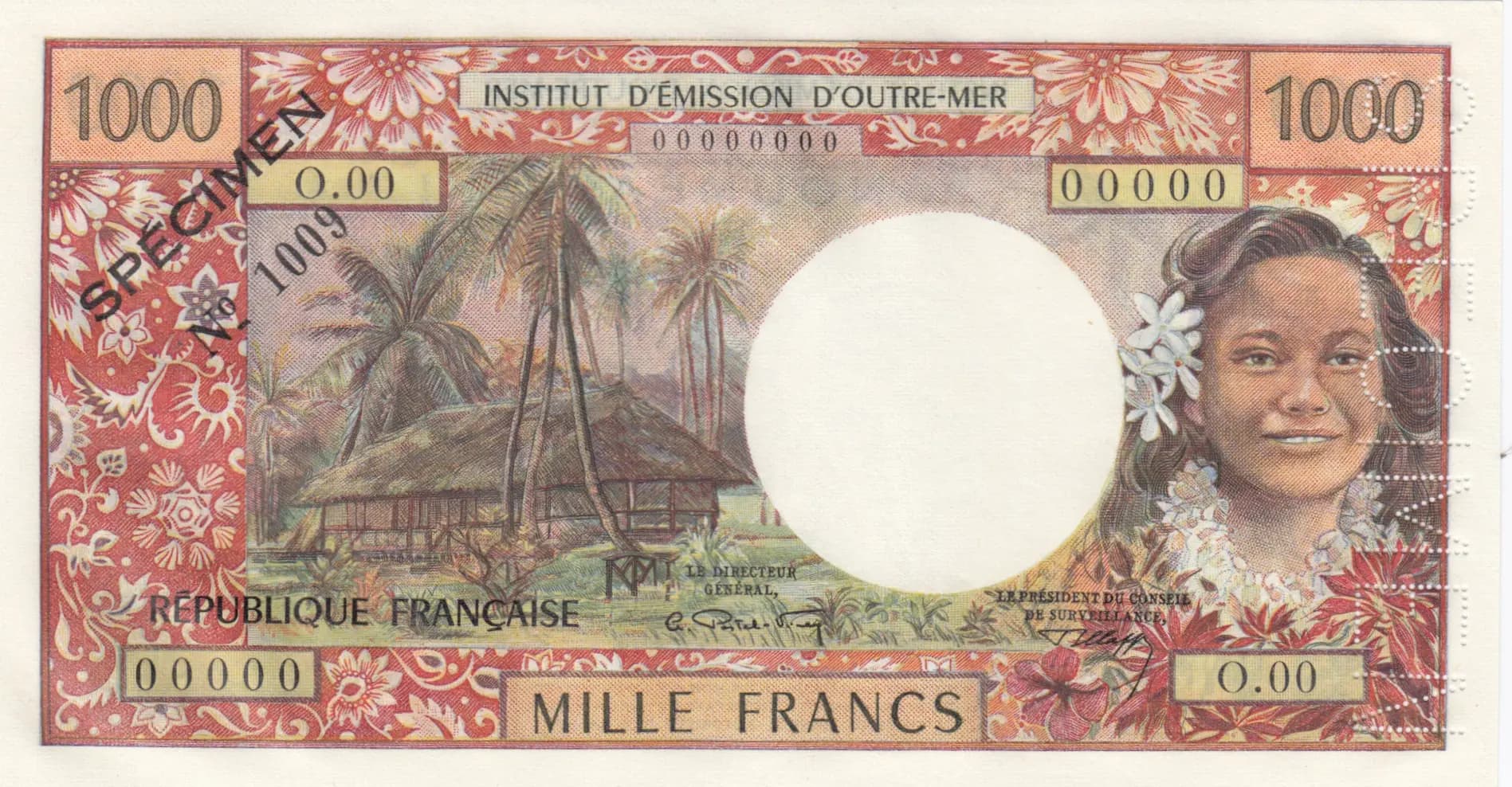
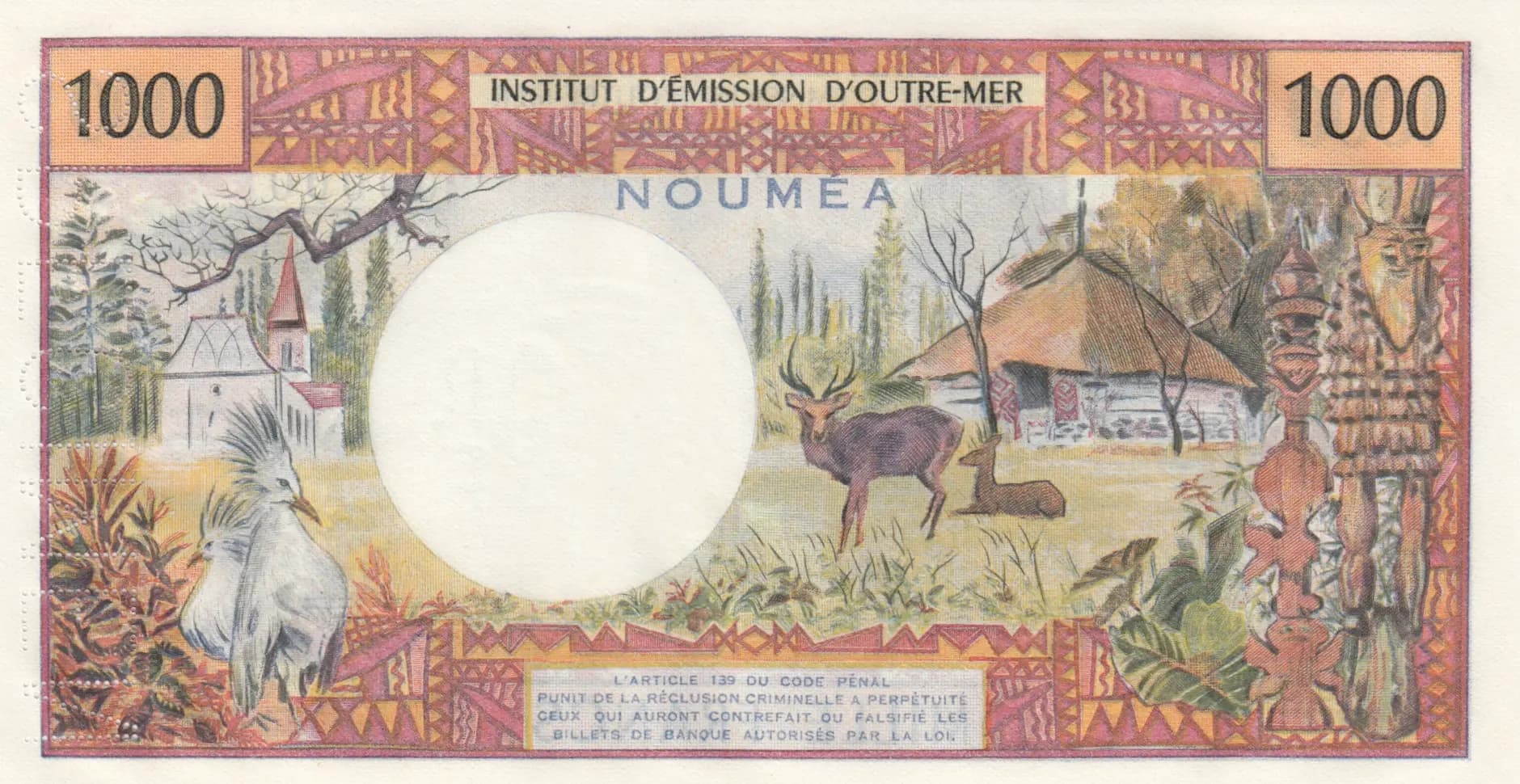
This is a 1971 specimen note from New Caledonia's Institut d'Emission d'Outre-Mer, graded UNC, featuring an elegant design with a portrait of a Melanesian woman adorned with tropical flowers on the obverse and a rich reverse depicting the cultural and natural diversity of New Caledonia including a church, traditional hut, Kagu bird, and deer. The note showcases exceptional printing quality with ornate red and cream-colored floral borders, fine line work, and clear inscriptions including the 'SPECIMEN' overprint characteristic of this issue type, making it a desirable example for collectors of Pacific territorial currency.
Common. This is a specimen note from a regular issue with a wide date range (1971-1985) and substantial circulation throughout New Caledonia during its issuance period. The eBay market data shows VF examples selling for approximately $12.23, indicating a liquid but modestly-valued note typical of post-WWII colonial currency. Specimen overprints were produced in reasonable quantities for banking and numismatic purposes. While specimen notes command a slight premium over circulated examples, this Pick number (P-64s) represents standard catalog material rather than a scarce or rare variety.
Issued during a period when New Caledonia remained under French colonial administration (1971-1985), this banknote reflects the territory's dual cultural identity through its artistic program—combining French institutional authority (République Française overprint) with indigenous Melanesian imagery and New Caledonian landmarks. The depicted elements—the Church of Vao, traditional Kanak huts, the endemic Kagu bird, and local fauna—celebrate New Caledonia's unique biodiversity and cultural heritage while the note served as legal tender for the French Pacific possession during the latter Cold War era.
The obverse features a right-facing portrait of a young Melanesian woman with dark hair crowned with white tropical flowers, set within an ornate circular vignette framed by red and cream floral borders with repeating leaf and flower motifs. Background elements include tropical vegetation and palm trees suggesting the island environment. The reverse depicts a comprehensive tableau of New Caledonian natural and cultural resources: the white Church of Vao with its distinctive red spire dominates the upper portion, complemented by coniferous forest imagery (representing temperate climate elements), a traditional Kanak thatched-roof hut, tribal wooden carved sculpture, an endemic white Kagu bird (New Caledonia's national symbol), and a deer. The design employs a warm color palette of red, brown, gold, yellow, green, and cream, with decorative geometric borders in the Art Deco/colonial style typical of French Pacific territory currency. Denomination numerals '1000' appear in multiple corners on both sides.
FRONT SIDE: 'Institut d'Emission d'Outre-Mer' (Overseas Emission Institute); 'République Française' (French Republic); 'Mille Francs' (One Thousand Francs); 'Specimen' (Specimen); 'Le Directeur Général' (The General Director); 'Le Président du Conseil de Surveillance' (The President of the Supervisory Board); serial number elements '0.00', '00000', '00000000'; denomination '1000'. BACK SIDE: 'Nouméa' (Nouméa - capital city); 'Institut d'Emission d'Outre-Mer' (Overseas Emission Institute); 'L'Article 139 du Code Pénal punit de la réclusion criminelle à perpétuité ceux qui auraient contrefait ou falsifié les billets de banque autorisés par la loi' (Article 139 of the Penal Code punishes with life imprisonment those who would have counterfeited or falsified banknotes authorized by law); denomination '1000'.
Intaglio/Recess printing (evidenced by the fine detailed line work, crisp border patterns, and dimensional quality of the ornate floral designs visible in the images). The security features including watermark areas and the complexity of the decorative border work are consistent with high-security banknote production by a specialized security printer, consistent with French colonial monetary standards of the 1970s-1980s era.
This note is cataloged as P-64s (specimen variety) per the Pick catalog. The PMG population report identifies three variants for this base Pick number: P-64a and P-64b (regular issues from Nouméa, likely differentiated by signature or numbering varieties) and P-64s (specimen). The specimen designation and 'SPECIMEN' overprint clearly identify this as the P-64s variety. No specific signature, date, or serial prefix variations are discernible from the provided images, though the zero-value serial numbers (0.00, 00000, 00000000) are typical of specimen notes intended for non-circulation release to collectors and institutions.