100 francs 1971 specimen
Market Prices
About This Note
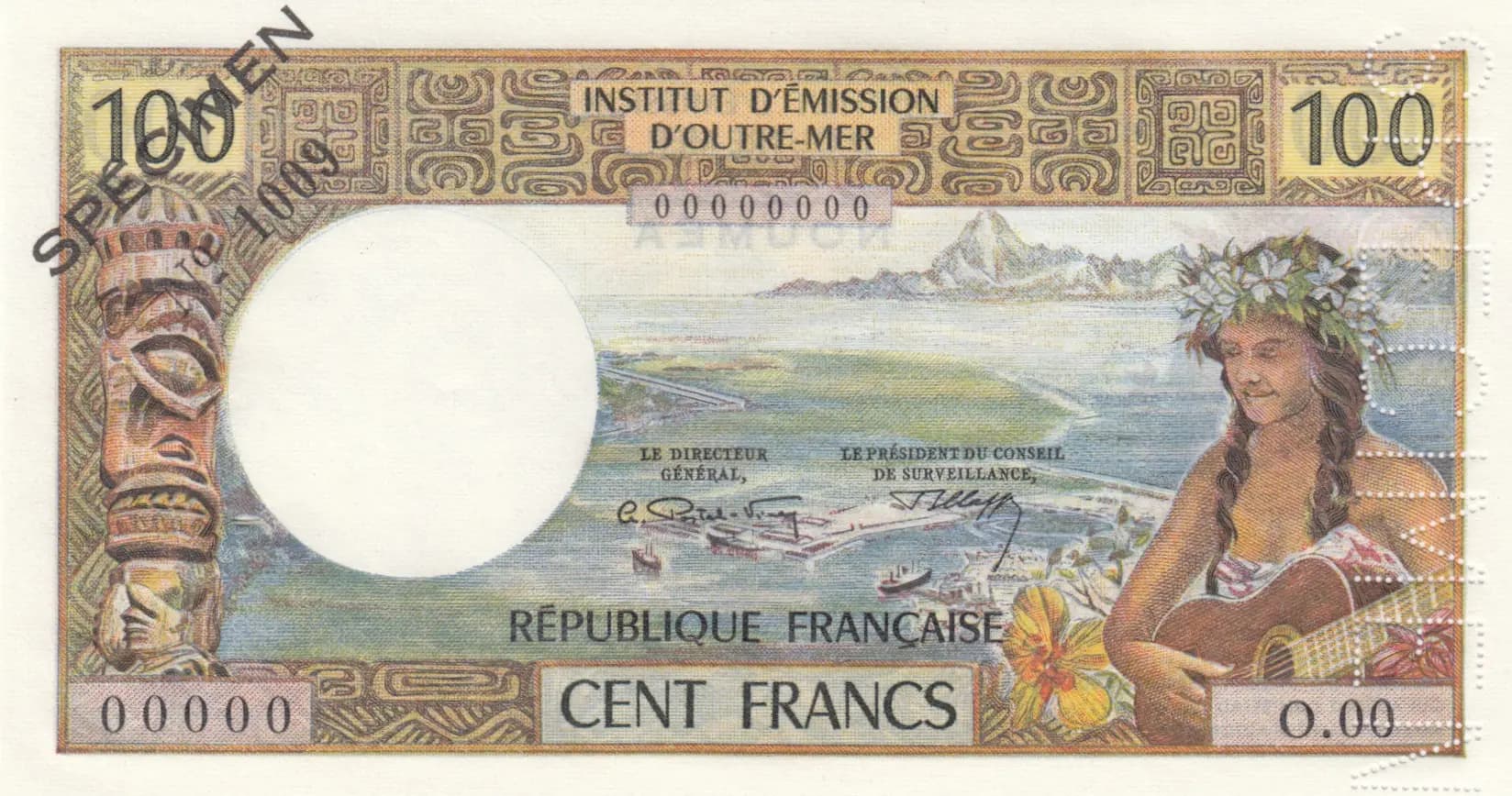
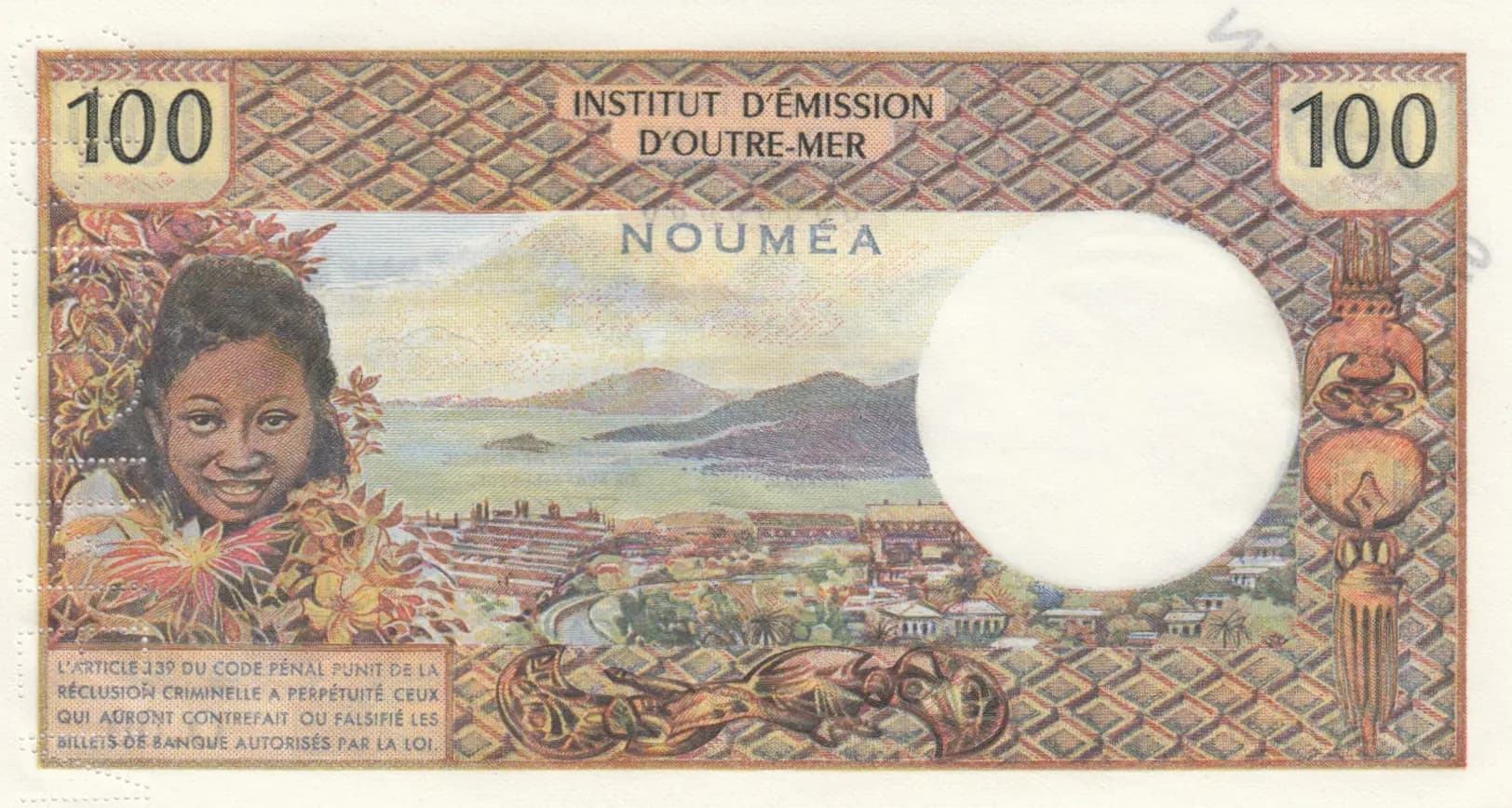
This is a stunning specimen example of the New Caledonia 100 Francs from 1971, issued by the Institut d'Émission d'Outre-Mer. The note features vibrant tropical imagery with a woman in a flower crown playing a ukulele on the obverse and a portrait of a woman surrounded by tropical flowers on the reverse, set against coastal landscapes with mountains and settlement scenes. In uncirculated condition with sharp, clean printing and well-preserved colors, this specimen note bears the characteristic diagonal "SPECIMEN" overprint and represents an important issue from New Caledonia's mid-20th century currency period.
Common. While this is a specimen note variant (P-63s), the eBay market data shows prices concentrated in the $20-$120 range, with most transactions under $35 for uncirculated examples. The 1971-1977 series of New Caledonia 100 Francs notes had substantial print runs as the primary circulating denomination for the territory. Specimen notes, while technically non-circulating, were produced in reasonable quantities for official and archival purposes. The lack of significant premium pricing and the availability of multiple examples on secondary markets confirms this as a common variety.
Issued during 1971-1977, this banknote reflects New Caledonia's status as a French overseas territory and its cultural identity, with the mandatory "RÉPUBLIQUE FRANÇAISE" overprint indicating French sovereignty. The tropical imagery—including the ukulele player, coastal settlements, mountains, and valley scenes—commemorates the islands' natural beauty and Melanesian cultural heritage. The inclusion of Papeete harbor and Moorea Island references the broader Pacific French colonial sphere, as New Caledonia was part of the integrated French Pacific monetary system managed by the Institut d'Émission d'Outre-Mer.
The obverse depicts a young woman with long braided hair wearing a flower crown, playing a ukulele or traditional stringed instrument, positioned at the right side of the note. She is rendered against a tropical background showing the coastal landscape, harbor with ships, and mountain peaks. The left side features a carved Melanesian mask or face design in brown and reddish tones, reflecting indigenous cultural elements. The reverse portrays a different woman with dark hair and a serene expression, surrounded by decorative coral and red tropical flowers, with her figure positioned at the left. The background shows a coastal valley settlement with buildings, palm trees, and mountainous terrain. Both sides feature elaborate ornamental borders with geometric patterns—diamonds, chevrons, and spirals—rendered in brown, beige, coral, and green. The large white circular spaces on both sides represent areas for watermarks or security features. The overall color palette of cream, beige, brown, green, and coral creates a warm, tropical aesthetic appropriate to New Caledonia's setting.
FRONT: "100" (denomination), "INSTITUT D'ÉMISSION D'OUTRE-MER" (Overseas Emission Institute), "RÉPUBLIQUE FRANÇAISE" (French Republic), "CENT FRANCS" (One Hundred Francs), "LE DIRECTEUR GÉNÉRAL" (The Director General), "LE PRÉSIDENT DU CONSEIL DE SURVEILLANCE" (The President of the Supervisory Board), "SPECIMEN" (Specimen marking). BACK: "100" (denomination), "INSTITUT D'ÉMISSION D'OUTRE-MER" (Overseas Emission Institute), "NOUMÉA" (Nouméa—the issuing city), "L'ARTICLE 138 DU CODE PÉNAL PUNIT DE RÉCLUSIÓN CRIMINELLE À PERPÉTUITÉ CEUX QUI AURAIENT CONTREFAIT OU FALSIFIÉ LES BILLETS DE BANQUE AUTORISÉS PAR LA LOI" (Article 138 of the Penal Code punishes with life imprisonment those who would have counterfeited or falsified banknotes authorized by law).
Intaglio (engraved) printing, as confirmed by both the visual analysis and external catalog reference. The sharp, crisp lines, fine detail in the portraits and ornamental borders, and the dimensional quality visible in the carved mask design are characteristic of intaglio work. The specimen notes were produced by the standard security printer contracted by Institut d'Émission d'Outre-Mer, with the fine detailing and security features typical of French banknote production standards of the 1970s.
This note is cataloged as P-63s, the specimen variant of the 100 Francs. Per PMG population data, there are three known varieties for this base Pick number: P-63a (Engraved) and P-63b (Lithographic) represent production method variants of the circulating issue, while P-63s represents this specimen version with the diagonal "SPECIMEN" overprint. This specific note shows zero serial numbers and the standard specimen markings typical of non-circulating presentation copies issued for official records and international collections. The presence of the "RÉPUBLIQUE FRANÇAISE" overprint distinguishes it from related notes in other French Pacific territories (referenced as NEW HEBRIDES P-16, P-18 and TAHITI P-23, P-24).