1 franc 1943
Market Prices
12 salesAbout This Note
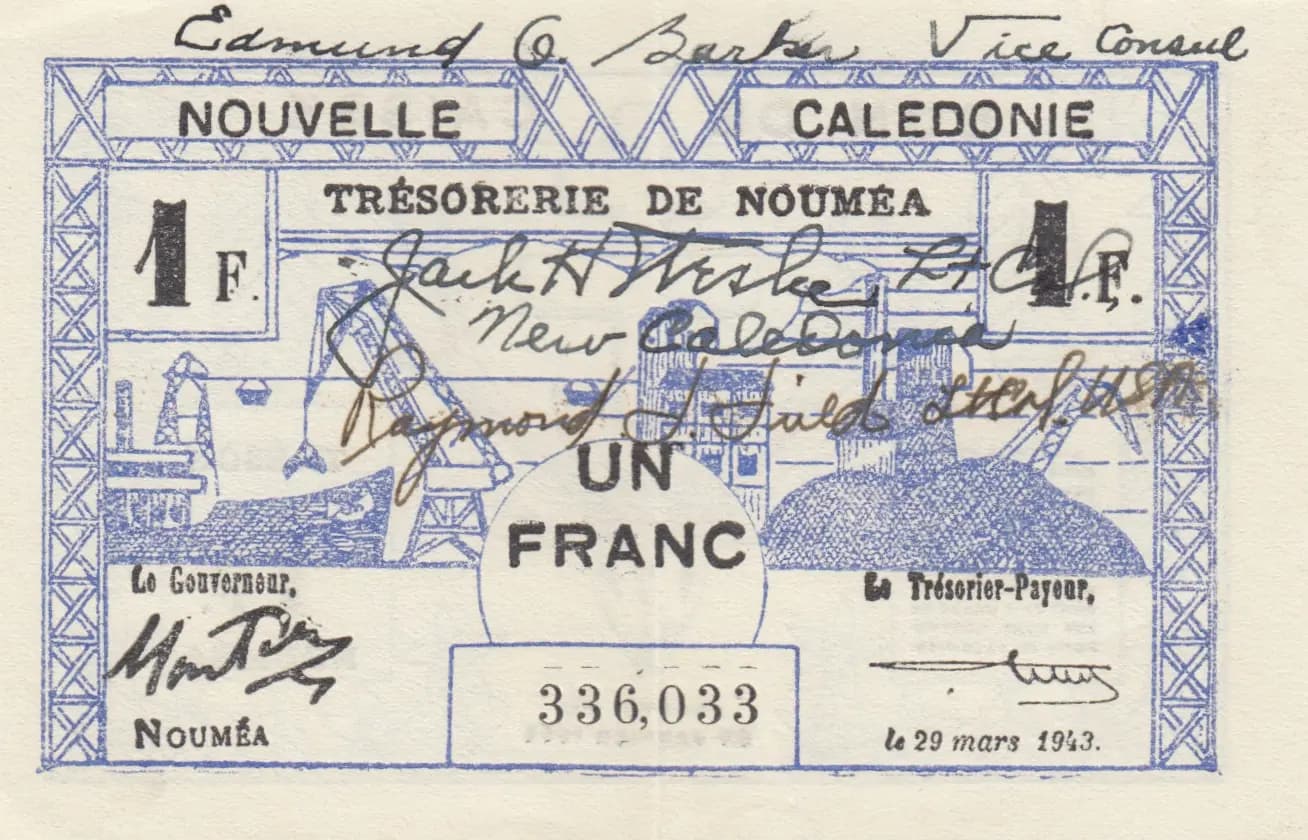
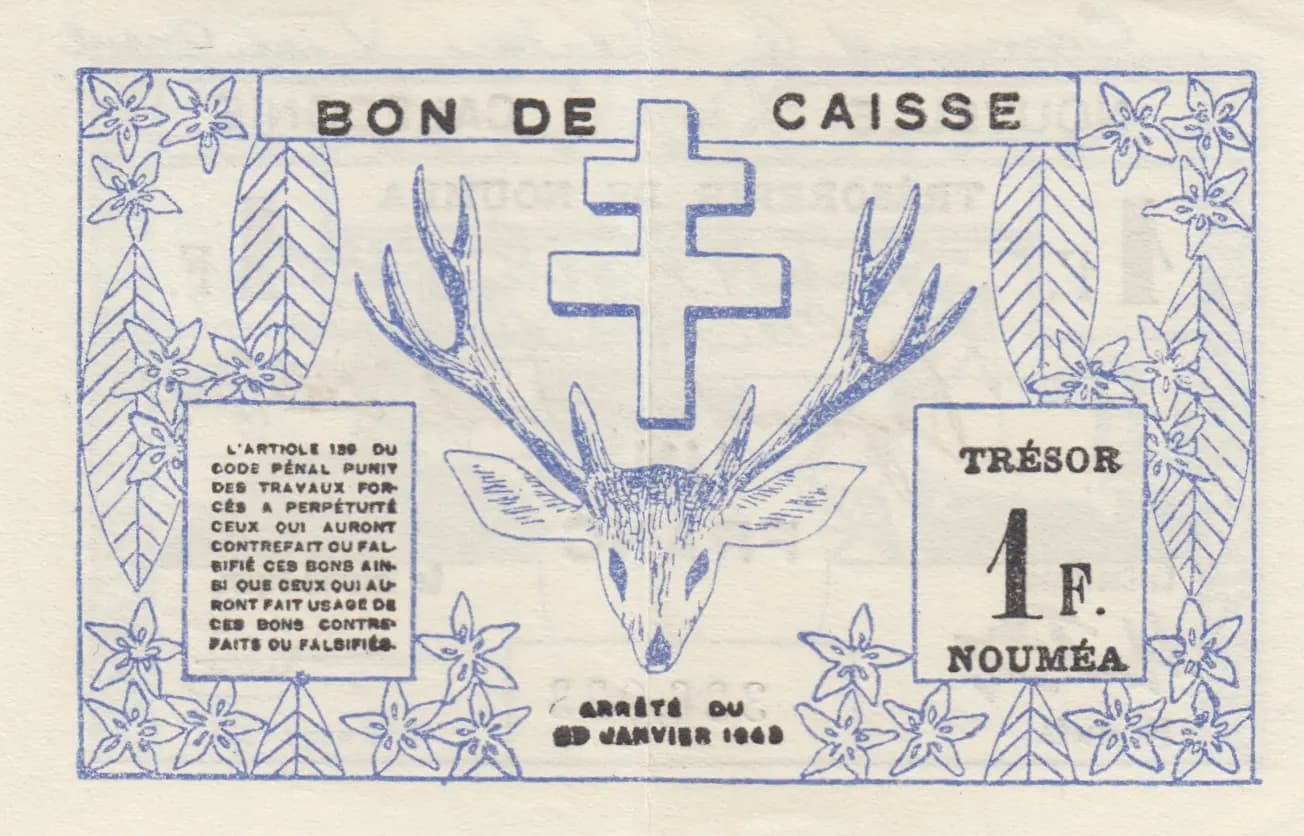
This 1943 New Caledonia 1 Franc Treasury note (P-55b) features distinctive industrial imagery reflecting the wartime economic activity of the territory, with mining structures and tropical landscape vignettes rendered in blue on cream paper. The note exhibits significant circulation wear with visible creases, foxing, and handwritten annotations on the obverse, consistent with its EF grade assessment. The reverse displays an ornamental Cross of Lorraine surrounded by floral and palm frond motifs, a symbolic design reflecting Free French influence during the WWII period.
Common. This denomination and series circulated widely as emergency currency in New Caledonia during 1943-1944. Secondary market evidence from realbanknotes.com confirms consistent availability, with multiple sales across various grades (VF to UNC) between 2009-2024, with catalog values as low as $1.50 (VG) and typical EF examples selling for $12-17. The note was issued in substantial quantities to support wartime commerce, and survivors remain readily obtainable for collectors.
Issued by the Trésorerie de Noumea on March 29, 1943, this note represents New Caledonian emergency currency during World War II, when the territory was under Free French control and serving as a strategic Pacific base. The industrial imagery on the obverse—specifically the mining towers and stockpile facilities—reflects New Caledonia's critical role in nickel and chromium production supporting the Allied war effort. The Cross of Lorraine on the reverse, the symbol of Free France, underscores the political alignment of the territory during this period.
The obverse features a central circular vignette containing 'UN FRANC' with the serial number 336,033 below, flanked by industrial imagery: on the left, mining derricks and processing facilities; on the right, a tropical settlement or landscape representation. The entire design is framed by decorative geometric borders composed of cross-hatched triangular patterns characteristic of early 20th-century security printing. The reverse presents a dominant Cross of Lorraine (Free French symbol) as the central motif, surrounded by symmetrically arranged stylized tropical flowers and palm fronds, with legal text and denomination markings integrated into the ornamental border scheme. Both sides are printed in blue on cream/beige paper stock.
OBVERSE: 'NOUVELLE CALEDONIE' (New Caledonia), 'TRÉSORERIE DE NOUMEA' (Treasury of Noumea), '1 F.' / 'UN FRANC' (1 Franc), Serial number '336,033', 'Le Gouverneur' (The Governor), 'Le Trésorier-Payeur' (The Treasurer-Paymaster), 'Noumea', 'le 29 mars 1943' (March 29, 1943). REVERSE: 'BON DE CAISSE' (Treasury Bond/Cash Bond), 'TRÉSOR' (Treasury), '1 F.' (1 Franc), 'NOUMEA', 'ARRÊTÉ DU 29 JANVIER 1943' (Decree of January 29, 1943), and the legal warning 'L'ARTICLE 138 DU CODE PÉNAL PUNIT DES TRAVAUX FORCÉS À PERPÉTUITÉ D'EUX QUI AURAIENT CONTREFAIT OU FALSIFIÉ CES BONS À INSSI QUE CEUX QUI AURAIENT FAIT USAGE DE CES BONS CONTREFAITS OU FALSIFIÉS' (Article 138 of the Penal Code punishes with forced labor in perpetuity those who would have counterfeited or falsified these bonds as well as those who would have used these counterfeit or falsified bonds).
Letterpress printing on cream-colored paper, evidenced by the crisp line work in the decorative geometric borders and the clear impression of text elements. The blue monochromatic color scheme and ornamental security patterns reflect standard 1940s French colonial treasury note production methods. No specific security printer attribution is definitively documented for P-55b in standard catalogs, though production was likely by the Banque de l'Indochine or affiliated French security printers operating in the Pacific theater during WWII.
This note is cataloged as Pick P-55b, indicating it is the second documented variant of the 1 Franc 1943 issue from New Caledonia. The primary distinguishing feature is the date 'L. 29.03.1943' (Decree of March 29, 1943), differentiating it from P-55a which carries the date 'L. 29.01.1943' (January 29, 1943). Both variants share identical design elements but represent separate authorization decrees. The serial number 336,033 on this example is consistent with the standard numbering sequence for this variety.