1 franc 1942
Market Prices
10 salesAbout This Note
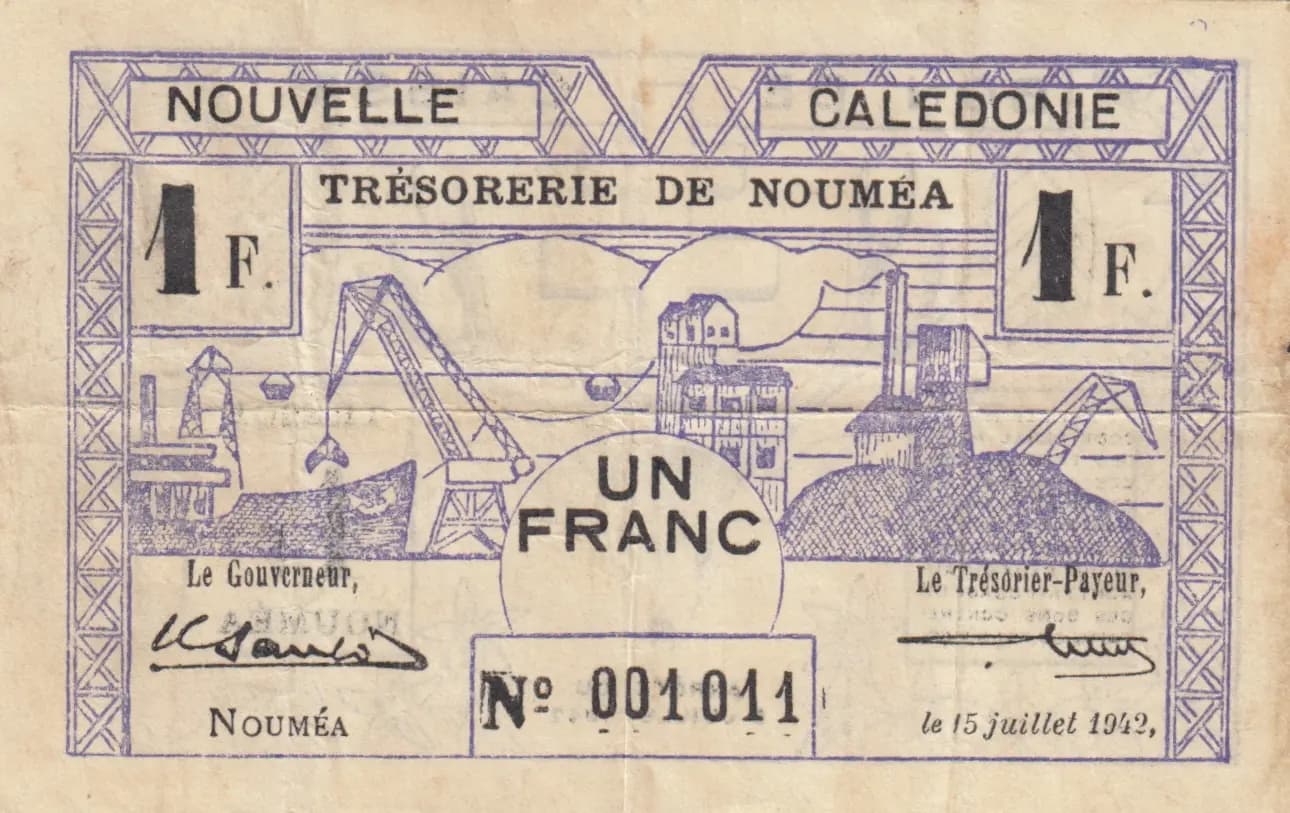
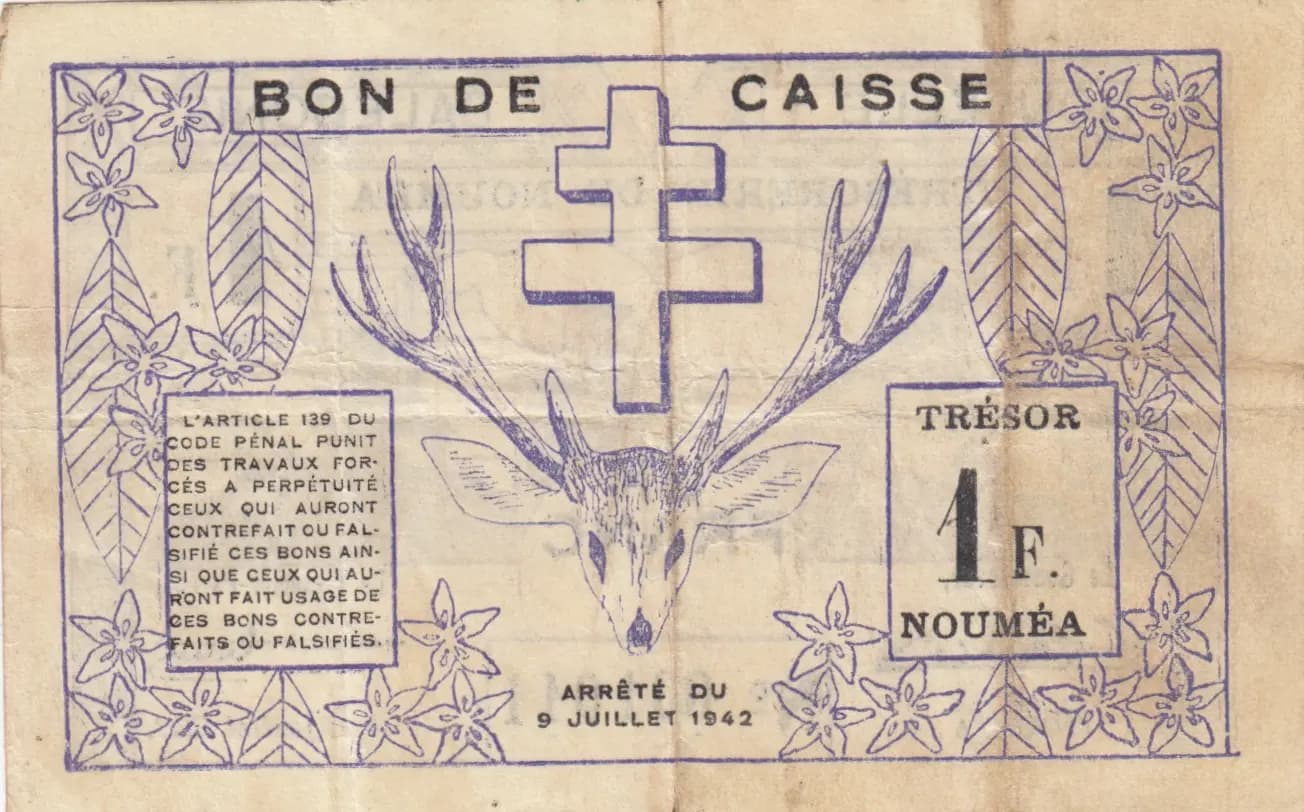
This VF-graded 1 franc banknote from the Trésorerie de Nouméa (1942) presents a compelling snapshot of New Caledonian wartime monetary authority. The note features an industrial-themed obverse depicting mining and processing facilities with a tall smokestack, reflecting the colony's economic focus, while the reverse showcases a striking Cross of Lorraine above a stag head with ornamental floral borders. Despite moderate age-related wear including foxing, creasing, and yellowing consistent with circulation, the note retains good overall eye appeal and clear inscription legibility.
Common. This note sold on the secondary market (eBay) with relative frequency across multiple years and condition grades, with VF examples averaging $10-$13 USD in recent transactions (2020-2024). Catalog values from 2016 list VF at $6, with even UNC examples valued at only $30, indicating substantial production runs and steady collector availability. The denomination and issue year fall within accessible parameters for mid-20th-century colonial French banknotes.
Issued during World War II under decree of July 9, 1942, this banknote represents New Caledonia's emergency wartime currency, replacing earlier denominations. The industrial imagery—prominently featuring mining equipment, derricks, and processing facilities with tall chimneys—documents the strategic importance of New Caledonian nickel mining to the Allied war effort. The Cross of Lorraine on the reverse symbolized Free French allegiance during the Vichy occupation period, making this denomination a symbol of colonial resistance and industrial contribution to the war effort.
The obverse design emphasizes New Caledonia's industrial-economic base with a detailed depiction of colonial mining and processing infrastructure: a prominent mining derrick or crane on the left, various mining equipment, and an industrial processing facility with a tall smokestack dominating the right side. The denomination 'UN FRANC' appears in a large circular marking at the center. The reverse features the Cross of Lorraine (a double-armed cross symbolizing Free French forces) positioned above a stag or antelope head shown frontally with prominent antlers, flanked by ornamental floral and leaf border designs. Both sides are framed with geometric diamond-pattern borders. The color scheme employs purple-blue ink on cream-colored security paper. Signature lines appear for the Governor and Treasurer-Paymaster on the obverse, with the note designated as a 'Bon de Caisse' (Cash Bond) on the reverse.
FRONT SIDE: 'Nouvelle Caledonie' (New Caledonia); 'Trésorerie de Nouméa' (Treasury of Noumea); 'UN FRANC' / '1 F.' (One Franc); 'Le Gouverneur' (The Governor); 'Le Trésorier-Payeur' (The Treasurer-Paymaster); 'Nouméa'; Serial number 'N° 001041'; 'le 15 juillet 1942' (the 15th of July 1942). BACK SIDE: 'BON DE CAISSE' (Cash Bond); 'TRÉSOR' (Treasury); '1 F.' / 'NOUMÉA' (One Franc / Noumea); 'ARRÊTÉ DU 9 JUILLET 1942' (Decree of 9 July 1942); Anti-counterfeiting text: 'L'ARTICLE 139 DU CODE PÉNAL PUNIT DES TRAVAUX FORCÉS A PERPÉTUITÉ CEUX QUI AURONT CONTREFAIT OU FALSIFIÉ CES BONS AINSI QUE CEUX QUI AURONT FAIT USAGE DE CES BONS CONTREFAITS OU FALSIFIÉS' (Article 139 of the Penal Code punishes with forced labor for life those who shall have counterfeited or falsified these bonds as well as those who shall have made use of these counterfeit or falsified bonds).
Intaglio/engraved printing, characteristic of colonial French banknotes of the 1940s. The sharp detail visible in the industrial structures, decorative borders, and fine line work indicates steel plate engraving. The color application (purple-blue on cream paper) and the clarity of inscriptions and security text support professional security printing methods typical of French colonial currency production during the WWII era. The specific printer is not identified in available documentation but follows metropolitan French banknote standards.
The observed specimen bears serial number 001041 and is dated 15 July 1942 (per inscription 'le 15 juillet 1942'), consistent with Pick catalog P-52. The Tresorerie de Nouméa issued this denomination under the decree of 9 July 1942. A known related variant (P-55) exists with the later date of L. 29.01.1943. No overprints or significant signature variations are apparent in this specimen. The specific serial number range and issuing authority confirm this as the standard 1942 issue within the P-52 classification.