500 meticais 1980 specimen

Market Prices
10 salesAbout This Note
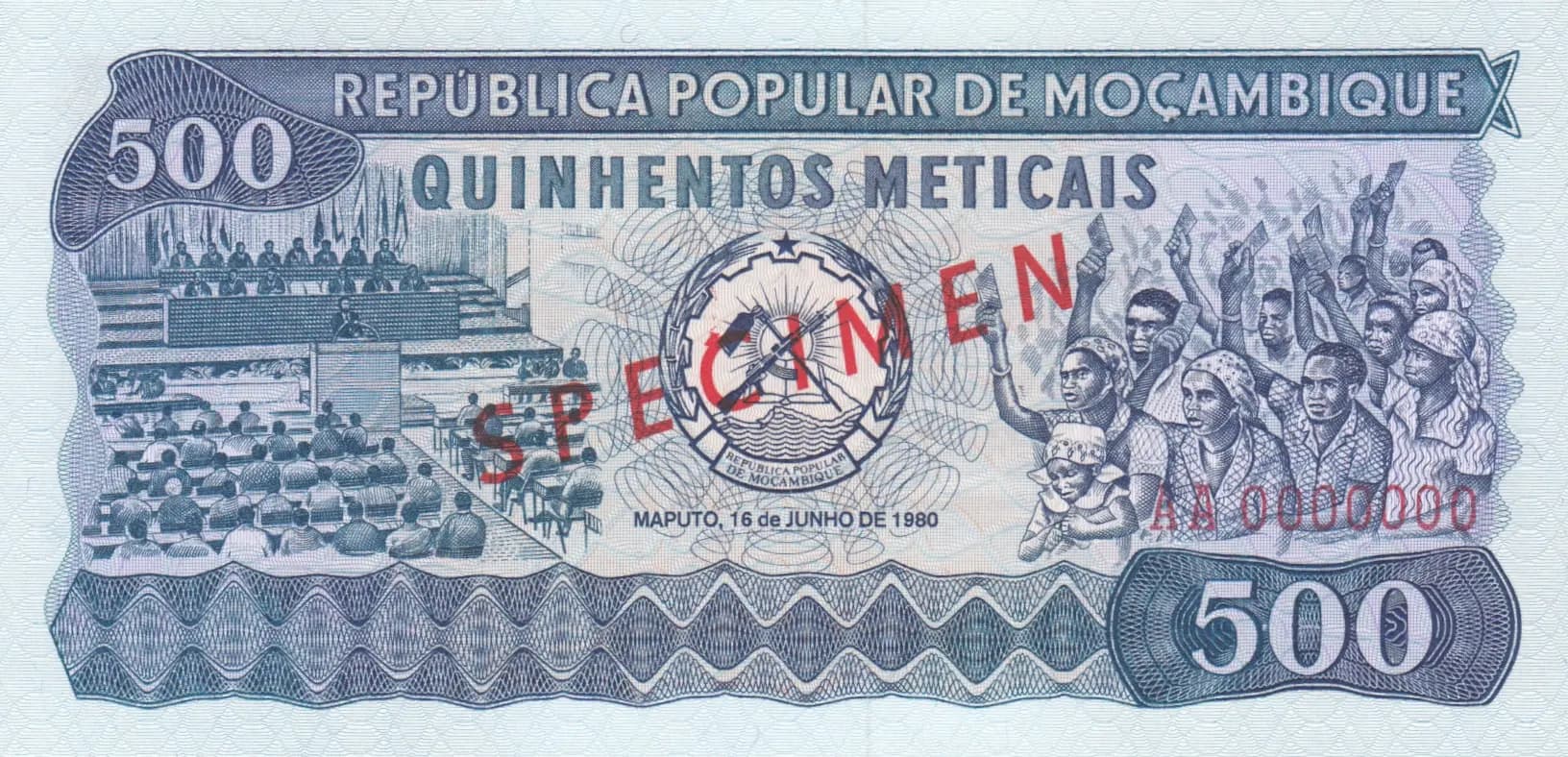
This is a pristine uncirculated specimen of the Mozambique 500 Meticais from June 16, 1980, notable for its red 'SPECIMEN' overprint across the national coat of arms. The note exhibits exceptional quality with crisp intaglio engraving, vibrant light blue and dark blue coloring, and clean margins throughout. As a specimen note with large alphanumeric serial number (A100000000), this represents an official bank/collector issue rather than circulating currency, making it a distinct variety sought by Mozambique specialists.
Common. While this is a specimen issue (indicated by the overprint), the denomination appears regularly on the secondary market with eBay transaction records showing consistent sales ranging from $1.25 to $5 in UNC condition (with PMG-graded examples commanding premiums to $20-22). The specimen designation does not significantly enhance rarity, as specimen notes from this period were routinely distributed to banks and collectors. Print runs for the 500 Meticais were substantial, and no evidence of recall or short-lived issue exists.
Issued during the early years of the People's Republic of Mozambique (República Popular de Moçambique), this 1980 note reflects the post-independence socialist era with its thematic imagery celebrating workers, education, and scientific advancement. The obverse features a government assembly and political gathering scene, while the reverse depicts laboratory workers and adult literacy activities—key priorities of the nascent socialist government. The multiple five-pointed stars and national emblems throughout the design reinforce the political ideology of the period.
The obverse features the national coat of arms of the República Popular de Moçambique at center, incorporating a five-pointed star within a wreath with crossed elements (representing tools and unity), flanked by a government assembly scene on the left and a diverse group of citizens in a political gathering on the right. Large denomination numerals '500' appear in ornate frames on both left and right margins. The reverse depicts an industrial or scientific laboratory scene with multiple male and female workers engaged in technical labor at various workstations, representing the state's commitment to modernization and human capital development. A circular national seal appears on the left side. The color scheme of light cyan/blue with dark blue intaglio printing creates strong visual contrast and security depth.
FRONT: 'REPÚBLICA POPULAR DE MOÇAMBIQUE' (Popular Republic of Mozambique); 'QUINHENTOS METICAIS' (Five Hundred Meticais); 'SPECIMEN' (Specimen designation); 'MAPUTO, 16 de JUNHO DE 1980' (Maputo, June 16, 1980); Serial number 'A100000000'. BACK: 'REPÚBLICA POPULAR DE MOÇAMBIQUE' (Popular Republic of Mozambique); 'A FALSIFICAÇÃO DA MOEDA É PUNIDA COM A PENA DE OITO A DOZE ANOS DE PRISÃO NOS TERMOS DA LEI.' (Counterfeiting currency is punished with eight to twelve years imprisonment in accordance with the law.)
Intaglio engraving with complex security features including fine line cross-hatching, guilloche patterns, and detailed background work throughout both sides. The printing exhibits the hallmark characteristics of high-security banknote production from this era, with precise line work and layered color underprinting visible in the multicolored background. This note was produced by the Banco de Moçambique's security printing facilities; the technical quality suggests professional security printer involvement typical of early 1980s African central bank note production.
This is Pick P-127s, the specimen variety of the 1980 issue (as opposed to P-127 for regular circulation notes). Key identifying features of this specimen: (1) red 'SPECIMEN' overprint across the central coat of arms; (2) large alphanumeric serial number 'A100000000' indicating specimen status; (3) Issue date: 16 de Junho de 1980 (June 16, 1980). The catalog reference notes that modified arms appear on later related notes P-131; this note represents the earlier standard arms version. No signature varieties or serial prefix variations are apparent in the visual analysis.