50 meticais 1980
Market Prices
12 salesAbout This Note
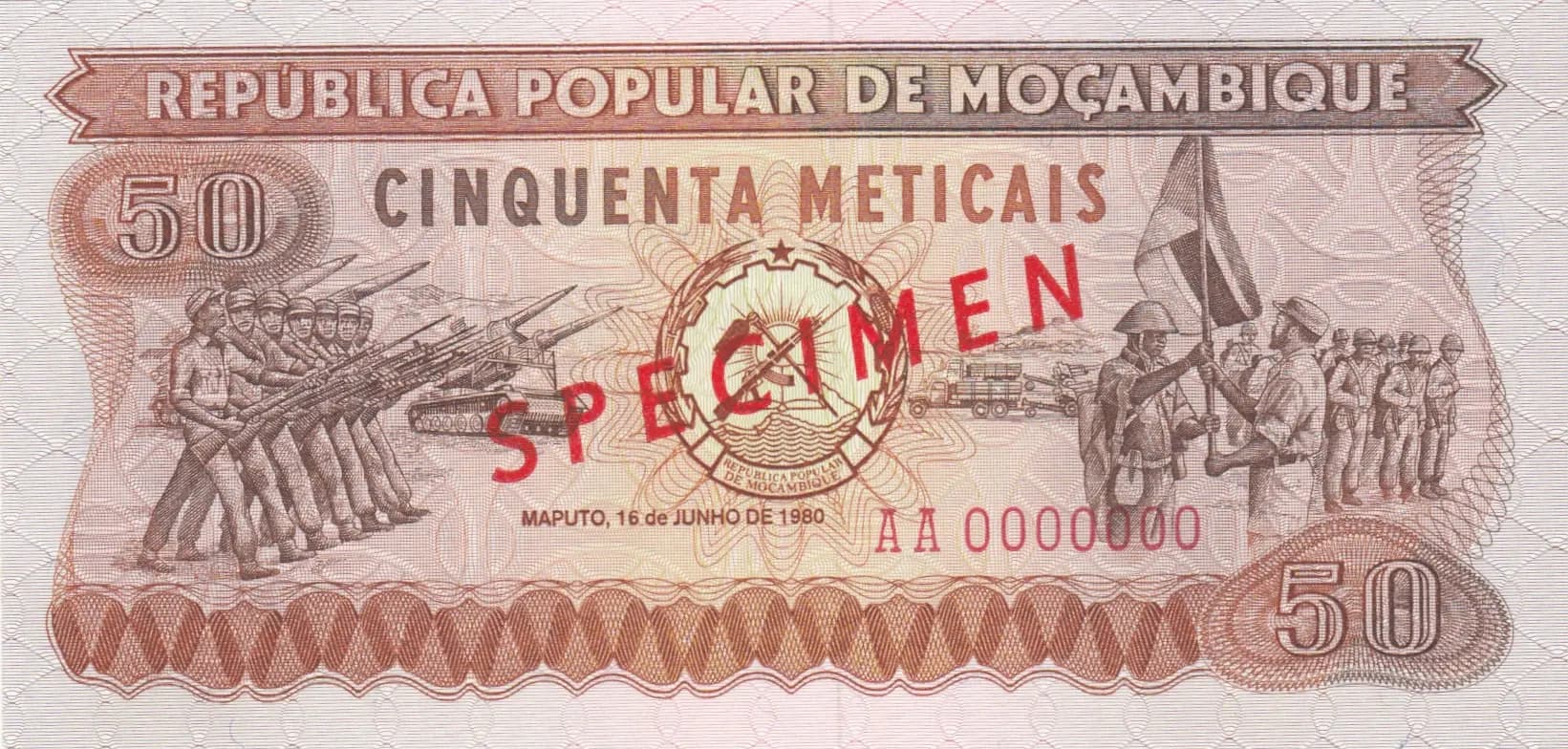
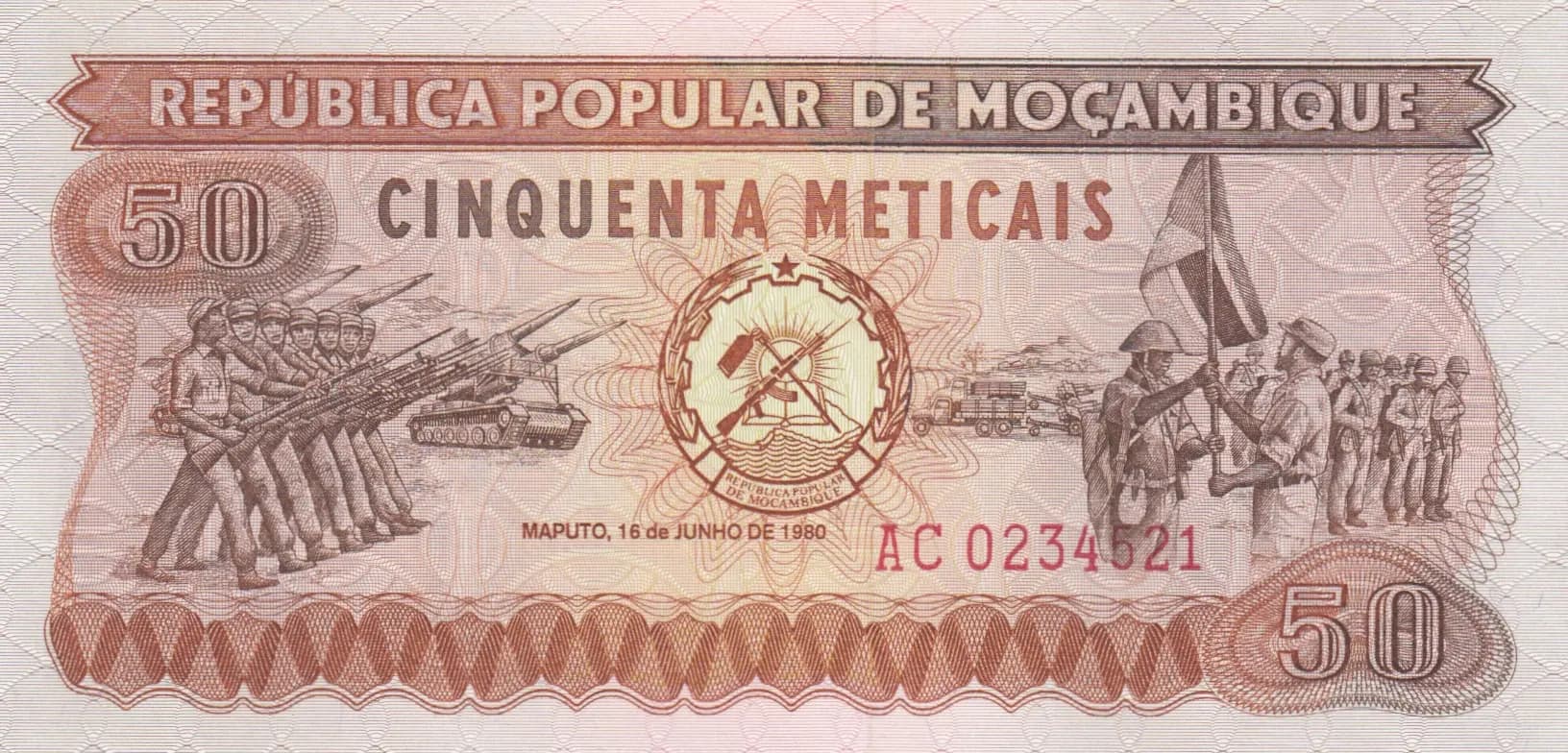
This is an uncirculated 1980 Mozambique 50 Meticais (Pick P-125) issued by the República Popular de Moçambique on June 16, 1980. The note features striking revolutionary imagery with soldiers, a flag-hoisting ceremony, and military vehicles rendered in warm reddish-brown tones on a cream background, exemplifying the post-independence propaganda aesthetic of early 1980s Mozambique. In pristine UNC condition with no wear or creases, this note represents an important commemorative issue from the early years of the People's Republic.
Common. Despite its historical significance, this note remains very common in the numismatic market. The eBay sales data shows consistent UNC examples selling for $0.99-$4.25 across multiple transactions from 2014-2020, with only PMG-graded specimens (66-grade) reaching $14-$17.50. The catalog value for UNC examples is listed at $2 (2019), and the note appears to have had a substantial print run. High-grade uncirculated examples are readily available at minimal cost, making this a common date and denomination for collectors of Mozambique or African post-independence issues.
Issued just four years after Mozambique's independence from Portugal in 1975, this note celebrates the military and socialist ideals of the newly established People's Republic under FRELIMO leadership. The prominent military imagery—soldiers with rifles, flag ceremonies, and armed vehicles—reflects the nation's ongoing civil conflict (1977-1992) and the regime's emphasis on military strength and revolutionary consciousness. The central emblem featuring the crossed hammer and machete, symbols of workers and peasants, underscores the Marxist-Leninist ideology that guided the República Popular during this transformative period.
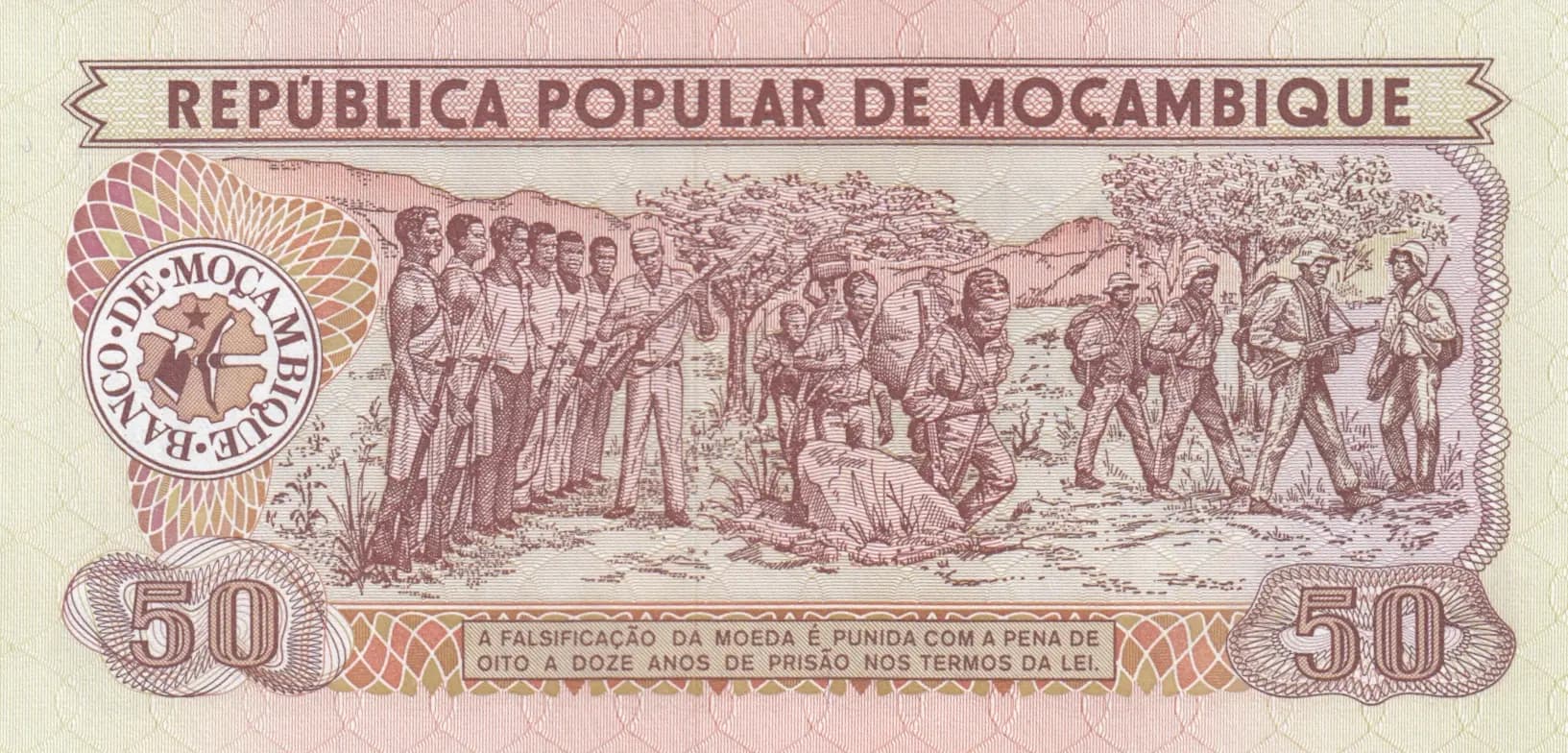
The obverse features an elaborate composition dominated by revolutionary military imagery on both flanks: armed soldiers with rifles on the left side, and a flag-hoisting ceremony with civilians and soldiers on the right, with military vehicles including a tank visible in the background—symbolizing national defense and popular mobilization. The central focal point is the national emblem of the República Popular de Moçambique, a circular design containing a five-pointed star surrounded by a wreath with crossed hammer and machete, representing the union of workers and peasants fundamental to the socialist state. Large denomination numerals '50' in decorative oval frames appear at the left and right edges. The reverse depicts soldiers in a training or mobilization scene set in a rural landscape with trees, emphasizing military preparedness and cadre development, with the Bank of Mozambique seal positioned on the left and further denomination numerals in the lower corners. The entire composition employs fine security line work and complex guilloche patterns throughout.
FRONT: 'REPÚBLICA POPULAR DE MOÇAMBIQUE' (People's Republic of Mozambique); 'CINQUENTA METICAIS' (Fifty Meticais); 'MAPUTO, 16 de JUNHO DE 1980' (Maputo, June 16, 1980); Serial number 'AC 0234621'. BACK: 'REPÚBLICA POPULAR DE MOÇAMBIQUE' (People's Republic of Mozambique); 'BANCO DE MOÇAMBIQUE' (Bank of Mozambique); 'A FALSIFICAÇÃO DA MOEDA É PUNIDA COM A PENA DE OITO A DOZE ANOS DE PRISÃO NOS TERMOS DA LEI.' (Counterfeiting currency is punished with eight to twelve years imprisonment under the terms of the law.)
Intaglio (recess) printing, evidenced by the fine line work, complex guilloche patterns, and microprint-style security elements visible throughout both sides. The sharp detail reproduction of military scenes, decorative wreath work around the central emblem, and geometric security patterns are characteristic of intaglio production. The printer for Mozambique's 1980-era notes is not definitively identified in available catalogs, though notes from this period were typically produced by De La Rue or similar Commonwealth security printers contracted by African central banks.
This note corresponds to Pick P-125, the standard 1980 50 Meticais issue dated 16 June 1980. The catalog reference notes that later similar notes with modified arms exist (Pick P-129), indicating a design revision in subsequent printings. The observed serial number 'AC 0234621' with the letter prefix is consistent with the standard issue format. No significant varieties (signatures, overprints, or major design modifications) are apparent in this UNC example. The note represents the standard variety of this denomination from the first year of issue.