50 centavos 1914
Market Prices
2 salesAbout This Note
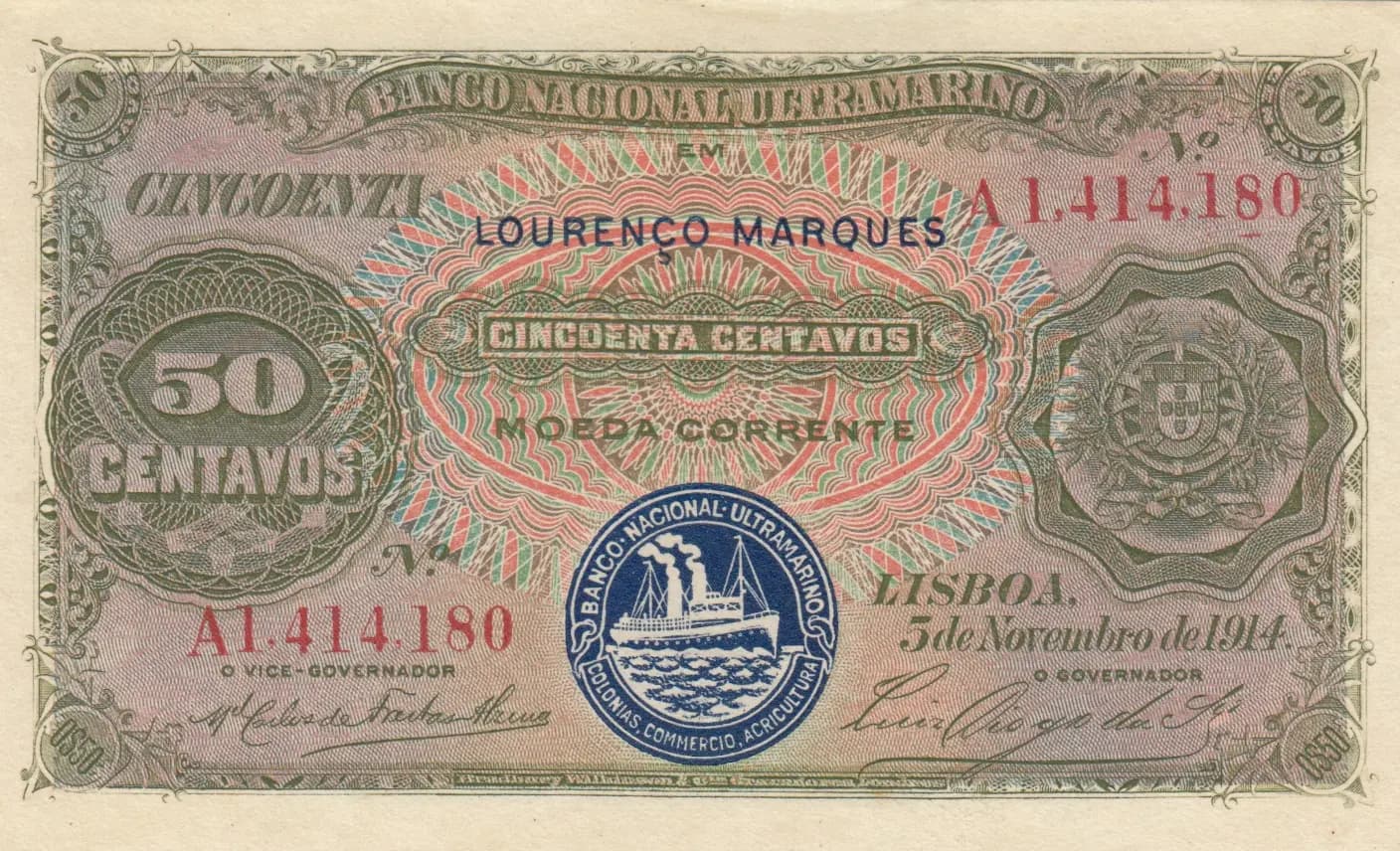
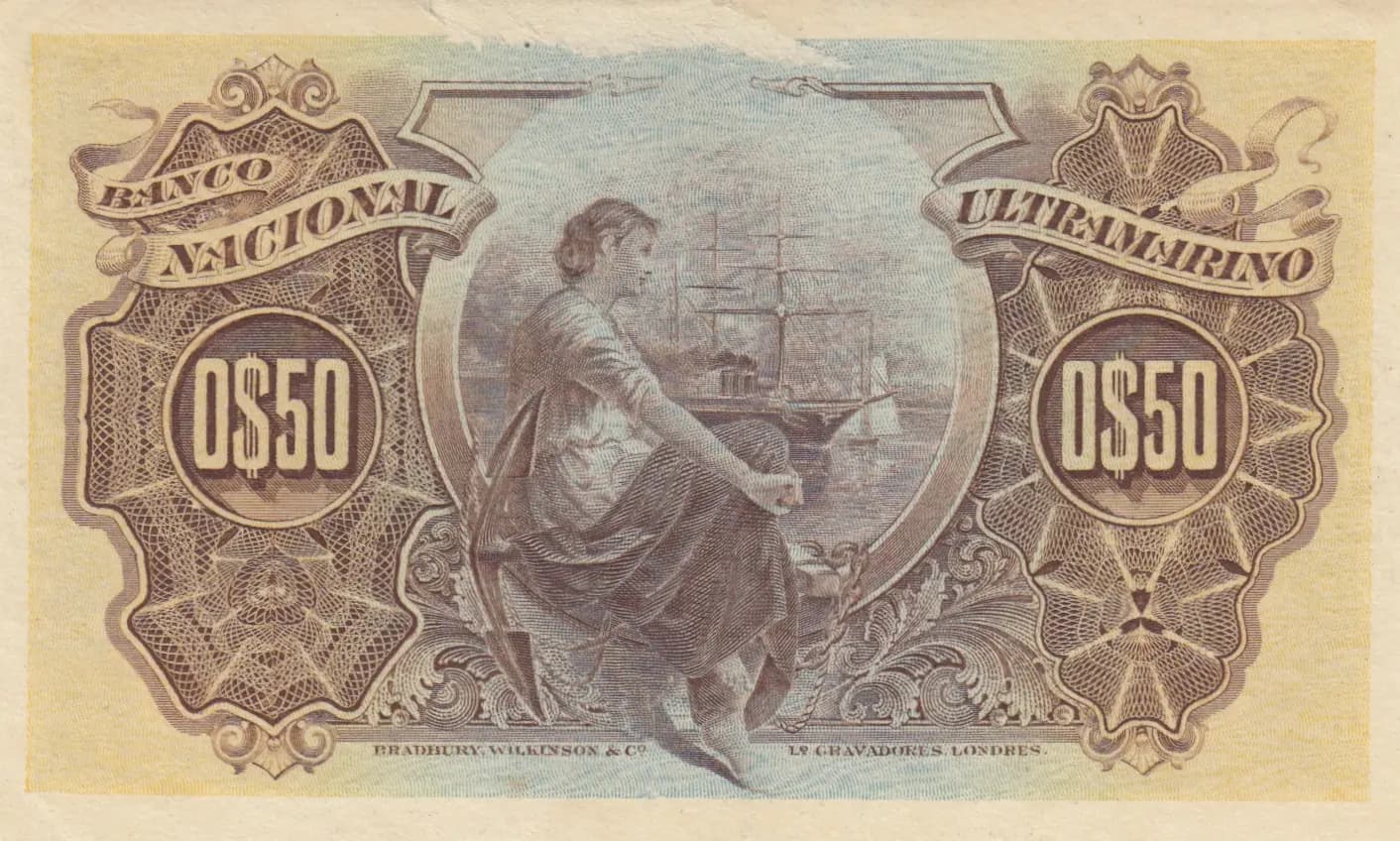
This 50 centavos note from Mozambique (1914) presents a well-preserved example of early 20th-century Portuguese colonial currency, featuring the distinctive green-dominated obverse with an ornate radiating sunburst pattern and blue steamship seal characteristic of Banco Nacional Ultramarino's Type III design. The reverse displays fine intaglio engraving of an allegorical female figure representing commerce and navigation, flanked by ornamental shields, with sailing ships rendered in the background—imagery that reflects the maritime mercantile emphasis of Portuguese colonial finance. Despite over a century of age, the note shows only minor foxing and discoloration consistent with AU condition, with crisp engraved details and well-preserved color printing.
Common. Market data from realbanknotes.com shows examples in Fine condition selling for $15-$20 on eBay (2020-2021), indicating ready availability at modest prices. The PMG population report documents this as a catalogued variant without counterfoil, but provides no rarity population data suggesting scarcity. No evidence from print runs, recall notices, or short-lived issuing authority suggests this was a limited issue. The Banco Nacional Ultramarino maintained steady production of colonial currency throughout this period, and this denomination represents standard circulation issue from a well-known security printer. In AU condition, it commands modest premiums over Fine grades but remains readily obtainable.
Issued on November 5, 1914, this note represents the Banco Nacional Ultramarino's role as the central financial institution of Portuguese Mozambique during the twilight of European colonialism. The prominent steamship imagery in the blue seal and the allegorical female figure with maritime background symbolized the colonial administration's emphasis on commerce, navigation, and maritime trade routes that connected metropolitan Portugal to its African territories. The note's design, printed by London's prestigious Bradbury Wilkinson & Co, reflects the cosmopolitan banking practices of the Portuguese Empire even as World War I was reshaping European geopolitics.
The obverse features the coat of arms or heraldic emblem of Banco Nacional Ultramarino rendered in the central radiating sunburst pattern with concentric wavy lines in red and green. A Type III steamship seal—a blue circular medallion containing a vessel surrounded by navigational imagery—occupies the lower center, symbolizing the bank's maritime and mercantile focus. Ornamental corner designs incorporate shield-like emblems with elaborate scrollwork in green. The reverse displays 'Commerce' or an allegorical female figure in classical robes seated at a desk or table, representing the prosperity and orderly administration of colonial commerce. Behind her, a sailing ship is visible in the background, emphasizing the maritime foundation of Portuguese colonial wealth. Left and right shield-shaped vignettes frame the composition, each containing circular denomination medallions marked '0$50' (old escudo notation) and ornamental flourishes. The entire design reflects the high aesthetic standards of Bradbury Wilkinson's intaglio work.
Front side: 'BANCO NACIONAL ULTRAMARINO' (Overseas National Bank), 'LOURENÇO MARQUES' (colonial administrative center), 'CINQUENTA CENTAVOS' (Fifty centavos), 'MOÇA CORRENTE' (Current money), '50 CENTAVOS' (denomination), 'LISBOA' (Lisbon), '5 de Novembro de 1914' (November 5, 1914), 'BANCO NACIONAL ULTRAMARINO MOEDAS, COMMERCIO, AGRICULTURA' (National Overseas Bank - Currency, Commerce, Agriculture), 'O Governador' (The Governor), and serial number 'A 1414180'. Back side: 'BANCO' (Bank), 'NACIONAL' (National), 'ULTRAMARINO' (Overseas), '0$50' (old Portuguese monetary notation: 0 escudos 50 centavos), 'BRADBURY, WILKINSON & CO' (printer), '19 GRACEDORES, LONDRES' (19 Gracechurch Street, London - printer's address).
Intaglio engraving on multicolor underprint, executed by Bradbury Wilkinson & Co of London. The note displays characteristic features of fine-line intaglio work: detailed line patterns throughout ornamental borders, elaborate geometric designs in the central sunburst pattern, crisp portrait engraving of the allegorical female figure, and finely rendered background nautical scenery. Multiple color passes in green, red, blue, and brown were applied over a cream/tan base stock, with the steamship seal rendered in distinct blue tones. The security design relies on the complexity and precision of the engraved line work, typical of early 20th-century banknote production standards.
This example is Pick-61, the variant 'without counterfoil at left.' The catalog reference notes that a similar variety with counterfoil exists as Pick-58, making the absence or presence of counterfoil the primary identifying characteristic between these two variants of the same denomination and date. The serial number format 'A 1414180' appears consistent with standard numbering practices for this issue. No overprints, re-denominations, or printer's variants are noted for this Pick number.