5 escudos 1945
Market Prices
6 salesAbout This Note
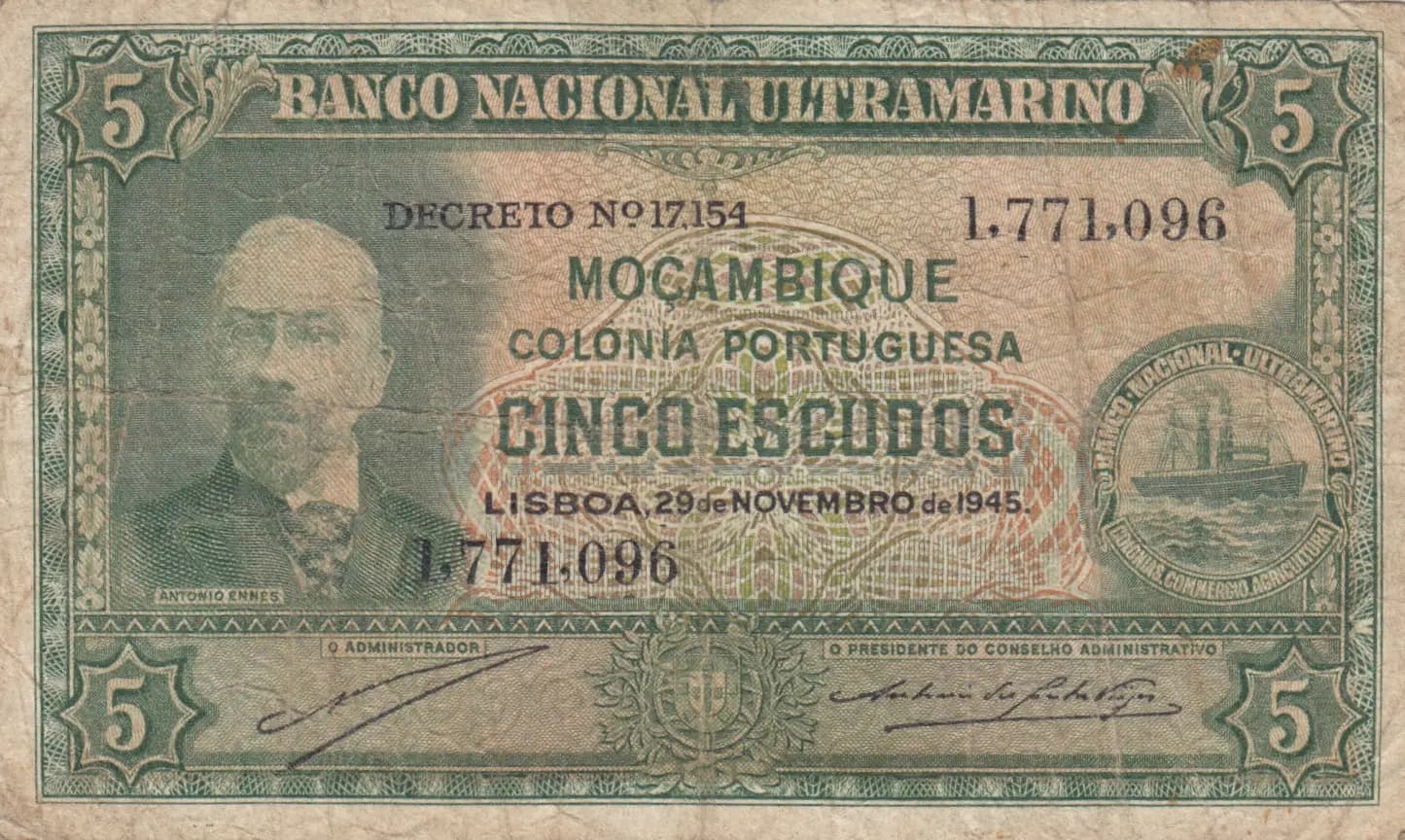
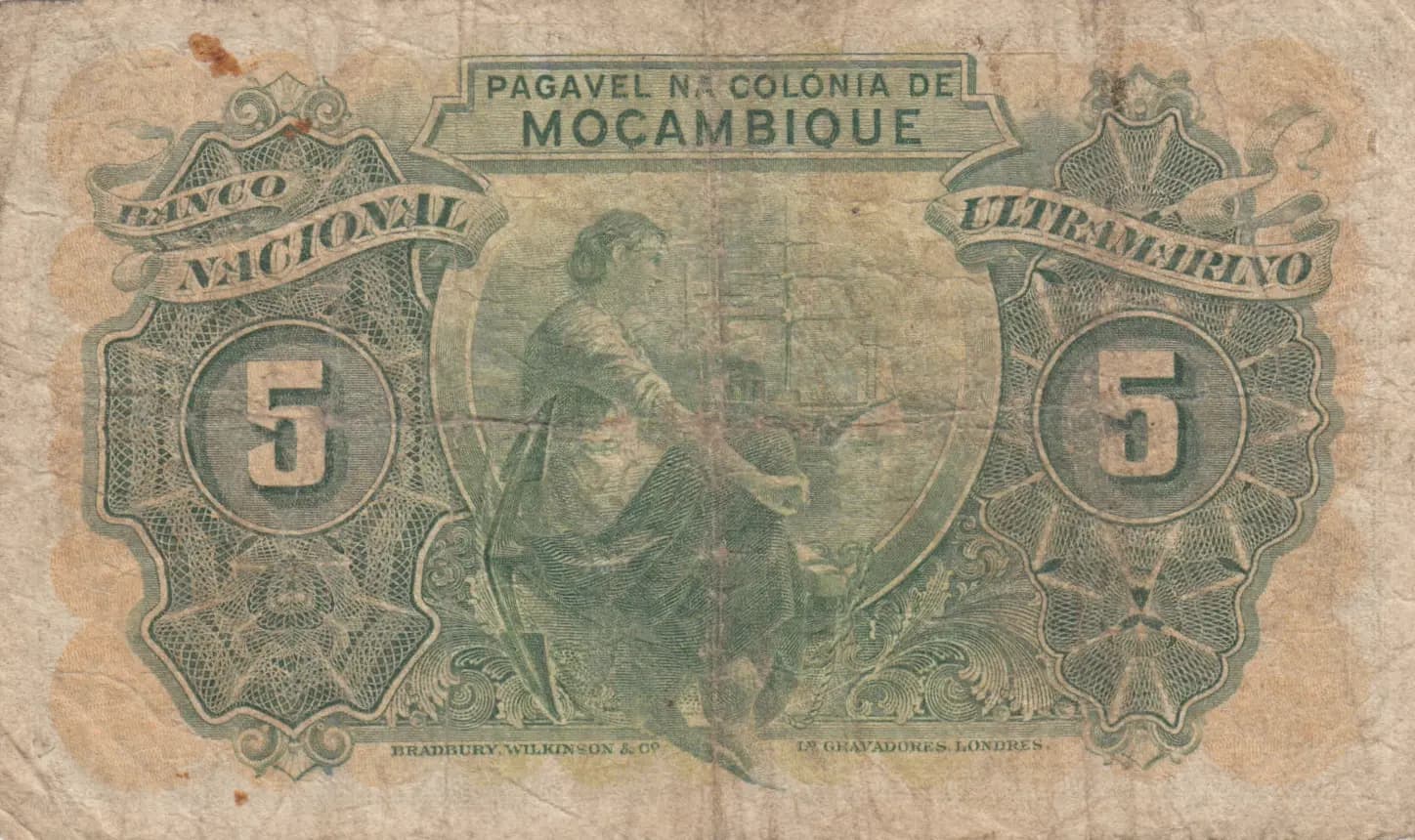
This is a F-grade 5 escudos banknote from Mozambique issued on 29 November 1945 by Banco Nacional Ultramarino. The note displays characteristic Art Deco styling with green and cream coloring on the obverse featuring a portrait of António Ennes on the left and a steamship vignette on the right, while the reverse shows a classical allegorical female figure (Lusitania) in the center with decorative shields bearing the denomination. The note shows moderate to heavy circulation wear with visible creasing, folds, foxing, and age-related patina consistent with its 78+ year history.
common. This note regularly appears in the market with eBay sales ranging from $10.50 to $23.38 depending on condition grade, with F-grade examples selling in the $11.50-$17.50 range. The catalog value for F-grade is approximately $3-5, and multiple examples appear annually in online auctions. While not a modern common issue, the combination of a modest denomination, standard 1945 production run for a colonial currency, and consistent market availability indicates this is a common collectible banknote rather than a scarce or rare issue.
This note was issued during the later years of the Portuguese Estado Novo under Salazar, when Mozambique remained a Portuguese colony (as indicated by 'COLONIA PORTUGUESSA' on the obverse). The allegorical female figure on the reverse represents Lusitania, the classical personification of Portuguese identity and imperial reach, while the steamship imagery reflects Portugal's maritime colonial heritage and the importance of sea trade to the colonial economy. The denomination and design reflect the monetary system used in Portuguese African colonies during the mid-20th century.
The obverse features a left-facing portrait of António Ennes, a notable Portuguese administrator and colonial official, positioned on the left side of the note. The right side displays a circular vignette containing a steamship, symbolizing Portugal's maritime commercial power. The entire design is framed with ornate Art Deco-style borders incorporating geometric star-like emblems at the corners and decorative scrollwork. Red-orange overprinting across the center contains the denomination, location, and date information. The reverse presents an allegorical female figure (Lusitania) seated in flowing classical robes, representing Portuguese identity and sovereignty, with architectural elements of colonial cities visible in the background. Ornamental shields with baroque scrollwork flank the central figure on both sides, each containing the denomination 5 in decorative circular cartouches. The color palette throughout is predominantly green and cream, with black engraved details.
OBVERSE: Banco Nacional Ultramarino (National Overseas Bank) | Decreto Nº 17.154 (Decree No. 17,154) | Serial number: 1.771.096 and 771.096 | Moçambique (Mozambique) | Colonia Portuguessa (Portuguese Colony) | Cinco Escudos (Five Escudos) | Lisboa, 29 de Novembro de 1945 (Lisbon, 29 November 1945) | O Administrador (The Administrator) | O Presidente do Conselho Administrativo (The President of the Administrative Council) | António Ennes (engraver credit). REVERSE: Banco Nacional Ultramarino (National Overseas Bank) | Pagavel na Colonia de Moçambique (Payable in the Colony of Mozambique) | 5 (denomination) | Bradbury, Wilkinson & Co (printer) | Los Gravadores, Londres (The Engravers, London).
This note was produced using fine line engraving, the standard security printing method for banknotes of this era. The printer was Bradbury, Wilkinson & Co (BWC), a London-based security printing firm renowned for its high-quality engraved banknote production. The intricate borders, allegorical vignettes, and portrait work demonstrate the characteristic precision of intaglio engraving, with fine line patterns visible throughout providing inherent anti-counterfeiting protection. The overprinting of denomination and date information appears to have been applied as a secondary process.
This note is cataloged as Pick P-94, with PMG noting one variant (P-94cts) exists in the catalog. The observed serial number 1.771.096 and administrative signatures visible on this example represent the standard variety. No major printing varieties, signature varieties, or significant overprint variations are documented for this Pick number. The note appears to be from the regular issue of 1945 with no remarkable variety characteristics beyond normal serial number variation.