20 escudos 1937
Market Prices
5 salesAbout This Note
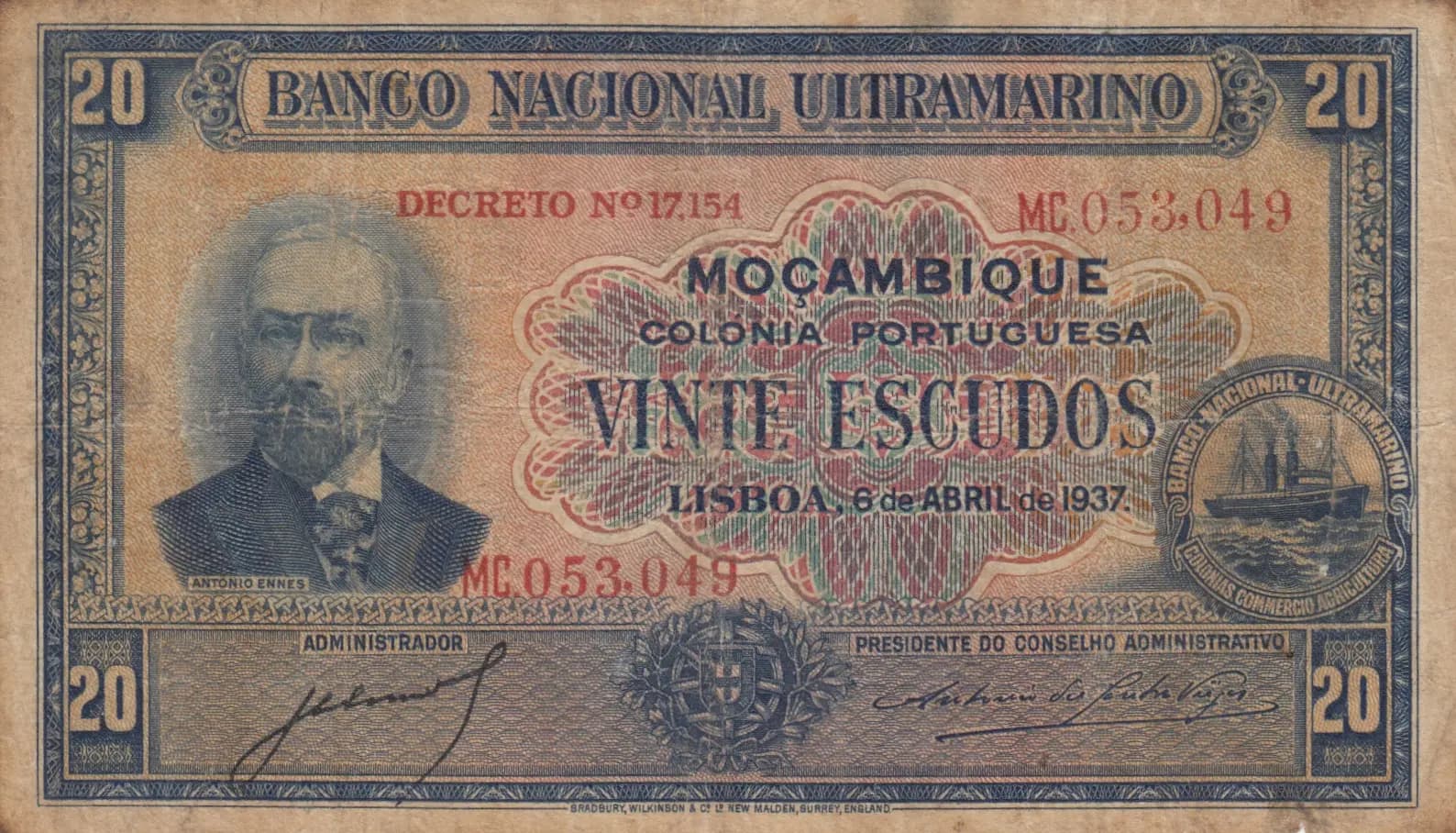
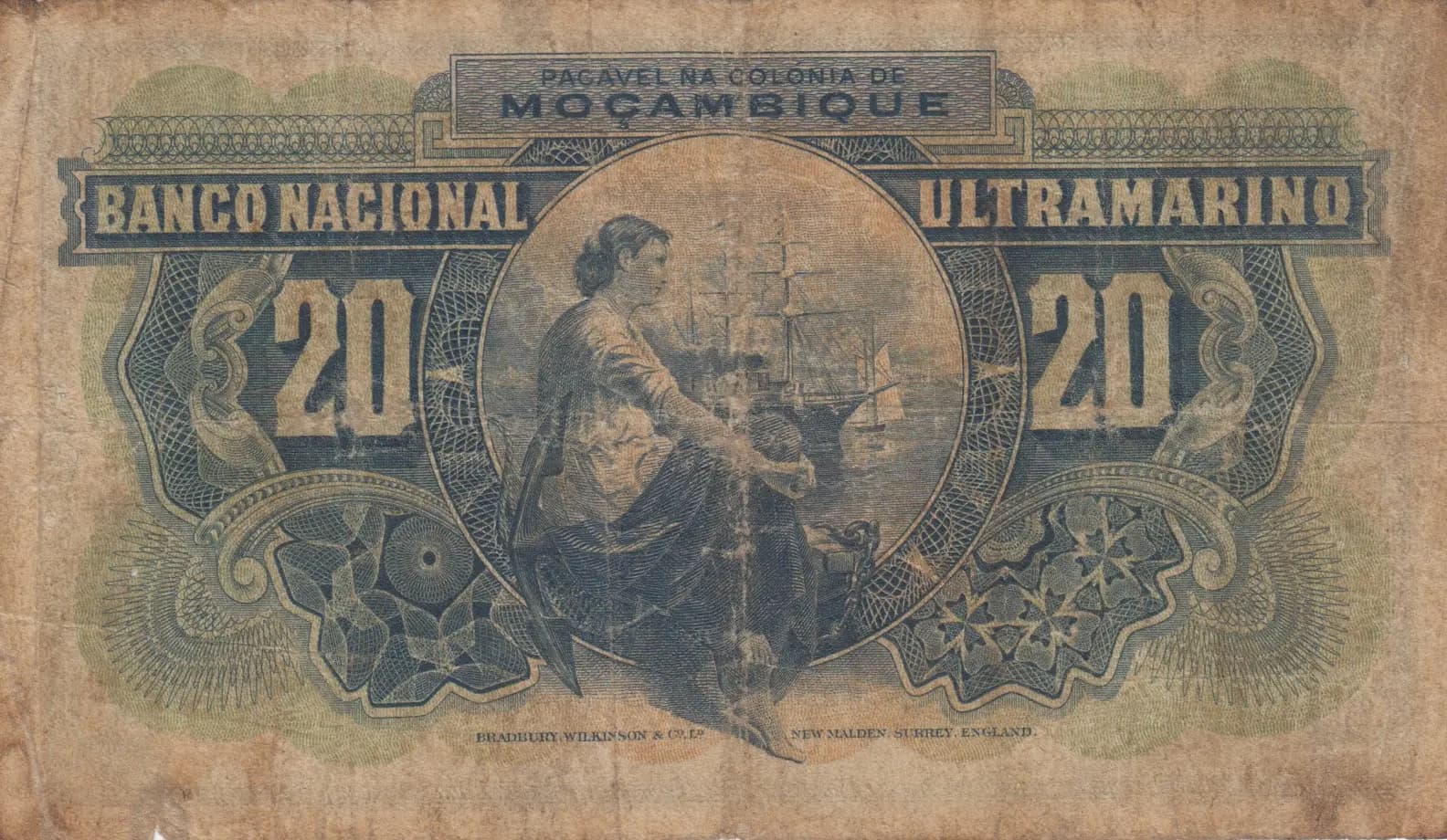
This Mozambique 20 Escudos from 1937 is an attractive early colonial-era banknote issued by the Banco Nacional Ultramarino, featuring a striking portrait of António Ennes on the obverse and allegorical maritime imagery on the reverse. The note displays the characteristic tan/beige background with blue and red printing typical of the era, and shows moderate circulation wear consistent with Fair condition, including creasing and foxing across both sides. This cataloged Pick-74 example represents an important piece of Portuguese colonial currency history with fine engraved security details.
Common. Despite being from 1937, this note exists in multiple condition grades on the secondary market with consistent availability. eBay price tracking data shows steady circulation with Fair condition examples selling for approximately $50, VF examples ranging from $18-$55, indicating robust supply. The Banco Nacional Ultramarino maintained substantial print runs for denominations like the 20 Escudos throughout the colonial period, and no evidence suggests this Pick number was recalled, had a limited issue, or is scarce in numismatic collections.
Issued on April 8, 1937, during the Estado Novo period of Portuguese history, this banknote reflects Portugal's continued emphasis on its overseas colonial possessions through the Banco Nacional Ultramarino (National Overseas Bank). The portrait of António Ennes, a 19th-century colonial administrator, and the prominent maritime/commercial imagery symbolized Portugal's historical reliance on maritime trade and colonial commerce that defined the Lusophone empire. The decorative ship vignettes and allegorical female figure representing commerce underscore the economic relationship between the Portuguese metropole and its Mozambique colony during this period of centralized fascist administration.
The obverse features António Ennes (1848-1901), a prominent Portuguese colonial administrator and former governor-general, portrayed at left in formal attire with beard in a three-quarter profile view. The center contains an ornamental cartouche bearing the denomination and issuing authority text, while the right side displays a sailing ship vignette representing colonial maritime commerce. The reverse showcases a classical allegorical composition in a central circular vignette depicting a female figure (representing Portugal or Commerce) in classical dress alongside maritime and commercial figures, with additional ship imagery and coastal background elements suggesting the commercial importance of Mozambique. Both sides feature ornate decorative borders with scrollwork, floral elements, and corner ornaments typical of the era's security printing aesthetic. The Portuguese coat of arms appears on the front lower portion.
FRONT: '20' (Denomination); 'BANCO NACIONAL ULTRAMARINO' (National Overseas Bank); 'DECRETO Nº17/154' (Decree No. 17/154); 'MOCAMBIQUE' (Mozambique); 'CORÔA PORTUGUESA' (Portuguese Crown); 'VINTE ESCUDOS' (Twenty Escudos); 'LISBOA, 8 de ABRIL de 1937' (Lisbon, April 8, 1937); 'MC.053.049' (serial/reference number); 'ANTONIO ENNES' (name of portrayed figure); 'ADMINISTRADOR' (Administrator); 'PRESIDENTE DO CONSELHO ADMINISTRATIVO' (President of the Administrative Council). BACK: '20' (Denomination, repeated); 'PAGAVEL NA COLONIA DE MOCAMBIQUE' (Payable in the Colony of Mozambique); 'BANCO NACIONAL ULTRAMARINO' (National Overseas Bank); 'BRADBURY, WILKINSON & CO LTD' (Printer); 'NEW MALDEN, SURREY, ENGLAND' (Printer location).
Intaglio (engraved) printing with multicolor overprinting. The note was produced by Bradbury, Wilkinson & Co Ltd of New Malden, Surrey, England, a premier security printer renowned for banknote and currency production. The fine line work visible throughout both sides, intricate border patterns, and detailed portraiture are characteristic of high-quality intaglio engraving. The tan/beige base stock with blue and red printed security elements demonstrates the layered color technique employed for enhanced security features typical of 1930s-era banknote production.
This example corresponds to Pick-74s per PMG cataloging. The serial number visible as 'MC.053.049' may indicate a specific printing batch, though without access to comprehensive serial number studies of this issue, individual variety classification is limited. The April 8, 1937 date on the face is consistent with the stated Pick catalog date of 06.04.1937 (noting potential calendar convention differences between sources). No known major varieties such as signature variations, overprints, or color variants have been identified for this Pick number, suggesting this represents a standard regular issue from the single documented printing authority.