20 centavos 1914
Market Prices
4 salesAbout This Note
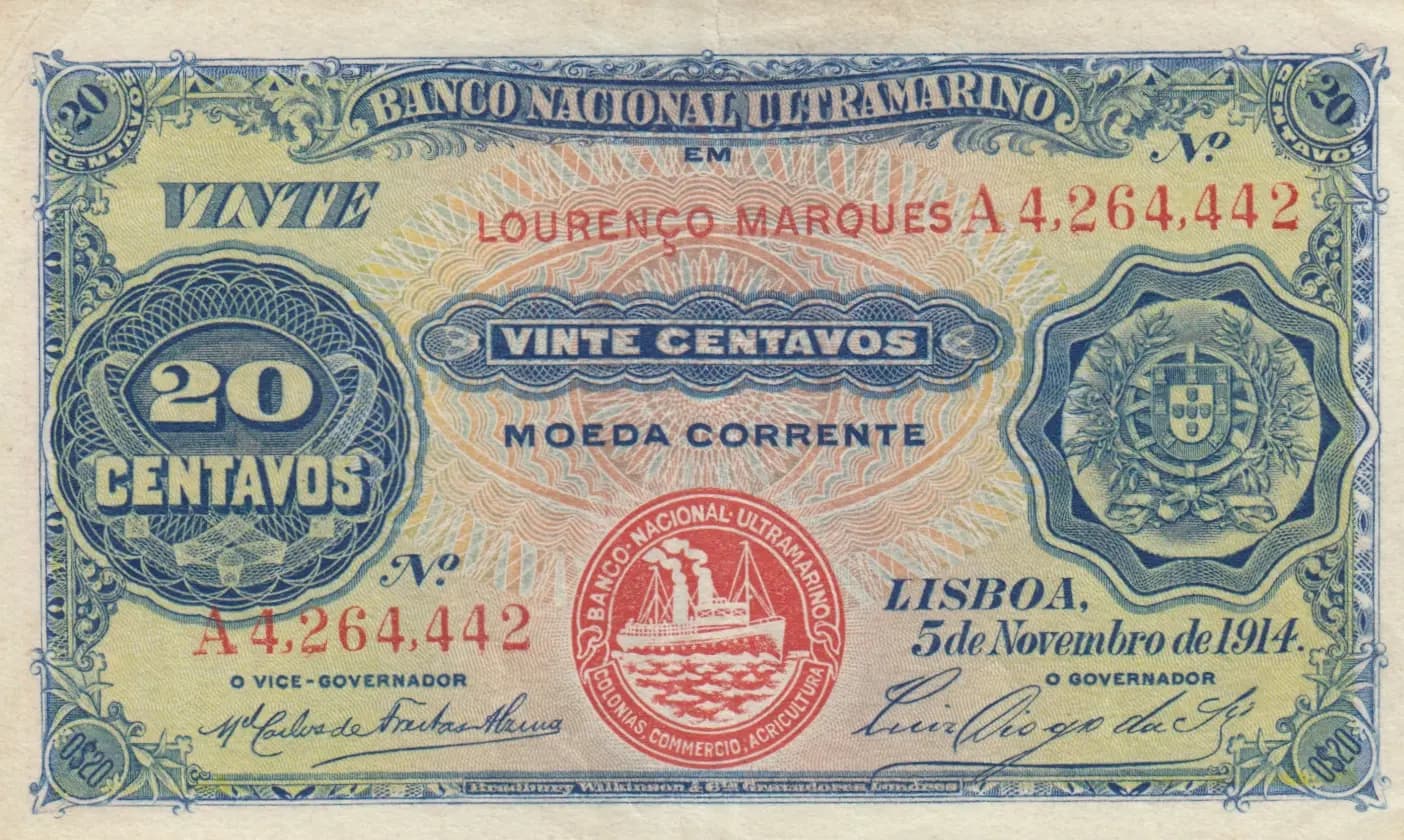
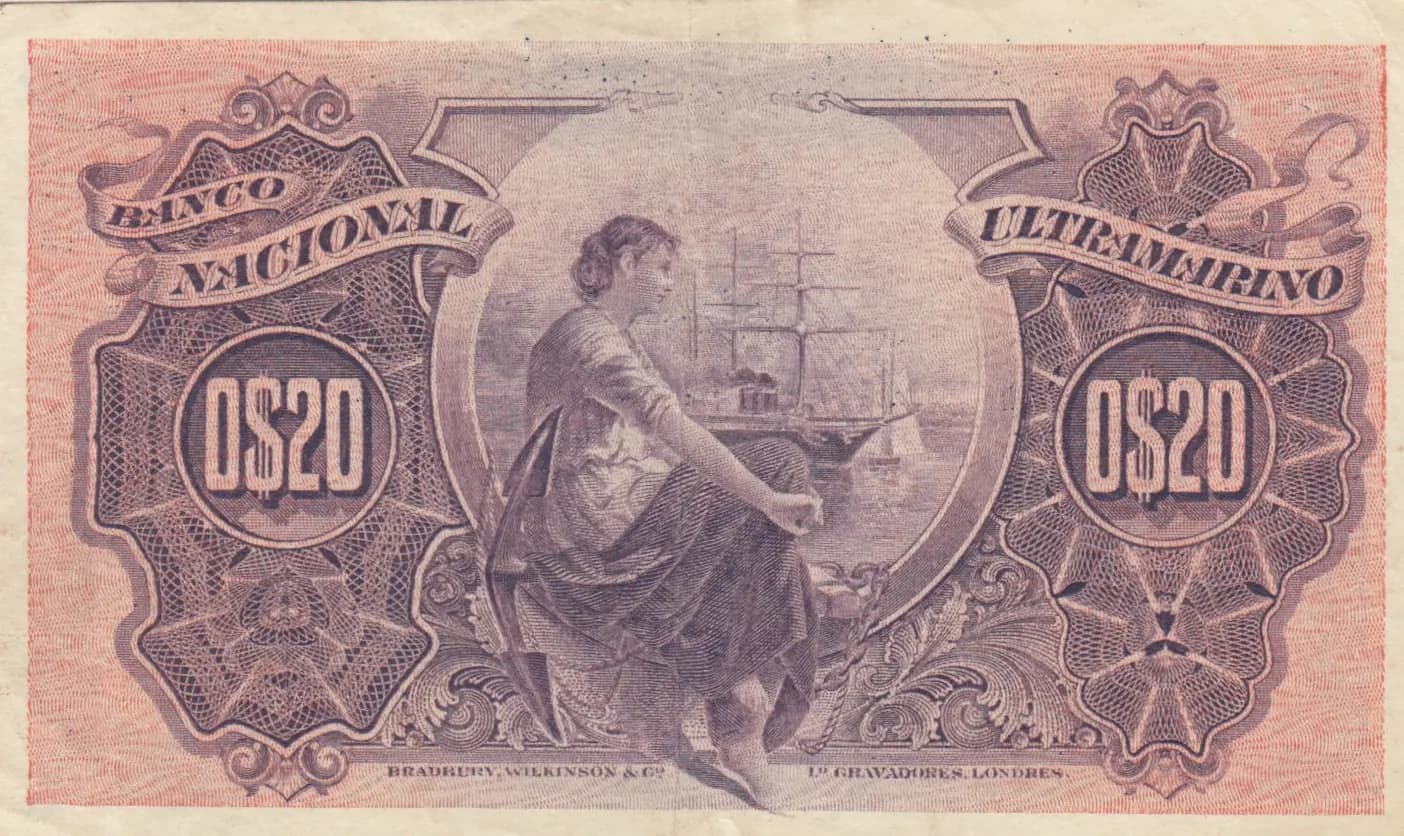
This is a VF-graded 1914 Mozambique 20 Centavos note issued by the Banco Nacional Ultramarino, printed by Bradbury Wilkinson & Co of London. The obverse features an ornate blue and gold design with a striking red circular steamship seal at center, while the reverse displays a classical allegorical female figure (Britannia) in purple tones, seated with sailing ships in a harbor background. The note is notable as the version without counterfoil (P-60), distinguishing it from the counterfoil variant P-57, and shows exceptional preservation with vibrant colors and crisp engraving detail throughout.
Common. The eBay transaction data shows this note in VF condition selling for approximately $21 in 2016, with F-grade notes consistently trading in the $11–$12 range across multiple sales. These modest price points, combined with the availability of multiple circulation records and the absence of rarity notations in major catalogs, indicate this is a regularly encountered issue. The 1914 date and Portuguese colonial Mozambique context do not suggest limited production or special collector demand beyond normal historical interest.
This banknote was issued on November 5, 1914, during the height of Portuguese colonial administration in Mozambique (then known as Portuguese East Africa, with Lourenço Marques as the capital). The Banco Nacional Ultramarino served as the principal issuing authority for Portuguese overseas territories, and the note's imagery—featuring both imperial Portuguese maritime symbolism and the allegory of Britannia with her trident—reflects the era's mercantile and imperial themes. The denomination in escudos and centavos, printed in Lisbon and London respectively, demonstrates the integration of Mozambique into the broader Portuguese monetary system during the early 20th century.
The obverse features the coat of arms of Portugal or the Banco Nacional Ultramarino positioned on the right side, surrounded by elaborate blue and gold ornamental borders with geometric scrollwork and filigree patterns. The central design emphasizes a red circular seal bearing a steamship emblem (Type III), symbolizing Portugal's maritime and colonial commerce. Denomination numerals appear in ornamental circular cartouches on both left and right margins. The reverse depicts Britannia (the classical female allegorical figure of Britain/maritime commerce) seated in profile facing right, draped in classical robes and holding a trident, positioned above a harbor landscape with sailing vessels. Large ornamental shield-shaped cartouches containing '0$20' flank the central composition on left and right. The decorative treatment of both sides employs fine line engraving to create complex anti-counterfeiting patterns.
FRONT: 'Banco Nacional Ultramarino' (Overseas National Bank) | 'Vinte Centavos' (Twenty Centavos) | 'Moeda Corrente' (Current Currency) | 'Lourenço Marques' (Lourenço Marques, the colonial capital) | 'Lisboa, 5 de Novembro de 1914' (Lisbon, November 5, 1914) | 'O Governador' (The Governor) | 'O Vice-Governador' (The Vice-Governor) | Serial number: 'N.º A 4,264,442'. BACK: 'Banco Nacional Ultramarino' (repeated across decorative shields) | 'Ultramarino' (Overseas) | Denomination: '0$20' (0 Escudos 20 Centavos in Portuguese notation) | 'Bradbury, Wilkinson & Co' (the London printer) | '1.ª Gravadores, Londres' (1st Engravers, London).
Intaglio/line engraving, executed by Bradbury, Wilkinson & Co, the renowned London security printer. The note displays the characteristic fine line work, intricate cross-hatching, and detailed scrollwork typical of high-security banknote production of the early 20th century. The crisp impression and vibrant color separation visible in both images indicate professional wet-printing techniques on specialized banknote paper, with multicolor underprint on the obverse and purple/mauve tones on the reverse.
This note is cataloged as P-60 and is specifically identified as the variant WITHOUT counterfoil at the left margin. The related variety P-57 is the same note WITH counterfoil. The observed serial number on the front is 'A 4,264,442', with the 'A' prefix typical of this series. No overprints, signatures, or other notable varieties beyond the counterfoil distinction have been identified in the visual analysis.