2,5 escudos 1941
Market Prices
14 salesAbout This Note
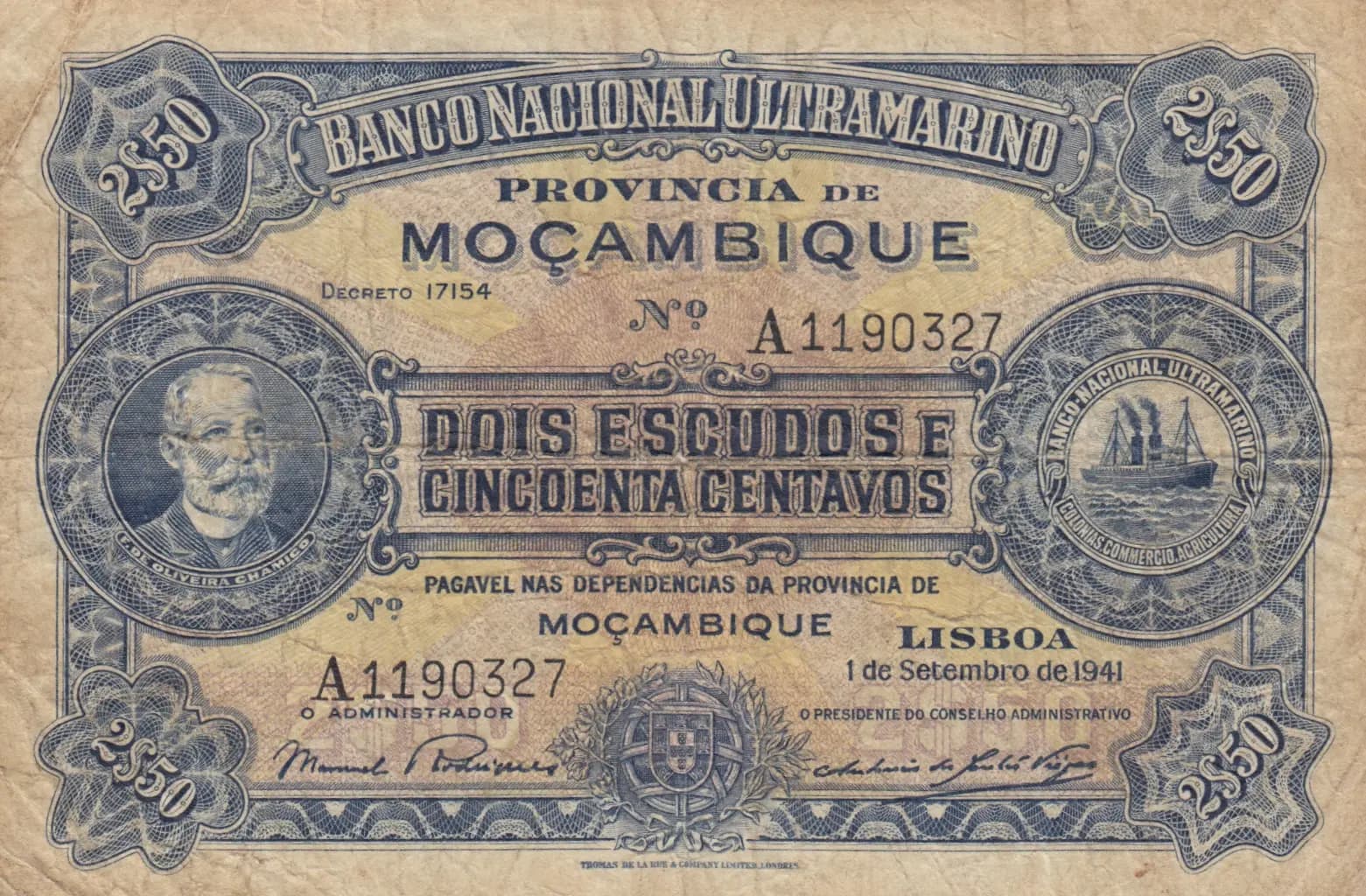
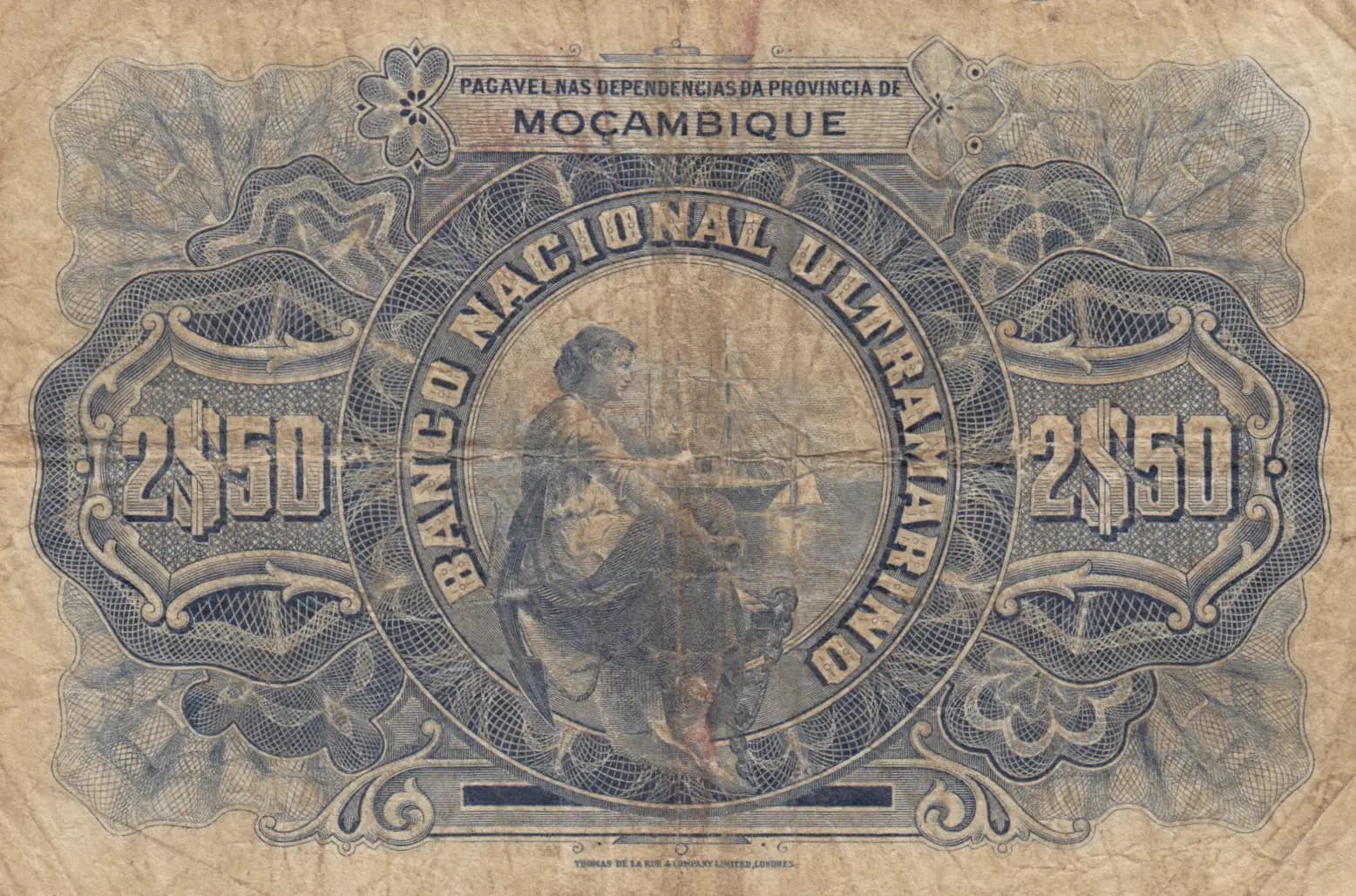
This is a VG-graded 2½ Escudos note from Mozambique issued September 1, 1941 by the Banco Nacional Ultramarino, printed by Thomas de la Rue in London. The note displays the characteristic blue coloring and fine engraving of the period, featuring a portrait of Francisco de Oliveira Chamico on the obverse and an allegorical female maritime figure on the reverse. The note shows typical aging with moderate yellowing, browning, creasing and handling wear consistent with VG condition, though all inscriptions and imagery remain legible.
Common. eBay market data shows consistent sales in the $10-$35 range for this note across multiple condition grades (F-VF) over more than a decade, with VG examples selling for approximately $10-$12.50 based on 2010-2016 records. The 2016 catalogue value for VG is listed at only $6, further confirming this as a common note in the market. No evidence of limited print runs, early recall, or scarcity appears in the available data. This denomination and date represent standard regular-issue colonial currency with substantial circulation.
This note was issued during the Portuguese Estado Novo period under the Salazar regime, when Mozambique remained a Portuguese overseas province. The allegorical female figure on the reverse represents Portugal's maritime heritage and colonial mercantile interests, while the steamship imagery reflects the importance of naval commerce to the Portuguese empire. The note's issuer, Banco Nacional Ultramarino, was the colonial banking authority responsible for currency circulation throughout Portuguese Africa during this era.
The obverse features a formal portrait of Francisco de Oliveira Chamico in a circular medallion on the left side, depicting a bearded man in formal attire characteristic of Portuguese colonial administrators. On the right side is a circular medallion containing a steamship, symbolizing maritime commerce and Portugal's naval power. The center-bottom displays the Portuguese heraldic shield with coat of arms. The reverse showcases a large central circular medallion containing an allegorical female figure in classical style, appearing seated with maritime/nautical elements, representing Commerce or Portugal's overseas dominion. Both sides employ ornate decorative borders with corner flourishes and intricate linework throughout, typical of early 20th-century high-security currency design. The denomination appears as '2$50' in period-appropriate notation.
FRONT SIDE: 'BANCO NACIONAL ULTRAMARINO' (Overseas National Bank) | 'PROVINCIA DE MOÇAMBIQUE' (Province of Mozambique) | 'Decreto 17154' (Decree 17154) | 'Nº A1190327' (Serial Number A1190327) | 'DOIS ESCUDOS E CINQUOENTA CENTAVOS' (Two Escudos and Fifty Centavos) | 'PAGAVEL NAS DEPENDENCIAS DA PROVINCIA DE MOÇAMBIQUE' (Payable at the Dependencies of the Province of Mozambique) | 'LISBOA' (Lisbon) | '1 de Setembro de 1941' (September 1, 1941) | 'O ADMINISTRADOR' (The Administrator) | 'O PRESIDENTE DO CONSELHO ADMINISTRATIVO' (The President of the Administrative Council) | 'OLIVEIRA CHAGAS' (signature). REVERSE SIDE: 'PAGAVEL NAS DEPENDENCIAS DA PROVINCIA DE MOÇAMBIQUE' (Payable at the Dependencies of the Province of Mozambique) | 'BANCO NACIONAL ULTRAMARINO' (Overseas National Bank) | '2$50' (2 Escudos 50 Centavos denomination notation).
This note was produced using steel plate intaglio engraving, the standard security printing method for the era. The fine line engraving, intricate cross-hatching patterns, detailed linework in allegorical and symbolic elements, and complex background patterns visible throughout both sides are characteristic of Thomas de la Rue's production standards. The printer, Thomas de la Rue & Company of London, was one of the world's premier security printers and employed multi-stage intaglio processes to create the depth and detail observed in the imagery and text.
The note exhibits signature varieties noted in catalog references, with 'OLIVEIRA CHAGAS' appearing as the signature. The series identifier is 'A' as shown in serial number A1190327. While PMG records indicate one variant catalogued for Pick-82, this specific example represents the standard 1941 issue without apparent overprints or exceptional identifying marks. The date of issue is confirmed as 1 de Setembro de 1941 (September 1, 1941), consistent with catalog records showing 01.09.1941.