10 escudos 1945
Market Prices
12 salesAbout This Note
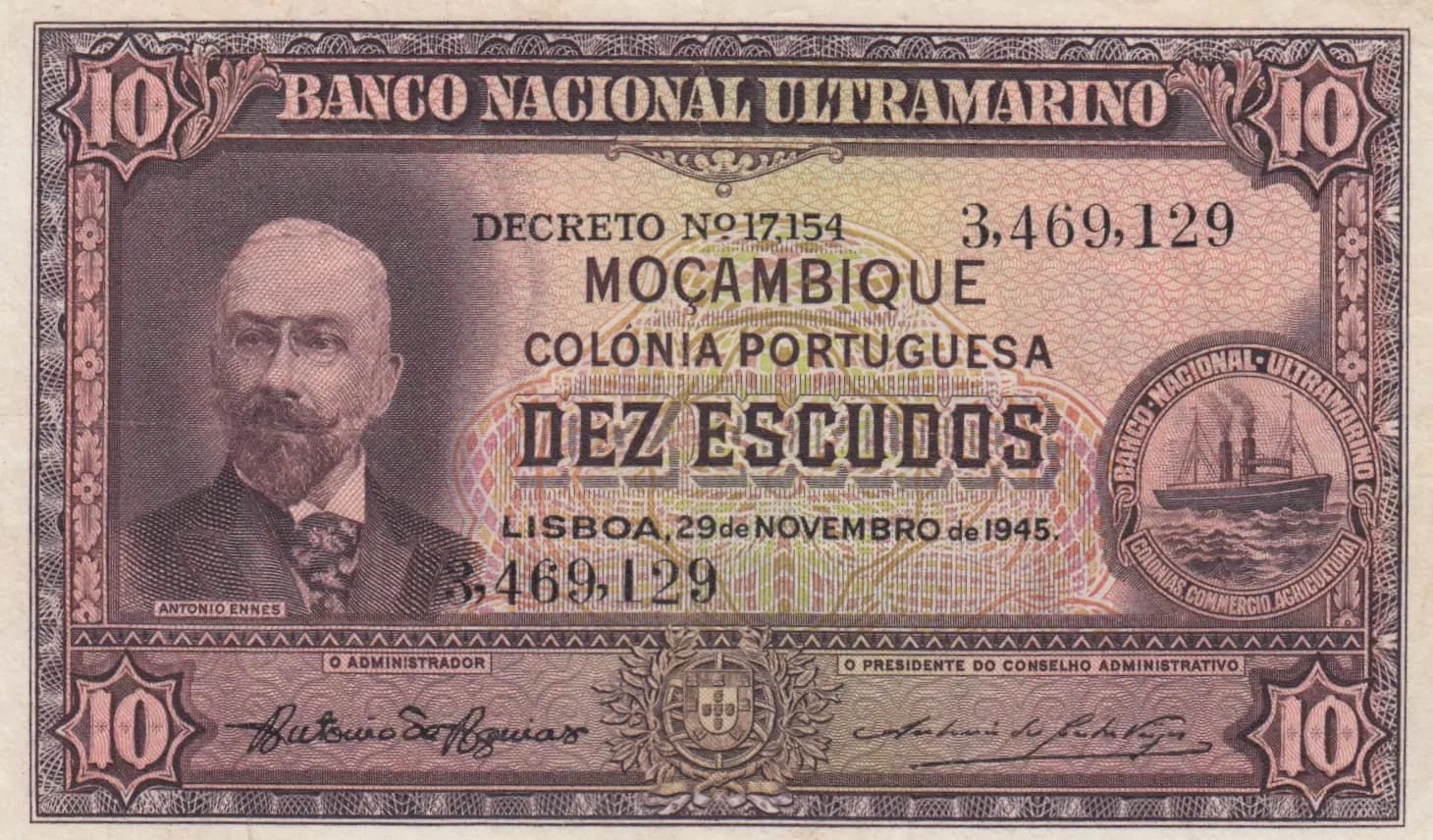
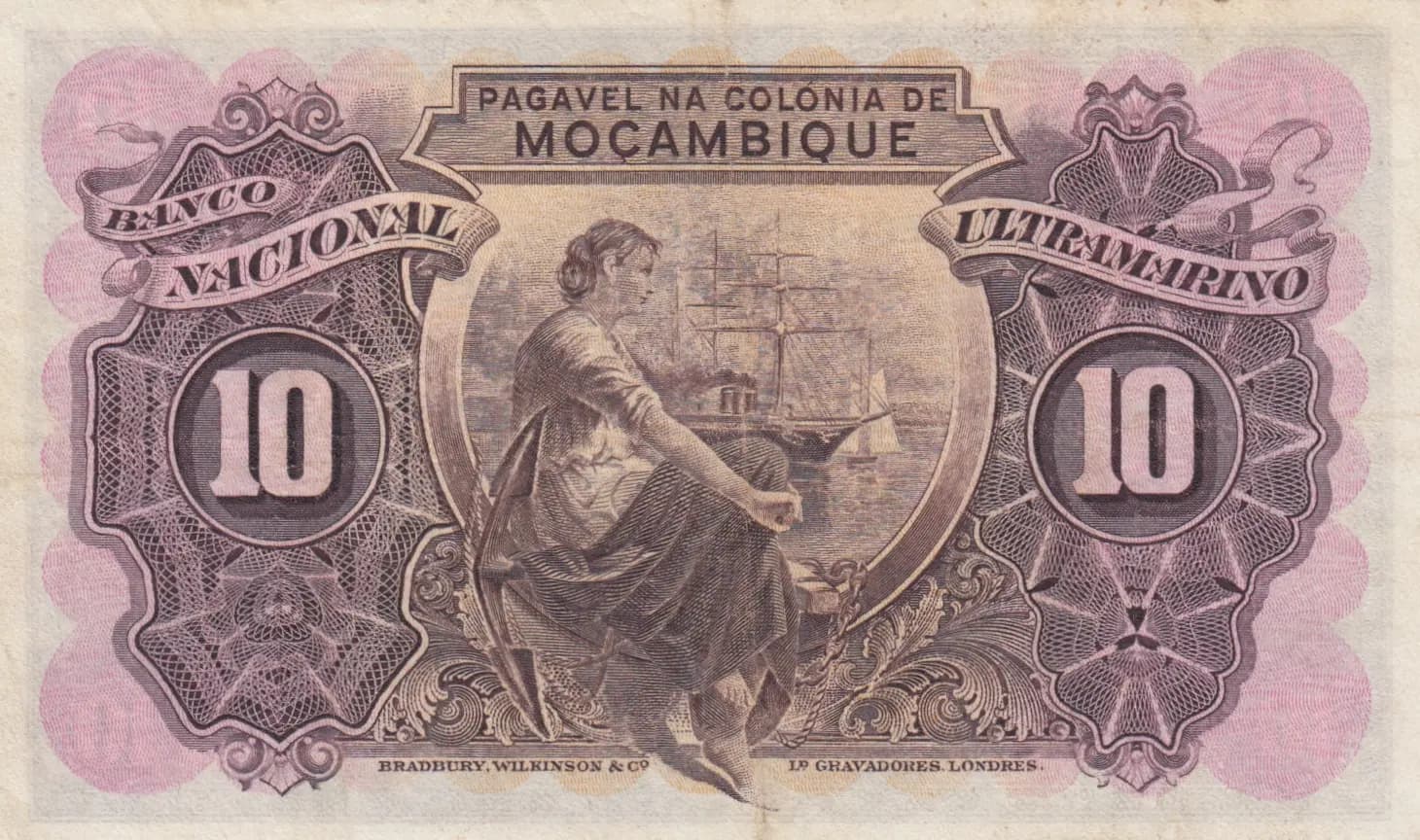
This Mozambique 10 escudos note from 1945 presents a classically elegant design typical of Portuguese colonial currency, featuring a formal portrait of António Ennes on the obverse and an allegorical female figure with maritime imagery on the reverse. The note exhibits the characteristic pink/mauve and brown toning of a 78-year-old document, with light foxing and age-related patina consistent with VF condition; the fine engraving work and ornate borders remain crisp and well-defined despite modest handling marks.
Common. The eBay market data provided shows consistent sales across multiple condition grades spanning over a decade (2011–2023), with VF specimens regularly selling in the $25–$46 range. The 2016 catalog value for VF of $25 aligns with observed market pricing. The note was issued by a major, stable issuing authority (Banco Nacional Ultramarino) and no evidence suggests a limited print run or early recall. The denomination (10 escudos) is intermediate and would have seen moderate circulation. This is a standard colonial-era Portuguese note with no documented scarcity factors.
Issued by the Banco Nacional Ultramarino on November 29, 1945—shortly after World War II and during the final decade of Portuguese colonial rule in Mozambique—this note reflects the Portuguese Crown's assertion of sovereignty over its African possessions through classical European iconography. The maritime imagery (ships, sailing vessels) and the allegorical female figure symbolize the commercial and imperial ambitions central to Portuguese colonial administration, while the explicit designation 'Colónia Portuguesa' (Portuguese Colony) underscores the political status that would persist until Mozambique's independence in 1975.
The obverse features a formal portrait of António Ennes (a Portuguese colonial administrator) in three-quarter profile, positioned at the left in formal business attire with beard and dignified bearing, rendered in fine line engraving characteristic of Bradbury Wilkinson's work. A circular vignette on the right displays a sailing ship within a medallion, symbolizing maritime commerce and colonial trade routes. Classical ornamental elements frame the composition—star-shaped corner cartouches, scrollwork borders, and the Portuguese shield (coat of arms)—all rendered in sepia and black against a pink/mauve underprint. The reverse presents an allegorical classical female figure (likely representing Commerce, Navigation, or Prosperity) draped in flowing robes and positioned centrally, with a sailing ship visible in the background; four corner medallions contain the denomination '10' within decorative circular frames. The overall design vocabulary is distinctly European and Renaissance-inspired, asserting Portuguese cultural and administrative authority.
FRONT: 'Banco Nacional Ultramarino' (National Overseas Bank) — 'Decreto Nº 17154' (Decree No. 17154) — '3,469,129' (serial number) — 'Moçambique' (Mozambique) — 'Colónia Portuguesa' (Portuguese Colony) — 'Dez Escudos' (Ten Escudos) — 'Lisboa 29 de Novembro de 1945' (Lisbon 29th November 1945) — 'António Ennes' (signature/identification) — 'O Administrador' (The Administrator) — 'O Presidente do Conselho Administrativo' (The President of the Administrative Council). BACK: 'Pagável na Colónia de Moçambique' (Payable in the Colony of Mozambique) — 'Banco Nacional Ultramarino' (National Overseas Bank) — '10' (denomination) — 'Bradbury, Wilkinson & C°' (printer) — 'LP Gravadores Londres' (LP Engravers London).
Intaglio engraving (steel plate printing), executed by Bradbury, Wilkinson & Co., Ltd. of London—one of the world's premier banknote security printers. The technique is evidenced by the fine line work, precise cross-hatching, intricate stippling for tonal gradation, and sharp detail in portrait work and border patterns visible in the visual analysis. The security features inherent to this process include the complexity of the engraved plates, making counterfeiting extremely difficult without access to original dies.
Pick P-95 identifies the 1945 issue (dated 29.11.1945) as the primary variety for this denomination and series. The visual analysis confirms the presence of administrative signatures ('O Administrador' and 'O Presidente do Conselho Administrativo') which may vary by specimen, but no overprints or date variations are noted. The serial number observed (3,469,129) is consistent with the standard serial numbering scheme for this issue. No documented major varieties (such as signature variants or emergency overprints) are known for this specific Pick catalog entry.