10 escudos 1921
Market Prices
1 saleAbout This Note
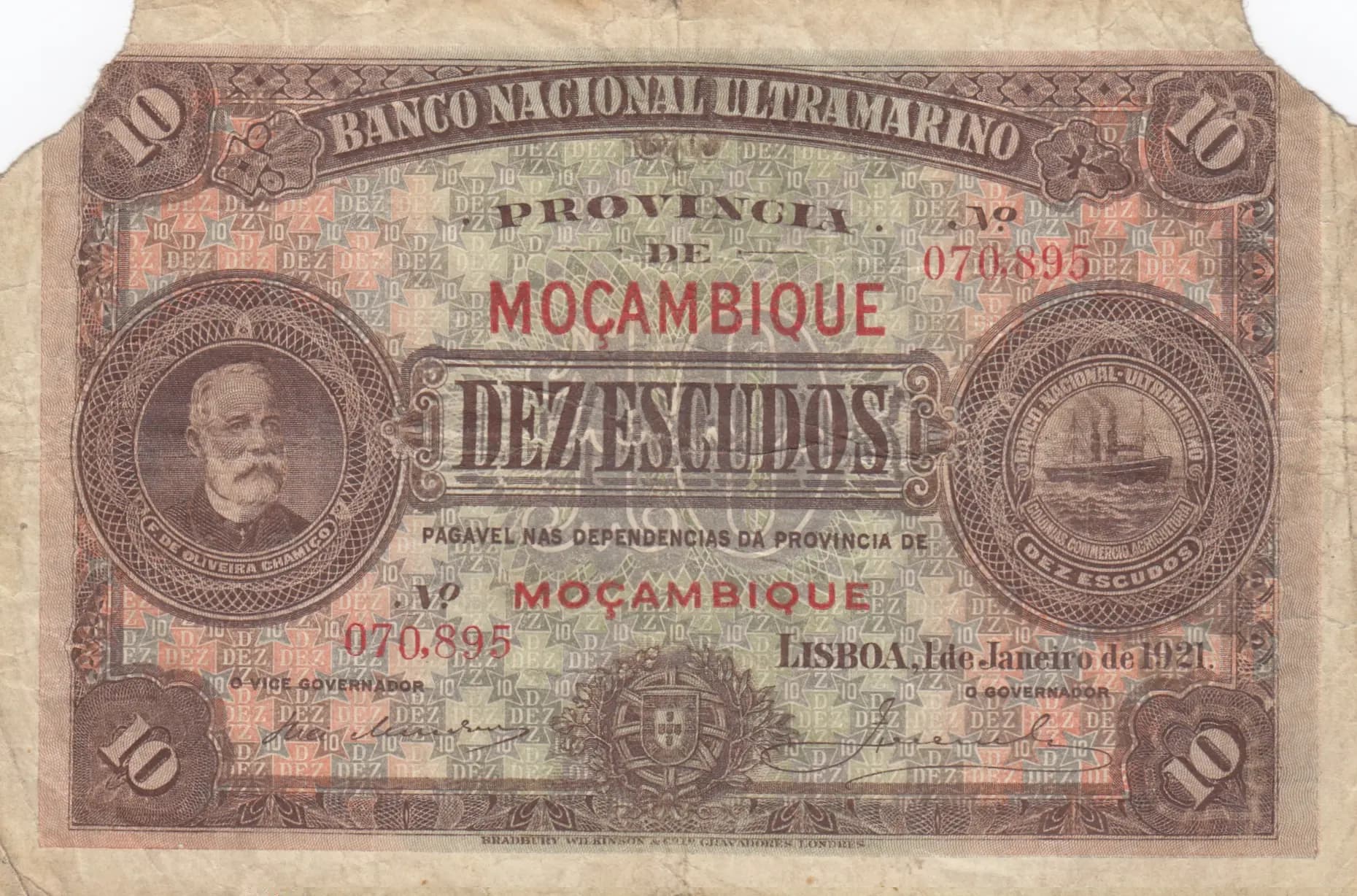
This Mozambique 10 Escudos from 1921 (Pick P-69b) is a classic example of Portuguese colonial-era currency featuring ornate intaglio engraving by Bradbury Wilkinson of London. The note displays the characteristic brown-violet coloring on multicolor underprint with portraits in circular medallions and depicts both historical Portuguese colonial officials and maritime imagery reflecting Mozambique's economic importance. In Good (G) condition, this note shows significant age-related wear including creasing, fading, and browning consistent with over a century of circulation, yet remains legible with intact security printing details.
Common. The eBay market data shows similar graded examples (VG condition) selling for approximately $13.50 with moderate bidding activity (9 bids), and 2016 catalog values for Good condition are listed at $17.50. These relatively modest prices indicate steady but unremarkable demand in the collector market. The note was issued in reasonable quantities by the Banco Nacional Ultramarino as regular currency for a major colonial territory, and multiple examples survive in collections today. The PMG population report shows at least one cataloged variant, suggesting the note is neither extremely rare nor subject to heavy collector demand based on scarcity.
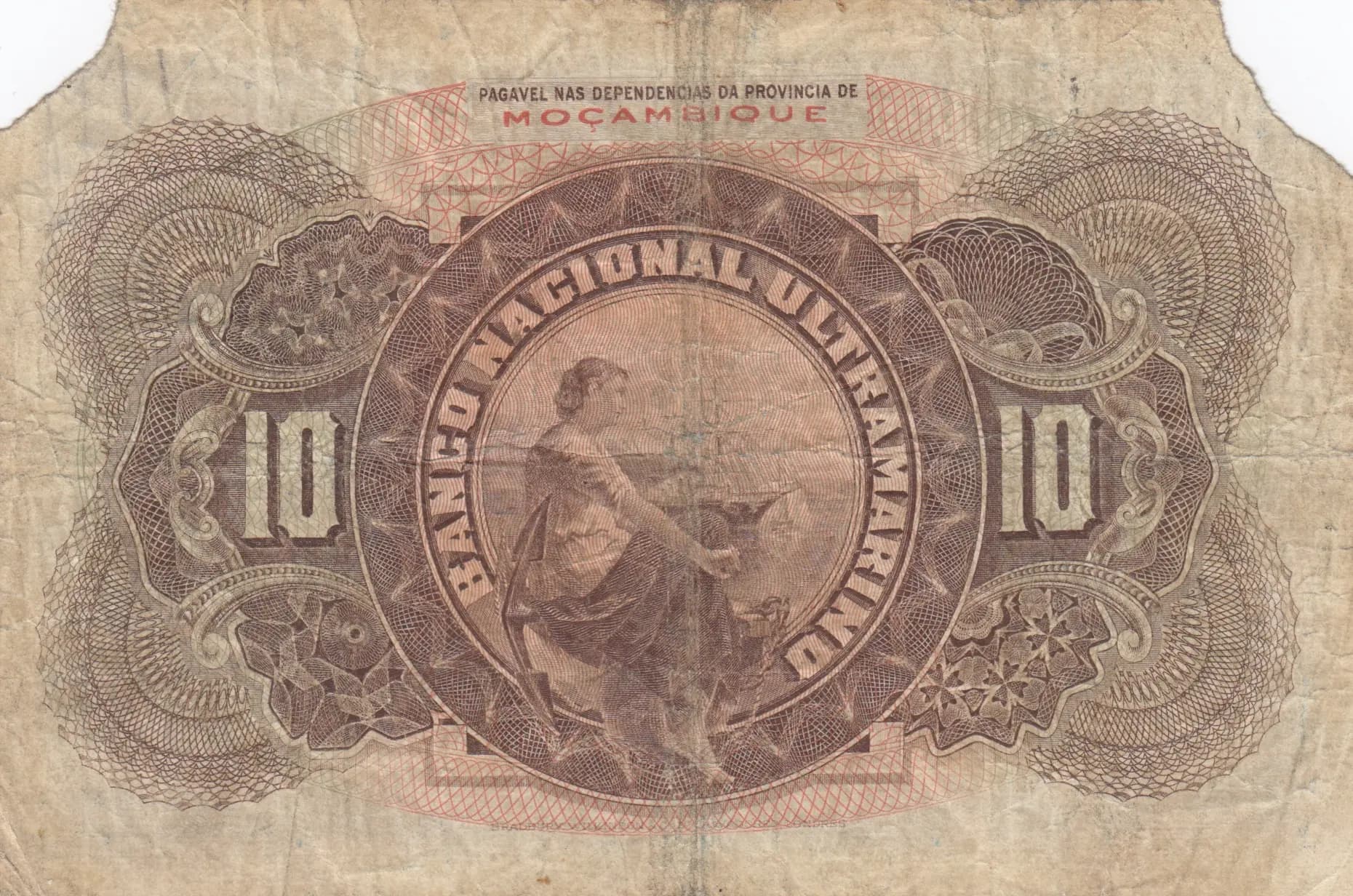
Issued on January 1, 1921, by the Banco Nacional Ultramarino (National Overseas Bank), this note represents the Portuguese colonial monetary system in Mozambique during the early 20th century. The maritime imagery (sailing ships) and allegorical woman depicted on the reverse reflect the province's strategic importance as a trading hub and colonial possession. The dated inscription 'LISBOA, 1º de Janeiro de 1921' and vice-governor/governor signatures underscore the centralized control of colonial finance from Lisbon.
The obverse features a formal colonial design with the left circular medallion containing a portrait of a bearded Portuguese colonial official (likely Francisco de Oliveira Chamico as identified in catalog data), while the right medallion depicts a full-rigged sailing ship symbolizing maritime trade. The reverse displays a large central circular portrait of a bearded gentleman in right-facing profile, surrounded by an ornate radiating line design creating depth and security features. The note employs classical Portuguese heraldic elements including the shield/coat of arms at bottom center of the obverse. The entire design is framed by intricate ornamental borders featuring floral and geometric patterns typical of high-security banknote engraving. The denomination '10' appears in all four corners of both sides. A continuous background security pattern of repeated 'DEZ' (Ten) text covers the obverse.
FRONT SIDE: 'BANCO NACIONAL ULTRAMARINO' (National Overseas Bank) — issuing authority; 'PROVINCIA Nº 070.895' (Province No. 070.895) — provincial designation; 'MOCAMBIQUE' (Mozambique) — territory name in red; 'DEZESCUDOS' (Ten Escudos) — denomination; 'PAGAVEL NAS DEPENDENCIAS DA PROVINCIA DE MOCAMBIQUE' (Payable in the dependencies of the province of Mozambique) — payment location stipulation; 'LISBOA, 1º de Janeiro de 1921' (Lisbon, January 1, 1921) — place and date of issue; 'VICE GOVERNADOR' (Vice Governor) — signature title; 'GOVERNADOR' (Governor) — signature title; 'DEZ' (Ten) — repeated in background security pattern. BACK SIDE: 'MOCAMBIQUE' (Mozambique) — in red at top; 'PAGAVEL NAS DEPENDENCIAS DA PROVINCIA DE MOCAMBIQUE' (Payable in the dependencies of the province of Mozambique); 'BANCO NACIONAL ULTRAMARINO' (National Overseas Bank) — on circular frame around central portrait.
Intaglio engraving (steel plate engraving), executed by Bradbury Wilkinson & Co., Ltd. of London — one of the world's premier security printers of the era. The fine line work, detailed portrait rendering, ornate decorative elements, and complex background patterns are all characteristic of intaglio/engraved printing. No additional printing techniques (such as lithography or letterpress) are evident; the security design relies entirely on the precision and complexity of the engraved plates.
Catalog data notes 'signature varieties' for this issue. The Pick P-69b designation indicates this is variant 'b' of the base Pick 69 number, likely representing a signature or date variety. The specific signature lines for 'VICE GOVERNADOR' and 'GOVERNADOR' would vary by issue period. The visual analysis does not provide clear enough detail to identify the exact signature variant, but the January 1, 1921 date and issuing authority details confirm alignment with the P-69b classification. No decree ('Without Decreto') is noted, which may distinguish this from other variants of the 10 Escudos 1921 issue.