10 centavos 1914
Market Prices
15 salesAbout This Note
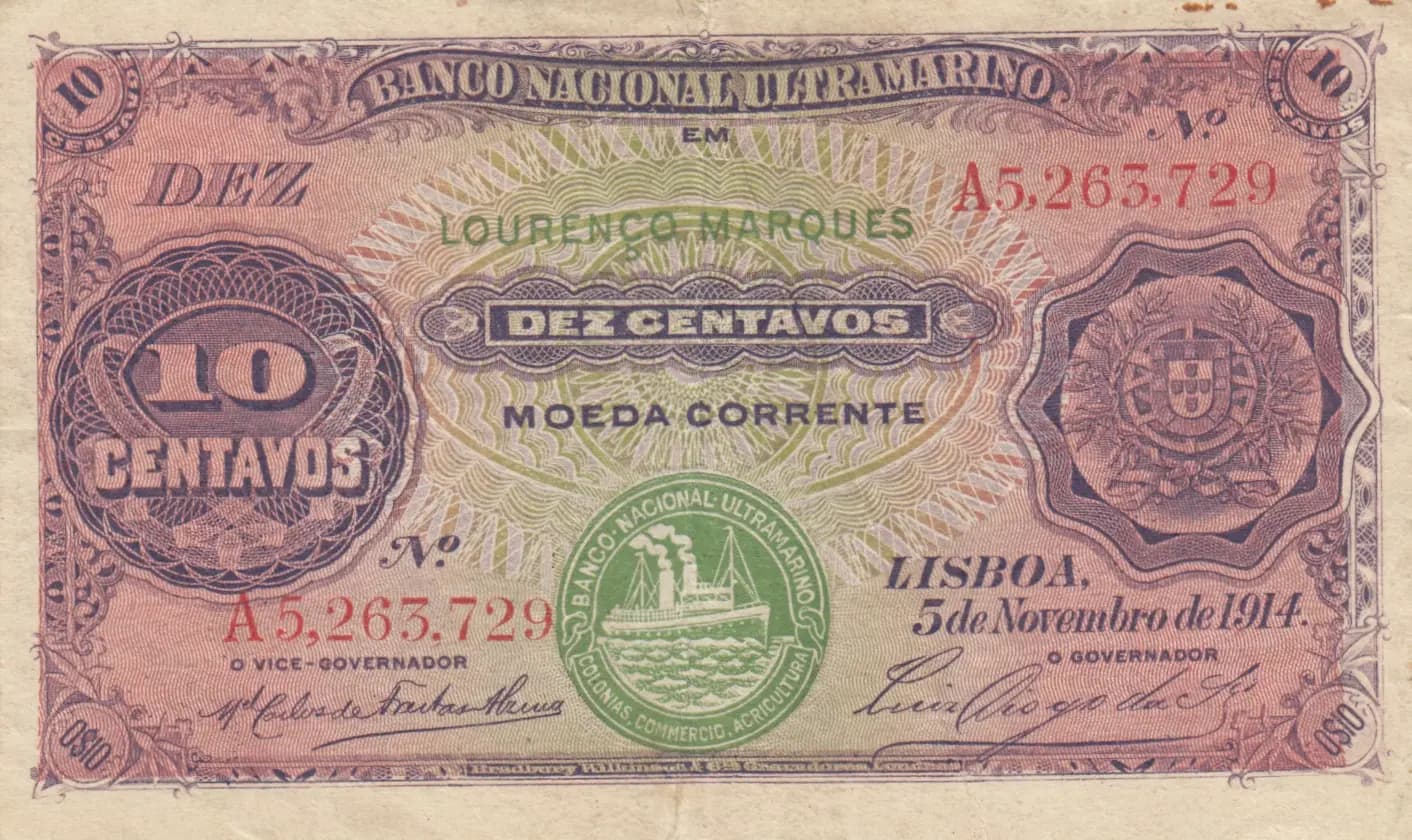
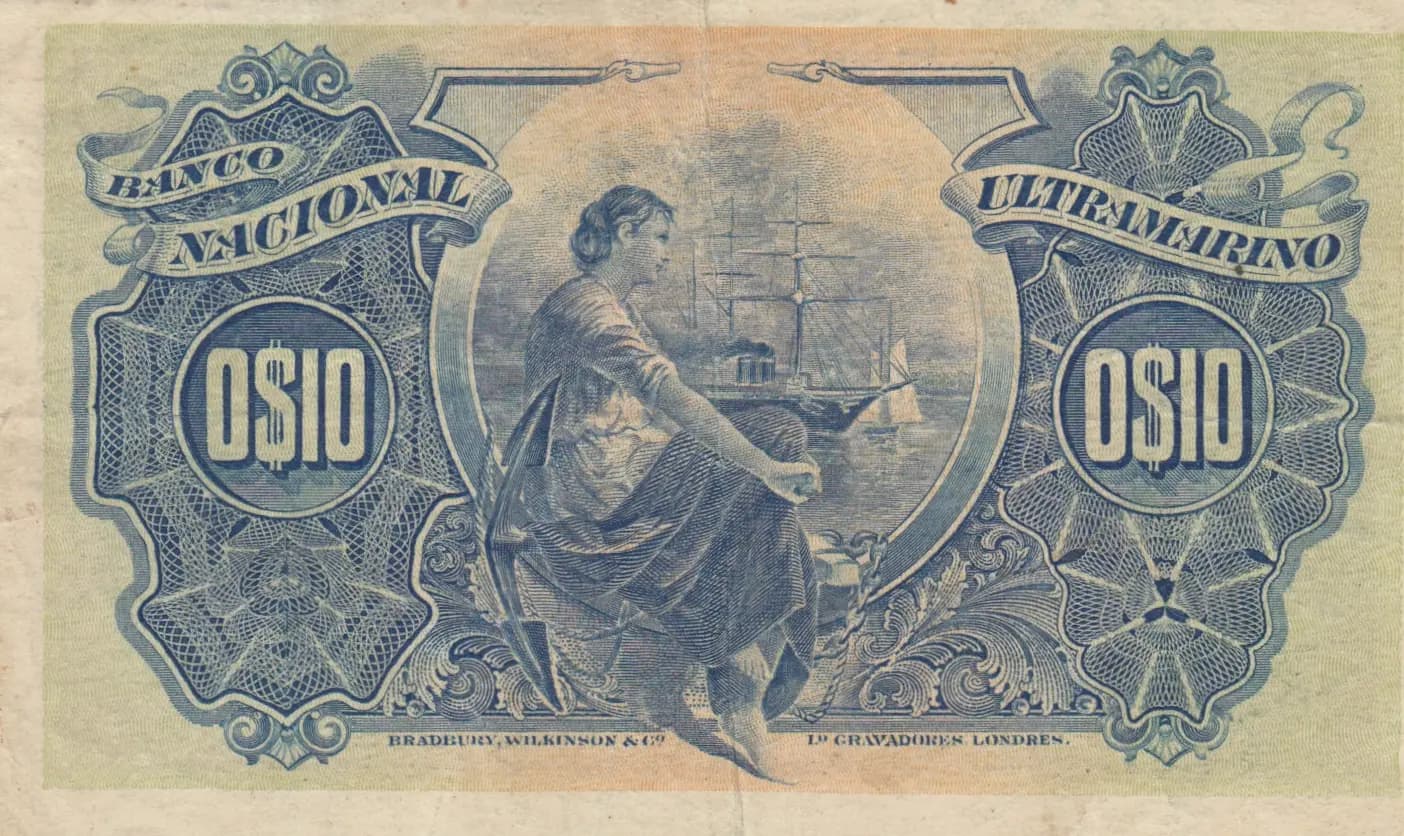
This is a Mozambique 10 Centavos note from 1914, issued by Banco Nacional Ultramarino and printed by the prestigious London engraver Bradbury Wilkinson. The note displays the characteristic purple front with an ornate steamship emblem and elaborate geometric borders, while the reverse features a classical allegorical female figure in maritime dress. The specimen shows honest aging with foxing and yellowing consistent with its over 100-year age, presenting in VF condition with visible patina that collectors of early Portuguese colonial currency find characteristic and desirable.
Common. Secondary market data shows consistent sales of this note type in VF condition ranging from $5 to $13.90 USD over the past decade, with an average selling price around $8-10. The 2016 catalogue value of $7.50 for F grade and $40 for EF grade is consistent with typical pricing for early 20th-century colonial Portuguese notes in common denominations. The PMG population report indicates this variety (without counterfoil) has minimal professional grading activity, typical of affordable common notes that collectors do not typically submit for certification. Print runs for Banco Nacional Ultramarino notes were substantial given the colonial administration's currency needs, and no evidence of scarcity, recall, or limited issue exists.
This note represents Portugal's monetary authority in Lourenço Marques (modern Maputo), Mozambique during the twilight of the Portuguese Empire's colonial administration. The steamship imagery and allegorical 'Commerce' or 'Navigation' figure on the reverse reflect the importance of maritime trade to Portugal's overseas territories in the early 20th century. The 1914 date places this note at the onset of World War I, a period when Portugal's colonial finances were increasingly strained.
The obverse features a formal colonial Portuguese design centered on a prominent circular emblem containing a steamship (Seal Type III), symbolizing maritime commerce and Portugal's naval heritage. The denomination '10' appears in ornate circular medallions at both left and right borders in purple and yellow-green. The coat of arms of Portugal or Mozambique administration occupies the right side. The reverse depicts an allegorical female figure (representing Commerce, Navigation, or Prosperity) seated in classical draped garments, holding surveying or maritime instruments, positioned against a background showing sailing ships and architectural maritime elements. Decorative cartouches frame the denomination 'O$IO' on both sides. The entire composition uses fine-line engraving with multi-color printing (purple/mauve on obverse, blue on reverse) typical of high-security currency production of the Edwardian era.
FRONT: 'Banco Nacional Ultramarino' (National Overseas Bank) | 'Lourenço Marques' (Place of issue, modern Maputo) | 'Deez Centavos' (Ten Centavos) | 'Moeda Corrente' (Current Currency/Legal Tender) | 'Centavos' (denomination) | 'Lisboa, 5 de Novembro de 1914' (Lisbon, November 5, 1914 - official date) | Serial number 'A 5,265,729' | 'O Vice-Governador' (The Vice-Governor) | 'O Governador' (The Governor). BACK: 'Banco Nacional' (National Bank) | 'Ultramarino' (Overseas) | 'O$IO' (Old notation for 10 Centavos, using Portuguese currency symbol) | 'Bradbury, Wilkinson & Co' (Printer/Engraver) | 'Gravadores Londres' (Engravers London). Note: The '1917' visible in the visual analysis may represent a reprint date or internal marking rather than the official issue date of November 5, 1914.
Intaglio engraving (fine-line steel engraving) with multi-color letterpress or chromolithographic printing. The note was produced by Bradbury, Wilkinson & Co, London, one of the world's premier security printers and engravers of the period. The intricate geometric patterns, complex border designs, fine line work throughout, and detailed portraiture are all characteristic of hand-engraved intaglio printing. The multiple color application suggests coordinated multi-plate printing to achieve the purple obverse and blue reverse. The precision and security features indicate state-of-the-art technology for 1914.
This is the P-59 variety specifically: '10 Centavos without counterfoil.' The catalog notation indicates a related variety exists as P-56 (the same note with counterfoil on the left), which was a format used for accountable issues. The serial number prefix 'A' and the November 5, 1914 date confirm the standard issue type. No significant varieties are noted for this Pick number regarding signature combinations, printer marks, or overprints. The visible '1917' marking in the visual analysis requires clarification—it may represent an internal administrative date or later reprint authorization rather than an official variety marker, as the official issue date remains November 5, 1914.