1 escudo 1921
Market Prices
3 salesAbout This Note
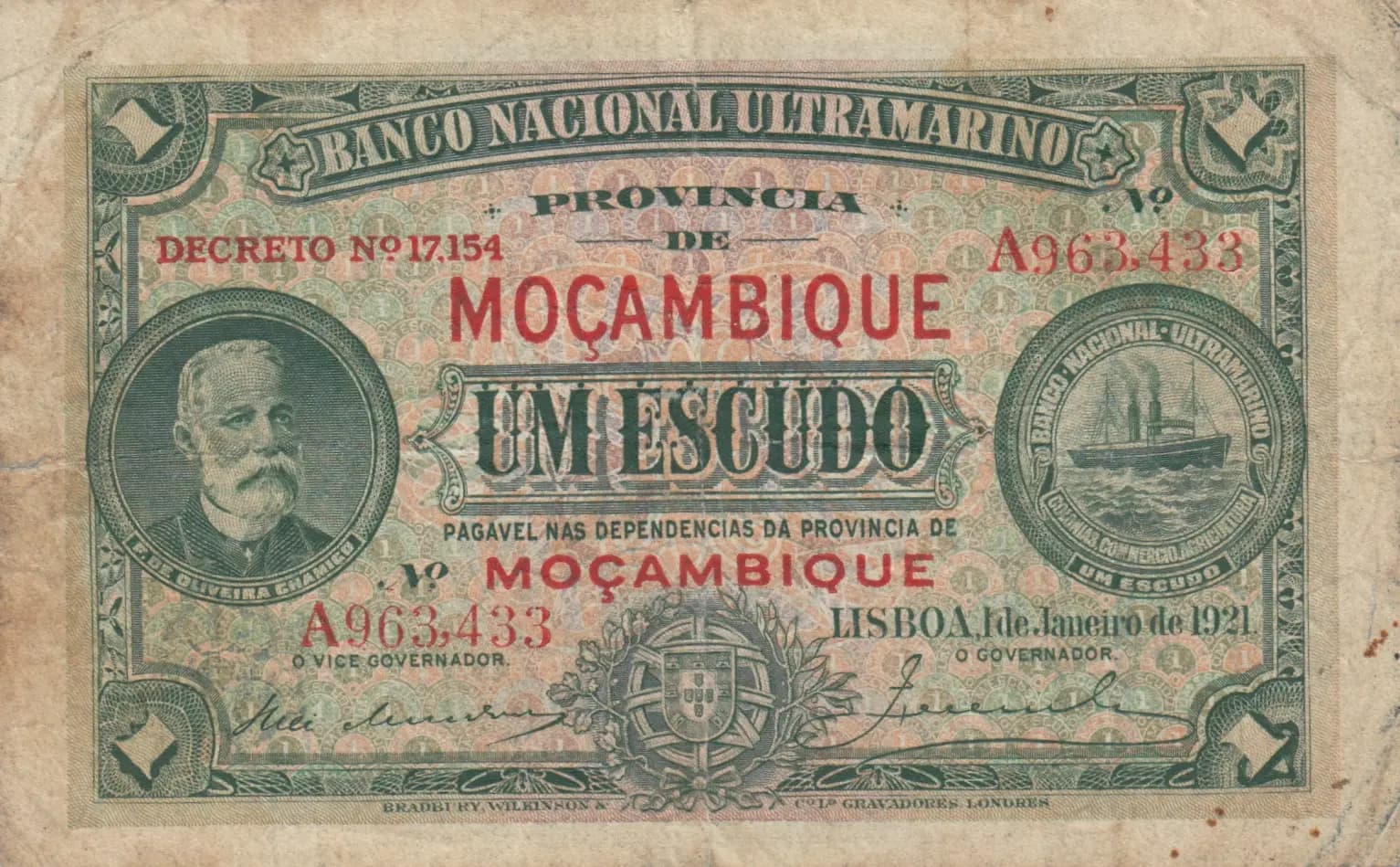
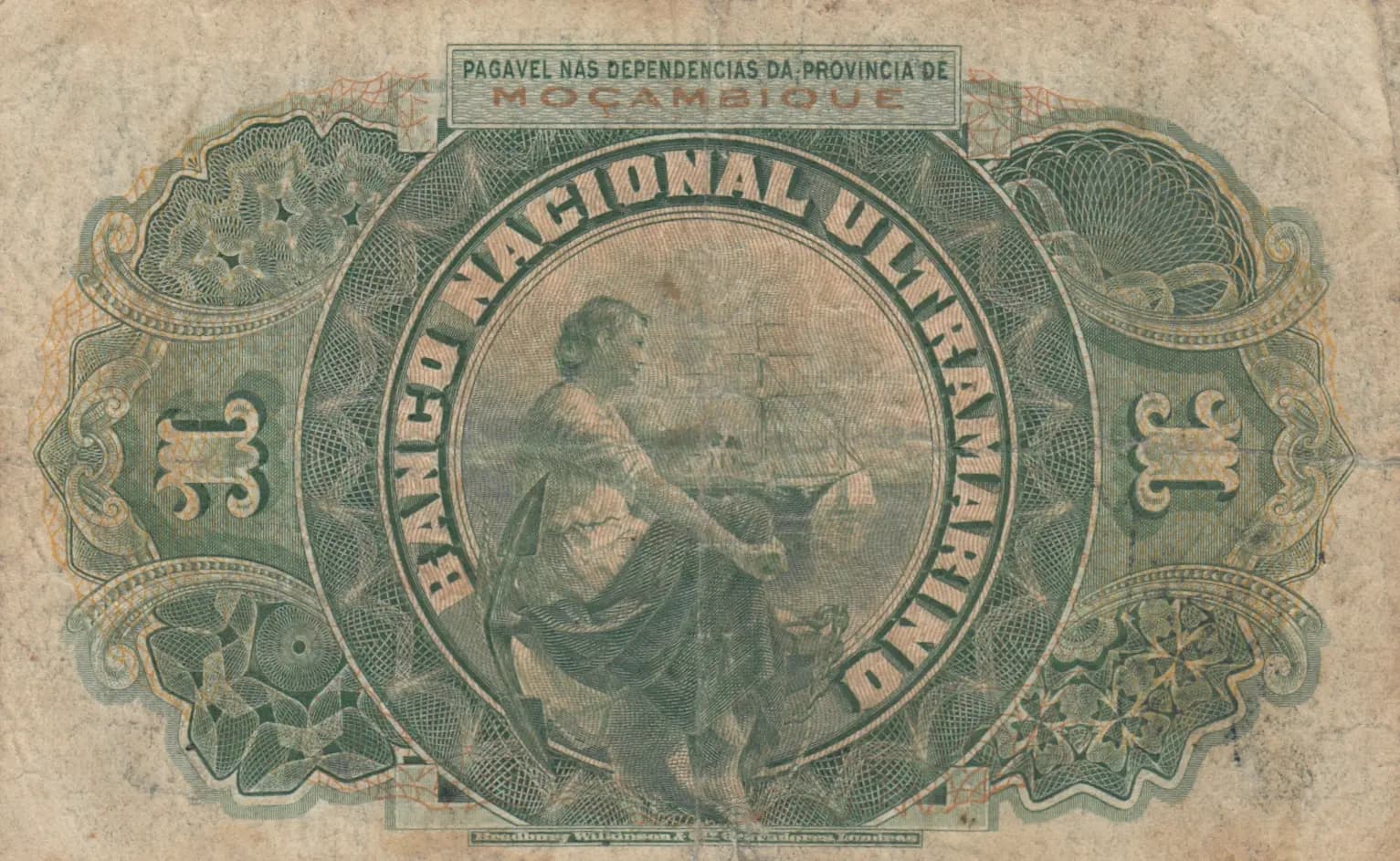
This is a 1921 Mozambique 1 Escudo note issued by Banco Nacional Ultramarino, printed by Bradbury Wilkinson in London. The note displays characteristic early 20th-century Portuguese colonial banknote design with green and multicolor printing, featuring a bearded male portrait on the front and an allegorical figure on the reverse. In Fine condition, the note shows extensive aging with foxing and creasing consistent with over a century of circulation, making it an attractive example of early Mozambique currency.
Common. eBay sales data shows notes in Fine condition selling for $18.59 to $21.51 in recent decades, with catalog values at $35 for F grade (2016). The note was issued in 1921 with multiple signature varieties (P-66a and P-66b known), indicating a reasonably substantial print run. There is no evidence of short-lived issuance, recall, or extreme scarcity. The denomination (1 Escudo) and widespread catalog availability confirm this as a standard issue of the Banco Nacional Ultramarino.
This note was issued under Decreto No. 17,154 dated January 1, 1921, during the Portuguese Republic period when Mozambique was administered as a province of the Portuguese colonial empire. The Banco Nacional Ultramarino served as the central financial institution for Portuguese overseas territories, and this denomination represents the monetary system used in Mozambique during the early republican era. The coat of arms and Portuguese heraldic symbols prominently displayed on the front underscore the colonial administrative structure of the territory at this time.
The front features an ornate border with geometric and floral patterns in green, with two circular medallion frames: the left contains a portrait of a bearded male figure (likely a Portuguese official or historical figure associated with the colony), and the right contains a maritime vessel, reflecting Mozambique's importance as a coastal trading territory. A Portuguese coat of arms with heraldic shield design is centered in the lower portion. The back displays a large central circular medallion containing a profile portrait of a historical figure in formal 19th/early 20th-century dress, flanked by ornamental scrollwork and allegorical design elements. The composition emphasizes Portuguese authority and maritime commerce, which were central to colonial administration.
Front Side: 'BANCO NACIONAL ULTRAMARINO' (National Overseas Bank); 'DECRETO Nº17,154' (Decree No. 17,154); 'PROVÍNCIA DE MOÇAMBIQUE' (Province of Mozambique); 'UM ESCUDO' (One Escudo); 'PAGAVEL NAS DEPENDÊNCIAS DA PROVINCIA DE MOÇAMBIQUE' (Payable in the Dependencies of the Province of Mozambique); 'O VICE GOVERNADOR' (The Vice Governor); 'O GOVERNADOR' (The Governor); 'LISBOA, 1ª de Janeiro de 1921' (Lisbon, January 1st, 1921); 'PERREY, WILKINSON' and 'LÓ GRAVADORES LONDRES' (Engravers London). Back Side: 'PAGAVEL NAS DEPENDÊNCIAS DA PROVINCIA DE MOÇAMBIQUE' (Payable in the Dependencies of the Province of Mozambique); 'REPÚBLICA PORTUGUESA ULTRAMARINO' (Portuguese Republic Overseas). Serial number observed: A963,433.
Intaglio engraving (line engraving and steel plate printing) produced by Bradbury Wilkinson & Co. (BWC), a renowned British security printer based in London. The fine line work, cross-hatching, detailed portraits, and intricate geometric patterns visible throughout both sides are characteristic of intaglio printing technology. The security features include complex engraved borders, fine-line work in backgrounds, and detailed portrait engraving, all standard for high-security banknote production of the period.
This note is cataloged as Pick P-66a. The catalog notes signature varieties exist for this issue (P-66a and P-66b variants documented by PMG, with P-66s representing specimen notes). The observed serial number A963,433 and the specific signature combination would determine the exact variety. All variants were printed by Bradbury Wilkinson & Co., London (BWC). The consistent design across variants and absence of overprints suggest this is a standard circulation variety rather than a rare emergency or provisional issue.