50 pesos 1889
About This Note
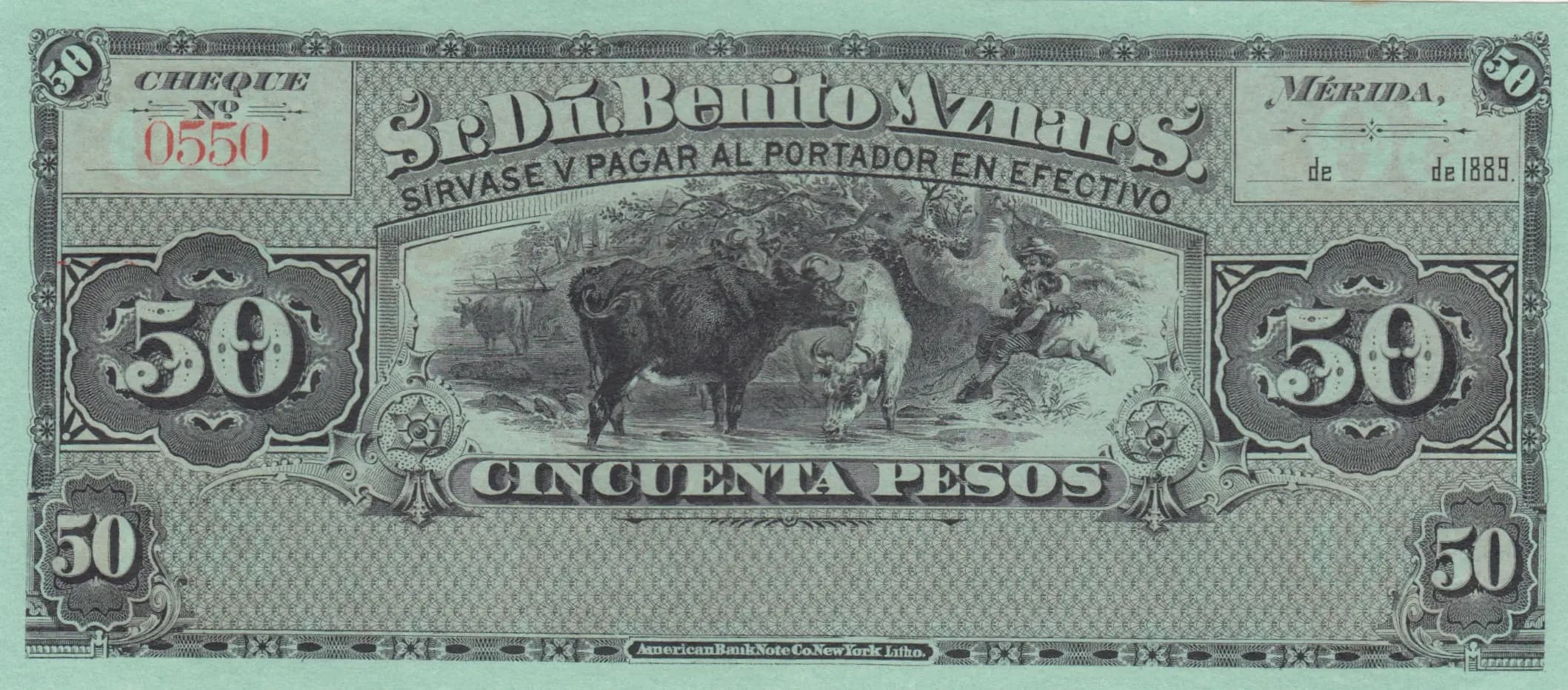
This is an exceptional 1889 Mexican 50 pesos note issued by Sr. Dn. Benito Aznar in Mérida, representing a fascinating piece of regional Mexican financial history. The note features a striking pastoral scene depicting cattle and a figure in period dress on the obverse, with ornate decorative borders in greenish-blue and reddish-pink inks on the reverse. In uncirculated condition with sharp printing and pristine appearance, this unlisted Pick number note showcases fine engraved artistry by American Bank Note Company and represents an important example of 19th-century Mexican regional currency.
Scarce. While the catalog lists this as Pick-unlisted (not in the standard Pick catalog), the specific issuer (Sr. Dn. Benito Aznar of Mérida) and the 1889 date suggest this was a limited regional issue. Regional Mexican banknotes from this period, particularly those from private or local authority issuers rather than the national government, typically had smaller print runs and lower survival rates than national currency. The fact that this note is not cataloged by Pick and appears to be a private financial instrument or regional emergency currency further supports a scarce rating. However, without documented print run information or comparative market data, a conservative assessment places this as scarce rather than very rare.
This note was issued during a period of regional financial autonomy in Mexico, when private individuals and local authorities could issue their own banknotes. The Mérida location and the pastoral agricultural imagery reflect the Yucatán Peninsula's economy during the late 19th century, while the reference to Benito Juárez (visible on the obverse) connects the note to Mexico's post-Reform period and the stabilization efforts following the French intervention. The 1889 date places this note near the end of the Porfirian era, when Mexico was undergoing modernization and foreign investment, as evidenced by the use of American Bank Note Company for printing.
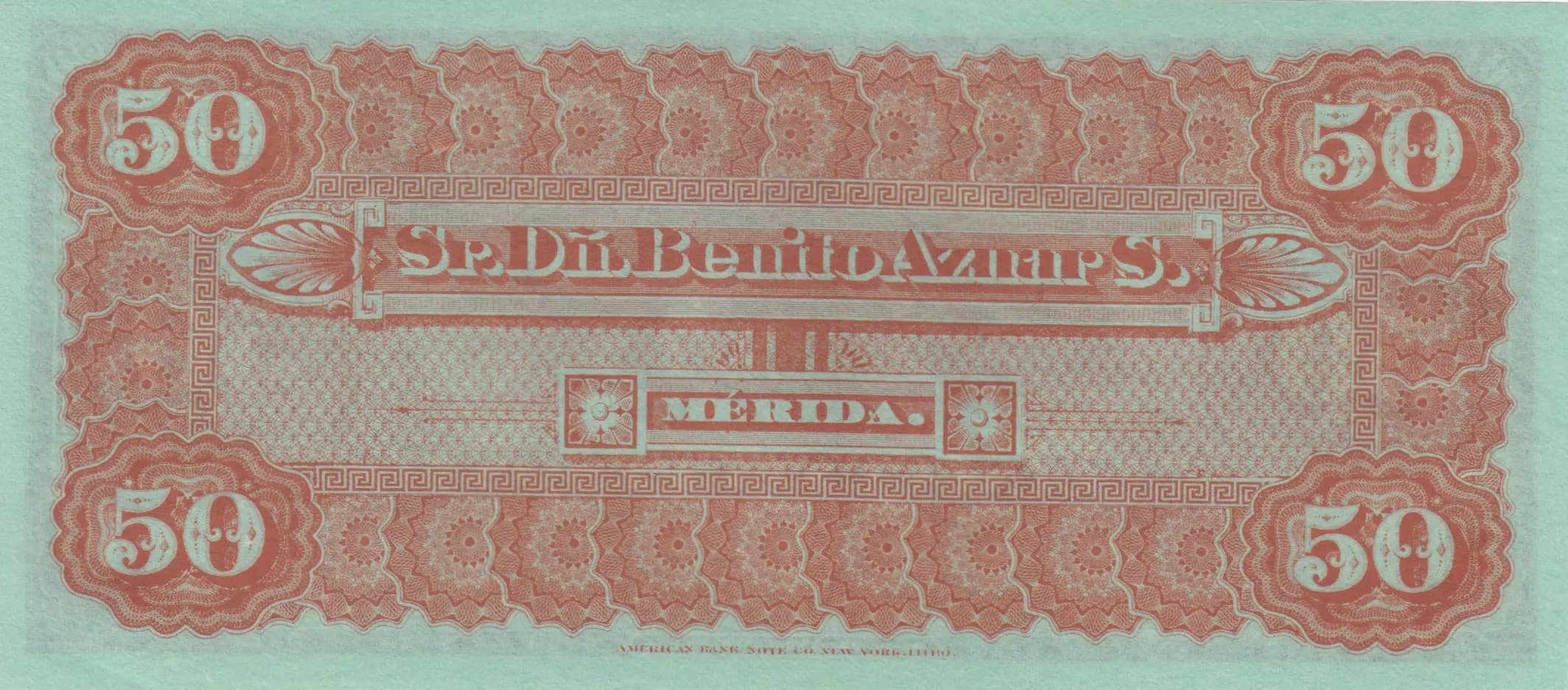
The obverse features an ornate frame design with the denomination '50' prominently displayed in decorative corner medallions. The central vignette depicts a pastoral agricultural scene with cattle and a human figure in period clothing, symbolizing the region's pastoral economy and labor. The note employs a greenish-blue color scheme with black engraved details. The reverse presents a more formal design with the denomination '50' repeated in all four corners within elaborate decorative frames featuring shell or fan motifs and Greek key pattern borders. The reverse uses a reddish-pink color scheme with red and black inks. Both sides display fine engraved ornamentation typical of American Bank Note Company's high-security work, with intricate geometric and floral patterns serving as anti-counterfeiting measures. The text bands identify the issuer as Sr. Dn. Benito Aznar and locate the note in Mérida.
OBVERSE: 'CHEQUE No 0550' (Check No 0550), 'MERIDA' (Mérida), 'de 1889' (of 1889), 'Benito Juárez' (Benito Juárez), 'SIRVASE PAGAR AL PORTADOR EN EFECTIVO' (Please pay the bearer in cash), 'CINCUENTA PESOS' (Fifty pesos), 'American Bank Note Co. New York. Litho.' (American Bank Note Co. New York. Lithography). REVERSE: '50' (numerical denomination), 'Sr. Dn Benito Azuñas' (Mr. Don Benito Azuñas - note: the catalog lists 'Aznar' but the visual analysis indicates 'Azuñas'), 'MERIDA' (Mérida), '50' (numerical denomination), 'AMERICAN BANK NOTE CO. NEW YORK LITHO' (American Bank Note Co. New York. Lithography).
This note was produced using lithographic engraving, as explicitly stated in the imprints 'Litho.' on both obverse and reverse. The American Bank Note Company of New York executed the work, employing fine line engraving combined with color lithography to create the multi-color security design. The sharp quality of the engraved lines, the fine detail in the pastoral vignette, and the precise decorative borders visible in the uncirculated condition are characteristic of American Bank Note Company's premium security printing techniques of the 1880s-1890s period.
The specific variety is identified by the check number 'CHEQUE No 0550' visible on the obverse, suggesting this may be part of a numbered series of bearer checks or provisional currency. The issuer name on the reverse presents a potential variant reading: the catalog data lists 'Sr. Dn. Benito Aznar S.' while the visual analysis transcribes the reverse as 'Sr. Dn Benito Azuñas'—these may represent different printings or transcription variations that should be verified against the actual note. The lack of Pick catalog listing indicates this variety is outside the standard cataloging system, making detailed variety documentation essential for future reference and valuation. The check number format and the 1889 Mérida location should be noted for any future cataloging attempts.