1 peso 1950
Market Prices
17 salesAbout This Note
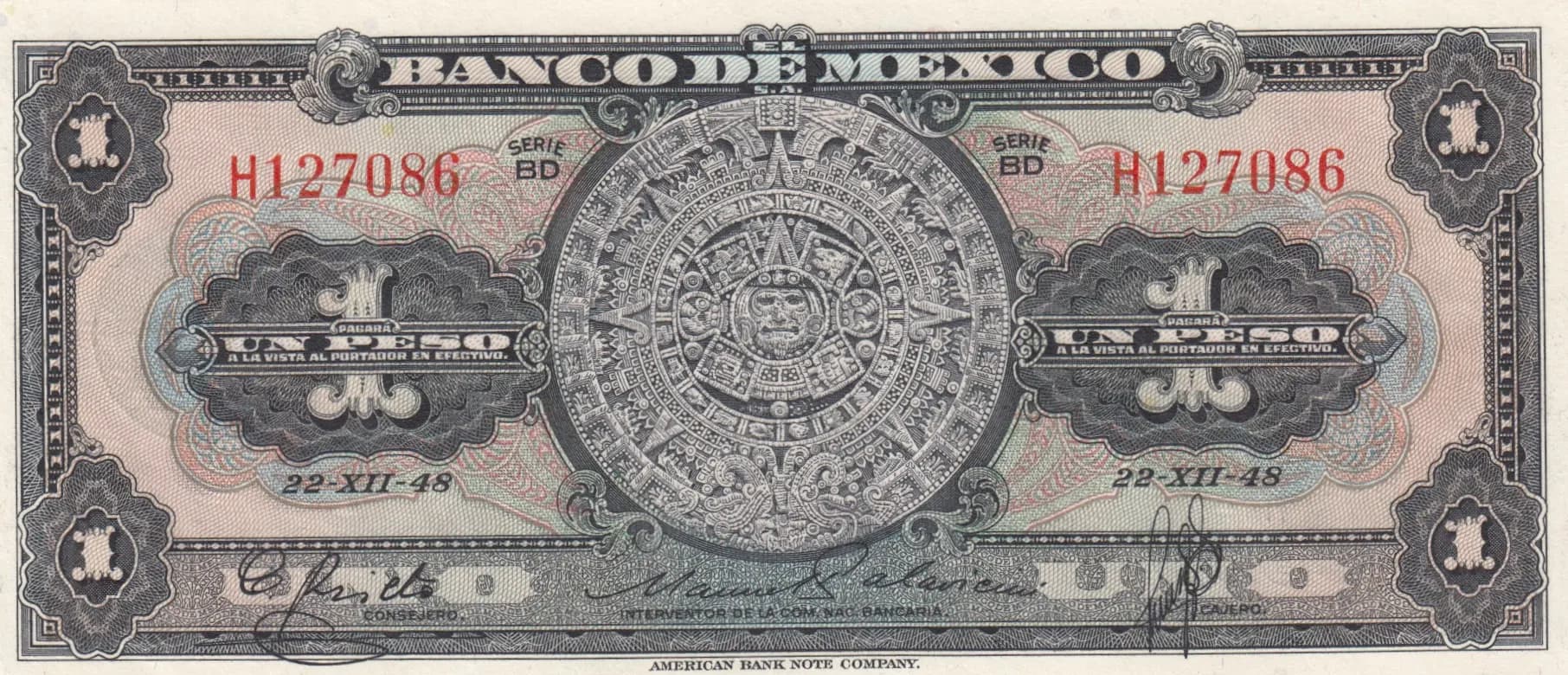
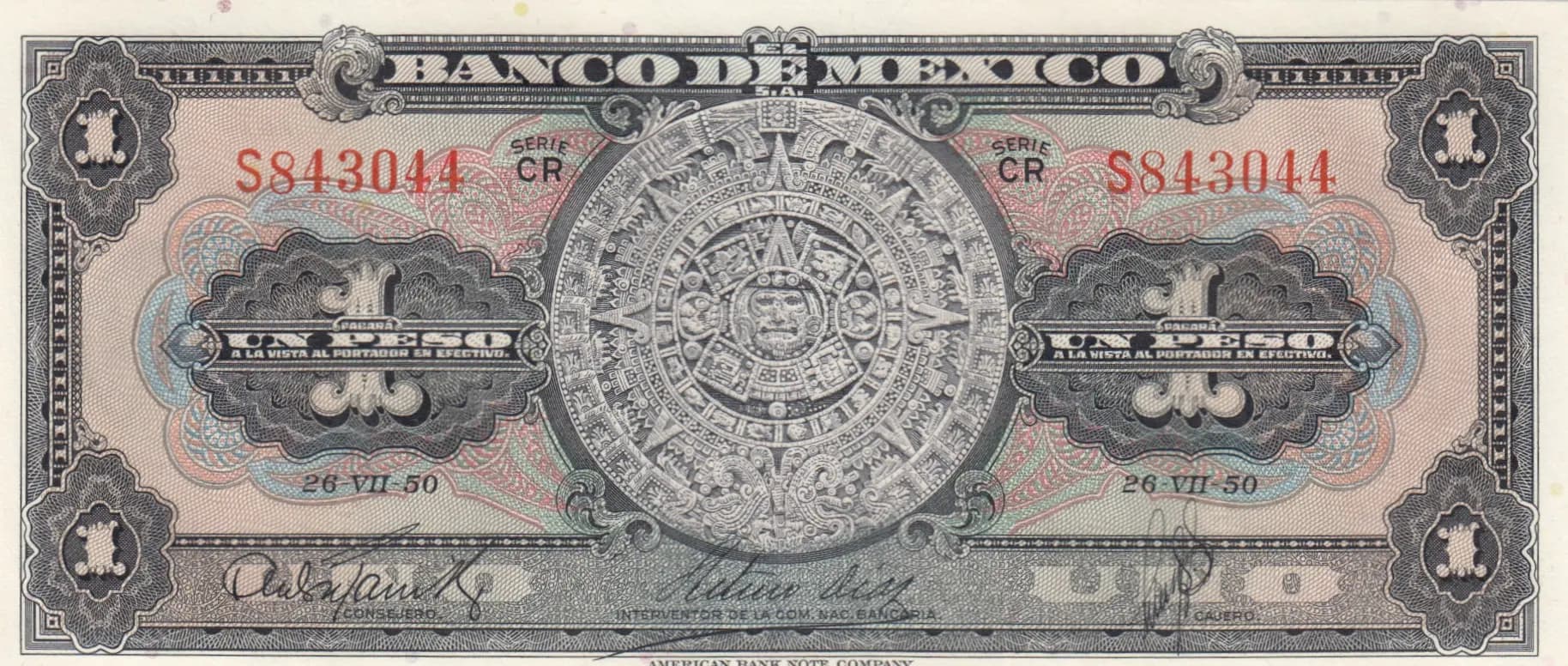
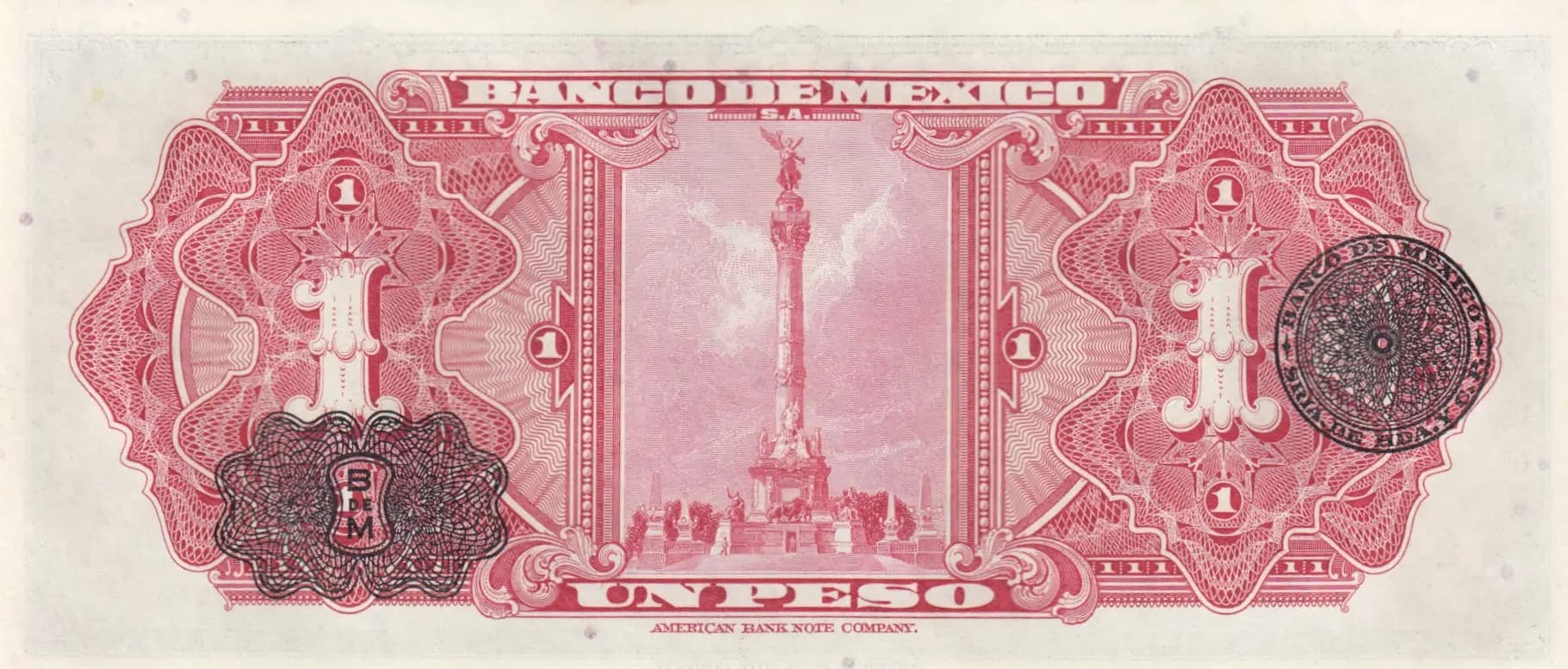
This is a Mexico 1 Peso note from 1950 (Pick P-46b) in Uncirculated condition, featuring the iconic Aztec Sun Stone (calendar) on the obverse and Mexico City's Angel of Independence monument on the reverse. The note displays excellent print quality with intricate multi-color engraving in beige/cream and pink/magenta tones, produced by the American Bank Note Company. This catalog-graded specimen represents a classic mid-20th century Mexican currency issue with strong collector appeal due to its historical imagery and technical execution.
Common. Market data from realbanknotes.com indicates robust trading activity across multiple condition grades (VG through UNC), with UNC specimens selling consistently in the $3.50–$6.10 range during the 2013–2020 period, and more recent sales (2022–2024) in the $1.29–$2.26 range for VF grades. The 2016 catalog value for UNC was only $4, consistent with common-grade pricing. While PMG-certified examples (particularly high grades 65–67) have commanded premium prices ($17.50–$96.15), the overall supply and demand pattern indicates this is a regularly encountered issue without significant scarcity. No recall or short production run is documented for this Pick number.
Issued on July 26, 1950, this banknote commemorates Mexico's post-revolutionary identity through its prominent Aztec calendar motif and the Angel of Independence monument—both symbols of Mexican national pride and constitutional governance. The date corresponds to Mexico's mid-century period of political stability and economic development under the PRI, when the Central Bank reasserted control over currency design and security. The American Bank Note Company's involvement reflects Mexico's continued reliance on established international security printers to produce high-quality currency during this era.
The obverse features a detailed engraved representation of the Aztec Sun Stone (Calendario Azteca), the monolithic calendar sculpture from pre-Columbian Mexico, centrally positioned and surrounded by ornate floral and heraldic corner medallions. Constitutional eagles appear in decorative cartouches on the left and right. The reverse depicts Mexico City's most iconic landmark, the Angel of Independence monument (Monumento a la Revolución area monument), rendered as a tall columnar structure with urban cityscape elements, framed by symmetrical floral baroque-style borders and constitutional eagle emblems. Two circular security stamps/validation seals are visible overlaying the reverse, suggesting specimen status. The color scheme employs cream/beige on the obverse and pink/magenta on the reverse—a distinctive aesthetic hallmark of 1950s Mexican currency.
FRONT SIDE: 'BANCO DE MEXICO' (Bank of Mexico) — institutional issuer; 'UN PESO' (One Peso) — denomination; 'SERIE CR' (Series CR) — series designation; 'S843044' — serial number; '26 VII 50' (July 26, 1950) — official issue date; 'LA VISTA AL PORTADORES EN EFECTIVO' (Payable to Bearer on Demand) — legal tender clause; 'AMERICAN BANK NOTE COMPANY' — printer attribution. REVERSE SIDE: 'BANCO DE MEXICO' (Bank of Mexico); 'UN PESO' (One Peso) — denomination repeated; '1' — numeric value designation; 'AMERICAN BANK NOTE COMPANY' — printer attribution.
Intaglio engraving and letterpress printing, executed by the American Bank Note Company. The visual characteristics—fine line work, intricate tonal gradations, complex decorative borders, and precise multi-color registration—are consistent with high-security intaglio production standards of the era. The use of two distinct color palettes per side (beige/black/red obverse; pink/white/black/red reverse) indicates multiple printing passes with careful registration control.
Series CR is identified in the visual analysis. The serial number S843044 is visible on this specific specimen. Pick P-46b designation suggests this is the second listed variety for the 1950 1-Peso issue; variations typically involve series letters, watermark types, or signature combinations. The presence of two circular security stamps on the reverse indicates this may be a specimen or validation copy rather than a standard circulation issue, which could represent a distinct sub-variety. Further examination of series designations and comparative specimens would be needed to establish whether S-series notes represent a documented variety.