50 pesos 1910
Market Prices
About This Note
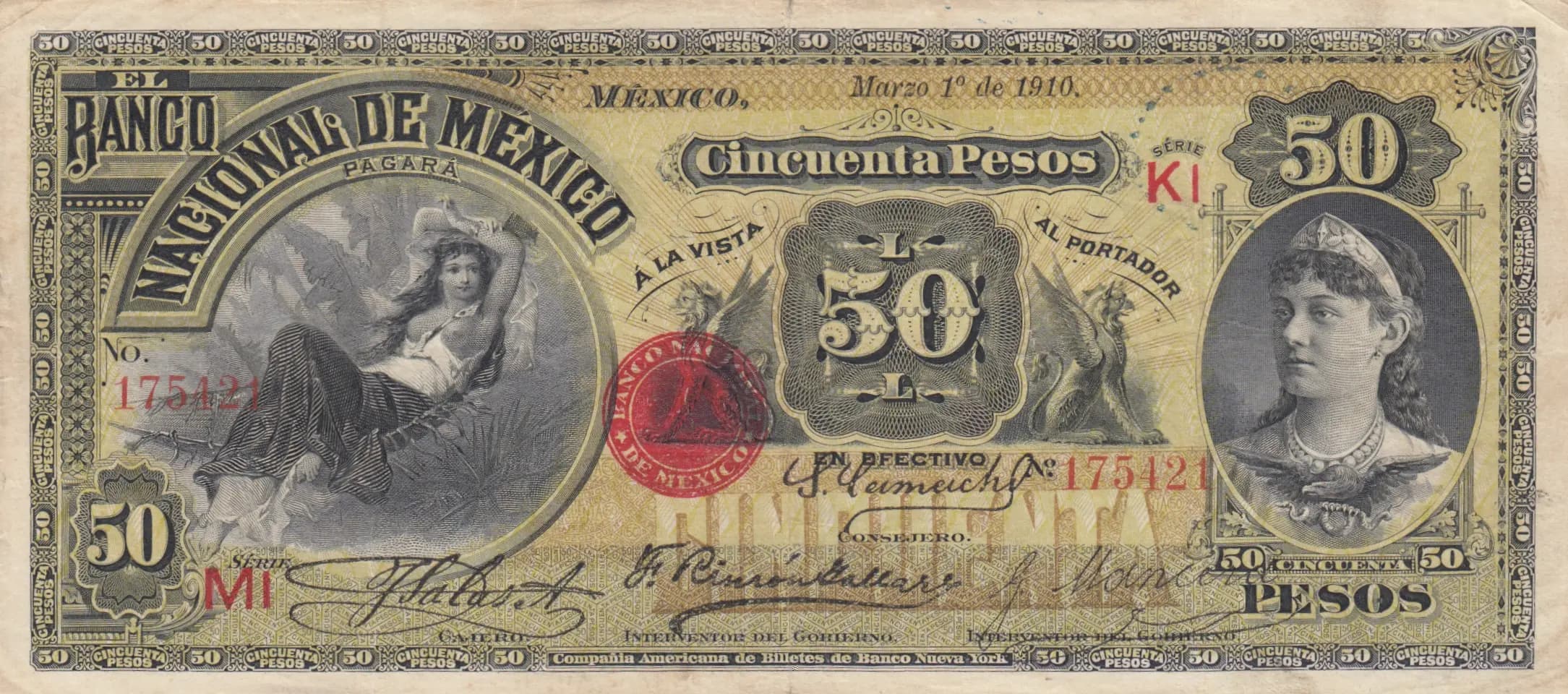
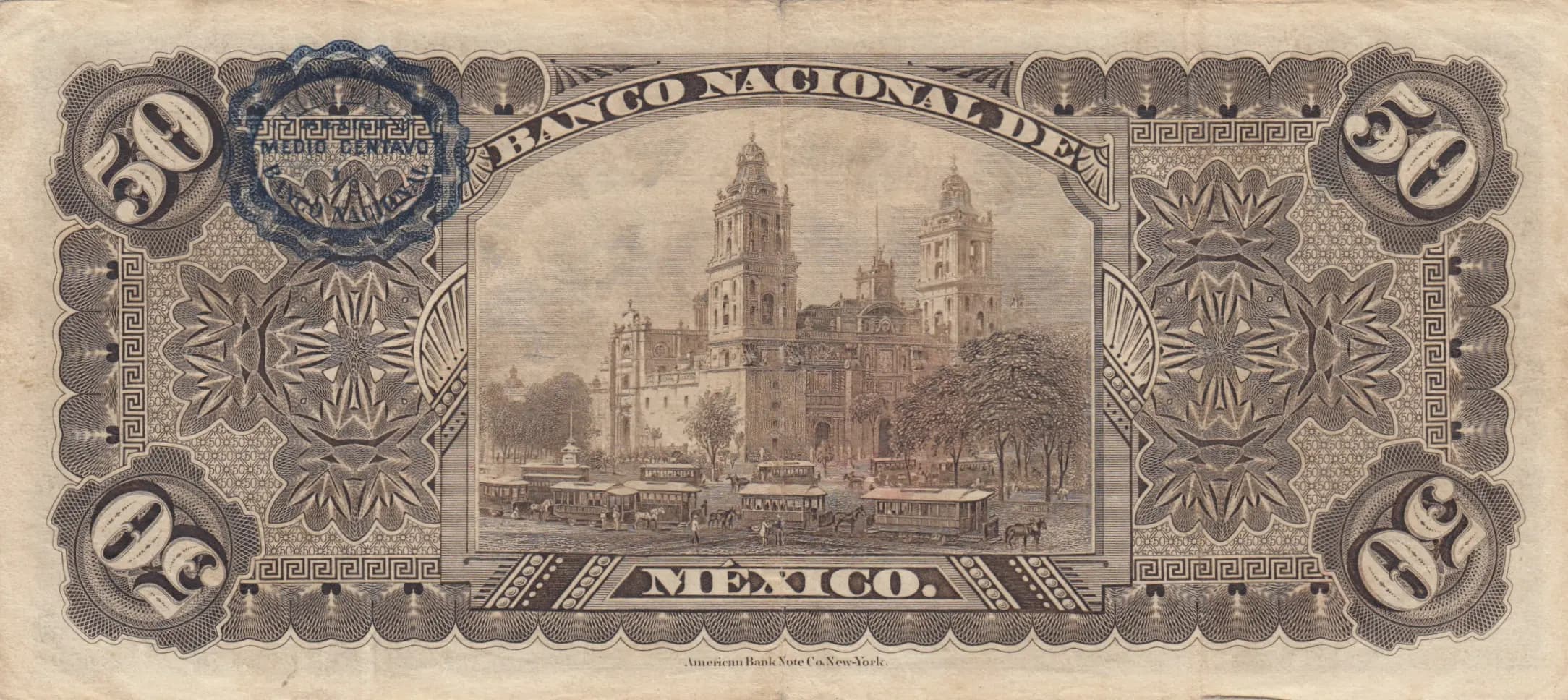
This is a VF-grade 50 pesos banknote issued by Banco Nacional de Mexico on March 1, 1910, during a pivotal moment in Mexican history just as the Mexican Revolution was beginning. The note features classical allegorical imagery including the reclining female figure 'La Siesta' on the obverse and a striking cathedral scene on the reverse, both executed in fine engraved detail by the American Bank Note Company. Despite visible creasing, foxing, and age-related wear consistent with over a century of circulation, the note retains good clarity in its ornate borders, red serial numbers, and architectural details.
Common. The eBay market data provided shows this note type trading frequently across a wide price range ($2.99 to $899.00 USD), with multiple listings at modest prices under $100, indicating substantial availability in the collector market. The print run for this issue (dated 1909-1913 per the catalog) was substantial, and the note circulated widely. PMG has graded multiple varieties of this Pick number (P-S260d, r, s1, s2), suggesting adequate population numbers. In VF condition specifically, this represents a typical circulated example of an early 20th-century Mexican banknote that, while historically interesting, is not difficult to obtain.
This banknote was issued during the final years of Porfirio Díaz's regime, on the eve of the Mexican Revolution (which formally began in May 1910). The allegorical female figures and classical architectural imagery reflect the Porfiriato's emphasis on European artistic sophistication and modernization ideals. The cathedral depicted on the reverse represents Mexico's colonial heritage and religious institutions, imagery designed to convey stability and institutional permanence during a period of significant political and social upheaval.
The obverse features two circular portrait frames: on the left, the allegorical female figure known as 'Pagara' (or 'La Siesta') in classical dress representing payment obligations, and on the right, a female portrait identified as M. García Tereul. The design is dominated by ornate rococo-style borders with repeating '50' denomination markers in the corners, elaborate scrollwork, laurel wreaths, and guilloché patterns in black and red on a tan/cream background. The center contains the Mexican national seal in red. The reverse depicts a grand cathedral or church building with multiple towers and domes, likely representing a significant Mexican ecclesiastical structure, surrounded by a bustling plaza with classical architectural framing. The entire design emphasizes neoclassical and baroque aesthetic elements appropriate to the Porfiriato period's aspirations toward European refinement.
OBVERSE: 'Banco Nacional de Mexico' (National Bank of Mexico) - institutional issuer; 'Pagará' (Will pay); 'Cincuenta Pesos' (Fifty Pesos) - denomination; 'Mexico, Marzo 1º de 1910' (Mexico, March 1st, 1910) - issue date; 'A la vista' (On demand) - payment terms; 'Al portador' (To the bearer) - bearer instrument clause; 'Serie K1' (Series K1); 'No. 175121' / 'Nº 175121' (Serial number); 'En efectivo' (In cash); 'Consejero' (Counselor), 'Intendentes del Gobierno' (Government Superintendents), 'Interventor del Gobierno' (Government Comptroller) - official roles; 'Compañia Americana de Billetes de Banco Nueva York' (American Bank Note Company New York) - printer. REVERSE: 'Banco Nacional de Mexico' (National Bank of Mexico); 'Medio Centavo' (Half cent - likely a misprint or administrative designation); 'Mexico'; 'American Bank Note Co., New York' - printer attribution.
Intaglio engraving (line engraving and steel plate engraving), as evidenced by the fine, detailed border work, guilloché security patterns, and the intricate architectural scene on the reverse. Printed by the American Bank Note Company (ABNC) of New York, one of the world's premier security printers of the era. The combination of black, red, and background colors was applied through multiple passes typical of high-security banknote production. The detailed engraving, complex guilloché patterns, and fine line work throughout the design are characteristic of premium intaglio production standards.
This note is cataloged as Pick P-S260d, one of four documented varieties for this base Pick number. The visual analysis confirms Series K1 with serial number 175121, dated March 1, 1910. The note is printed by ABNC as indicated on both obverse and reverse. The specific variety P-S260d is distinguished from P-S260r, P-S260s1, and P-S260s2 in PMG records, though the visual distinctions between these varieties (likely signature combinations, overprints, or minor design variations) are not definitively identified in the images provided.