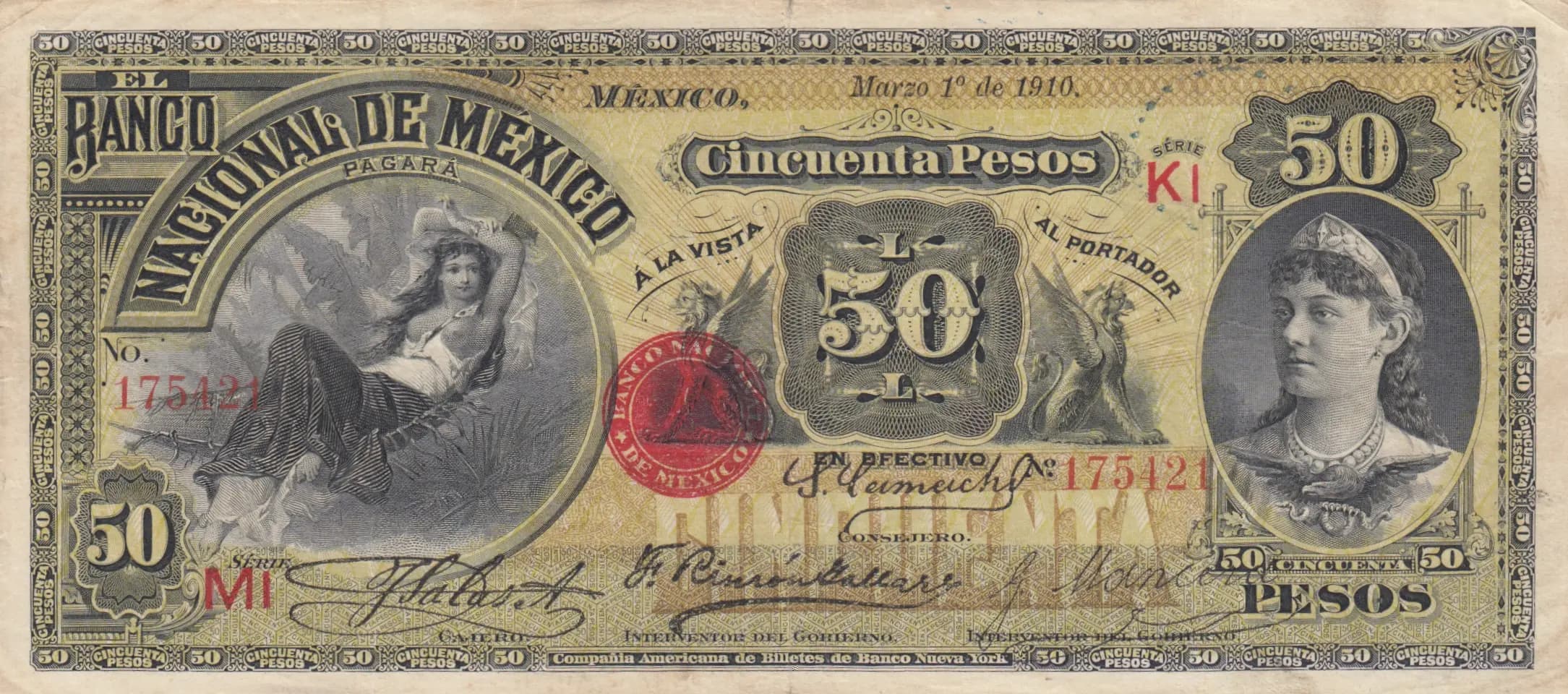
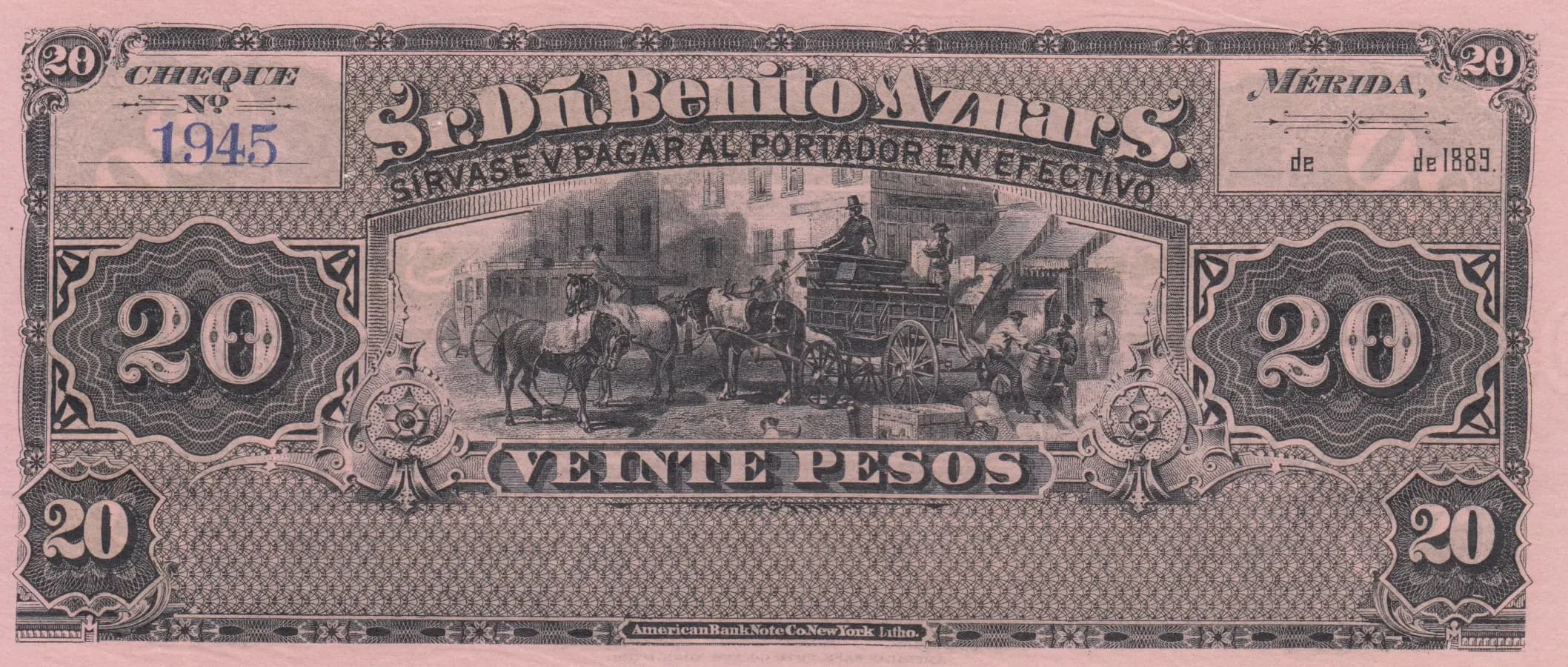
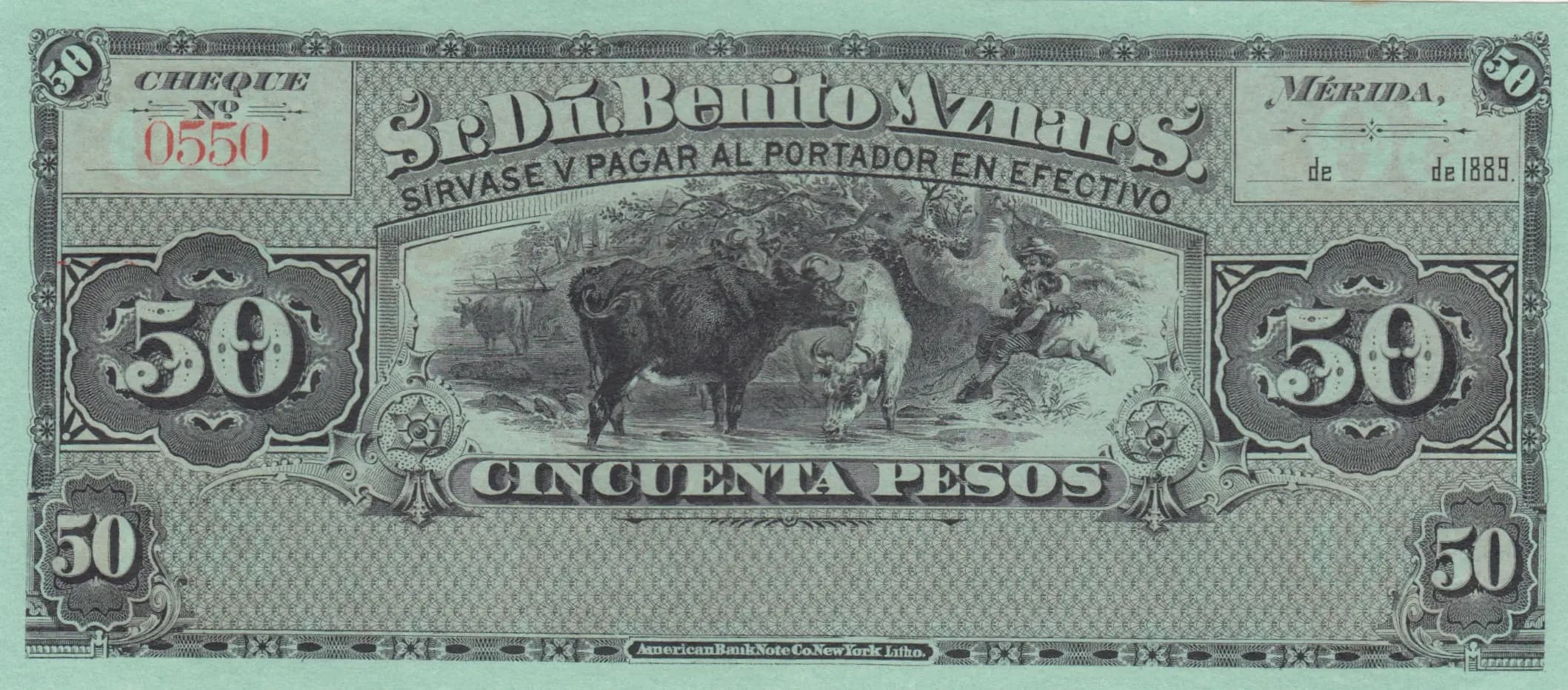
50 pesos 1910
Market Prices
About This Note
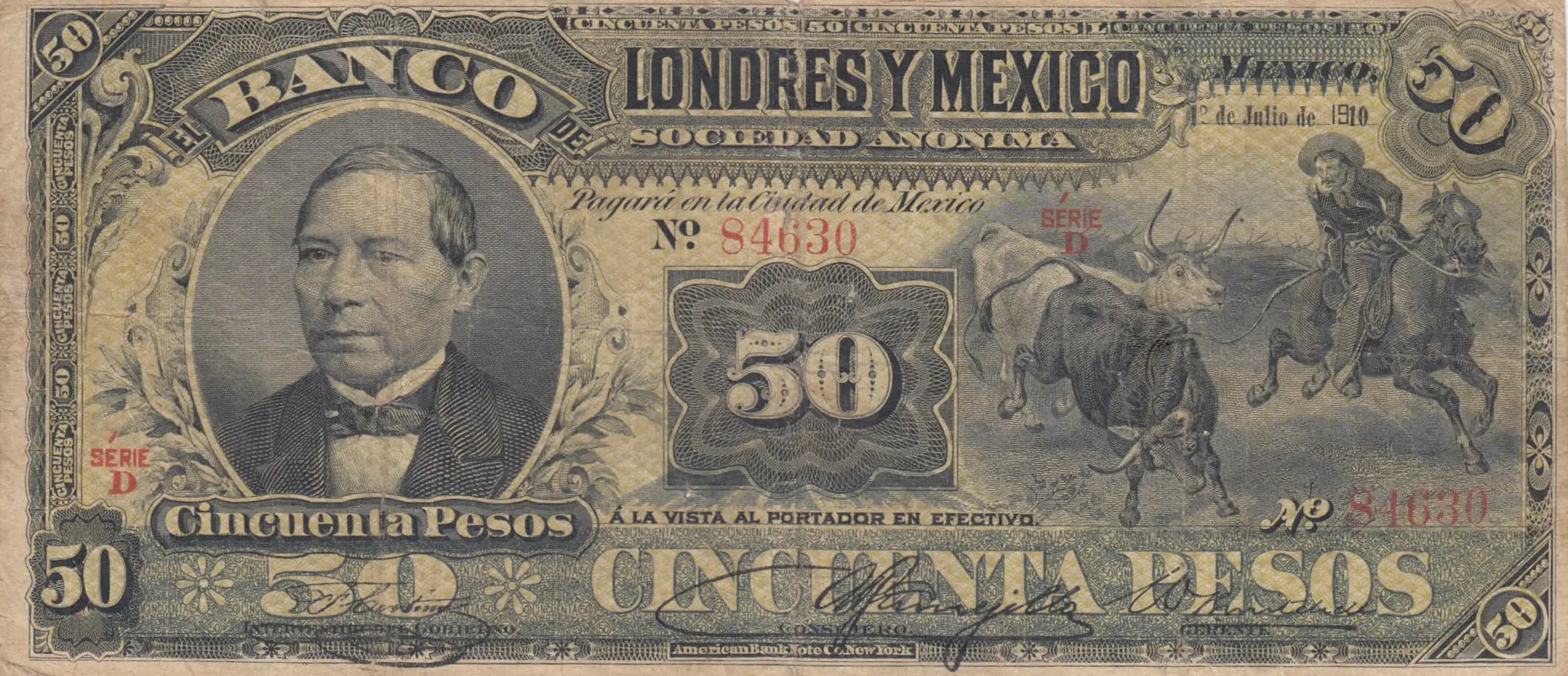
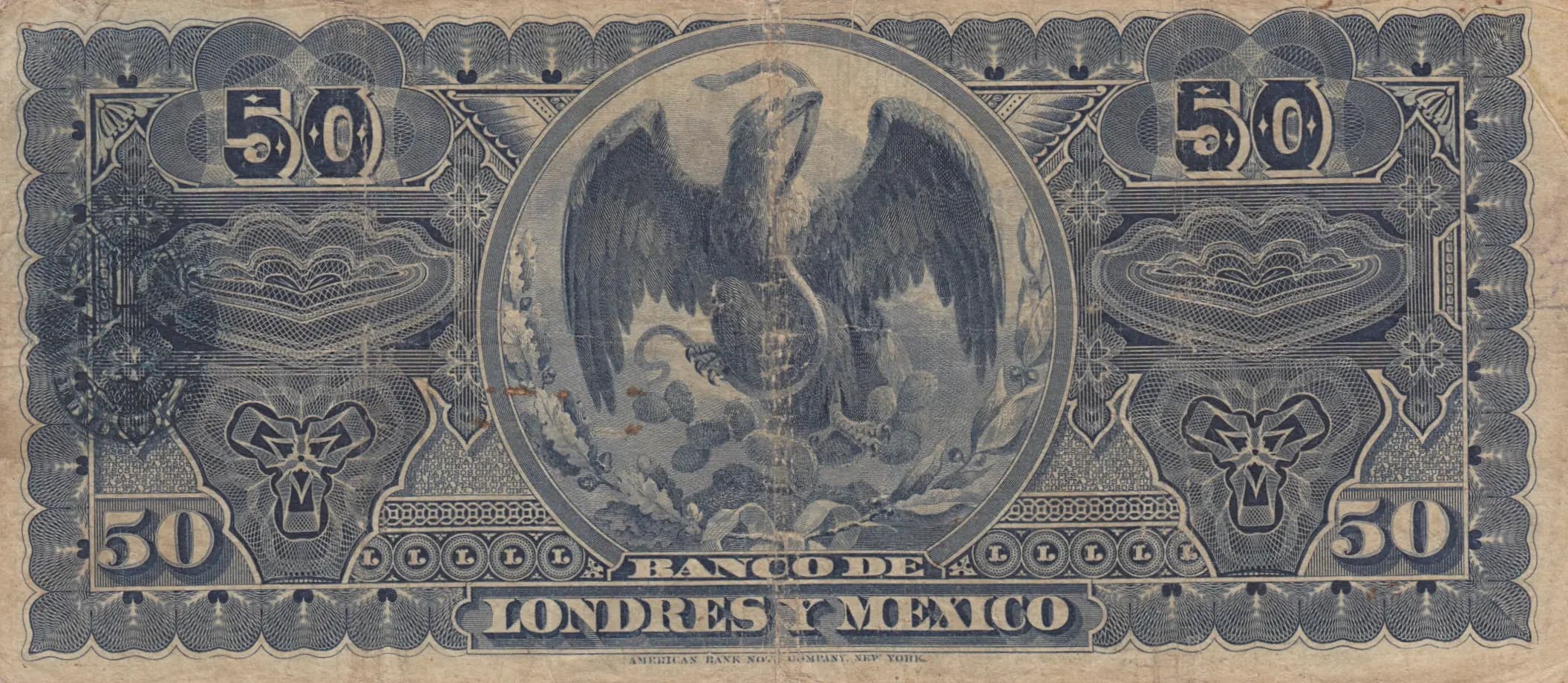
A well-circulated 50 Pesos note from Banco de Londres y Mexico dated July 2, 1910, printed by American Bank Note Company. The note displays the characteristic ornate engraving of the period with a portrait of a dignitary in formal attire on the obverse and a striking central eagle motif on the reverse. Despite obvious signs of circulation including creasing, fold lines, and age-related discoloration, the fine line engraving remains clearly legible, making this a historically significant example of early Mexican banking currency.
Common. eBay market data shows multiple sales of this denomination and series in recent years ranging from $1.99 to $295 USD, with typical circulated examples selling in the $50-200 range. This Pick number (P-S236e, Series D from 1910) appears to have had a substantial print run, as evidenced by the multiple variants catalogued by PMG (P-S236g, P-S236s) and consistent availability in the secondary market. The Fine condition grade specified aligns with market expectations for well-handled historical notes of this type.
This note was issued during a transitional period in Mexican banking, just months before the Mexican Revolution would significantly disrupt the nation's financial system. The Banco de Londres y Mexico, operating as a foreign-controlled joint-stock company (Sociedad Anónima), represented the significant European and North American financial interests in Mexico during the Porfiriato era. The reverse's eagle and cactus imagery references the national symbolism that would become central to Mexico's post-revolutionary identity.
The obverse features a left-facing profile portrait of a dignified gentleman in formal 19th-century attire with suit jacket and bow tie, positioned at the left side of the note. To the right of the portrait is a large ornamental shield containing the denomination '50'. The right side of the note displays an elaborate allegorical scene with classical/mythological imagery including human figures and horses, typical of the ornamental style favored by American Bank Note Company for prestigious financial institutions. The reverse displays Mexico's national symbol—an eagle with outstretched wings perched upon a cactus—rendered in a circular central medallion, surrounded by ornate geometric and floral border decorations. Large '50' denomination markers occupy all four corners. The entire design employs fine line engraving with complex decorative patterns throughout, rendered in dark green and gray on a tan/beige field.
FRONT SIDE: 'Banco de Londres y Mexico' (Bank of London and Mexico); 'Sociedad Anónima' (Anonymous Society/Joint Stock Company); 'Pagadero en la Ciudad de Mexico' (Payable in Mexico City); 'Cincuenta Pesos' / 'Cinquanta Pesos' (Fifty Pesos); 'No 84630' (Serial Number 84630); 'Serie D' (Series D); '2 de Julio de 1910' (July 2, 1910); 'Á la Vista al Portador en Efectivo' (On sight to the bearer in cash); 'American Bank Note Co. New York' (Printer attribution). REVERSE SIDE: '50' (denomination markers in all four corners); 'Banco de Londres y Mexico' (Bank of London and Mexico); 'American Bank Note Company New York' (Printer attribution).
Intaglio engraving (fine line engraving) executed by American Bank Note Company, New York, the world's leading security printer of the period. The note demonstrates sophisticated anti-counterfeiting measures through complex stippled/dotted pattern work, fine parallel lines, and intricate decorative elements throughout. Multiple passes of the engraving plate would have been required to achieve the varied tonal densities and fine detail visible in the portrait and allegorical scenes.
This note is catalogued as P-S236e, representing Series D printed July 2, 1910. The visual analysis confirms Series D designation and the 1910 date. PMG records indicate at least two other variants exist (P-S236g and P-S236s), likely representing different series, signatures, or date varieties. The serial number 84630 observed on this specimen helps identify it within the production sequence, though individual serial numbers do not typically create distinct catalog varieties for notes of this period unless they fall outside normal ranges.