50 pesos 1978
Market Prices
5 salesAbout This Note
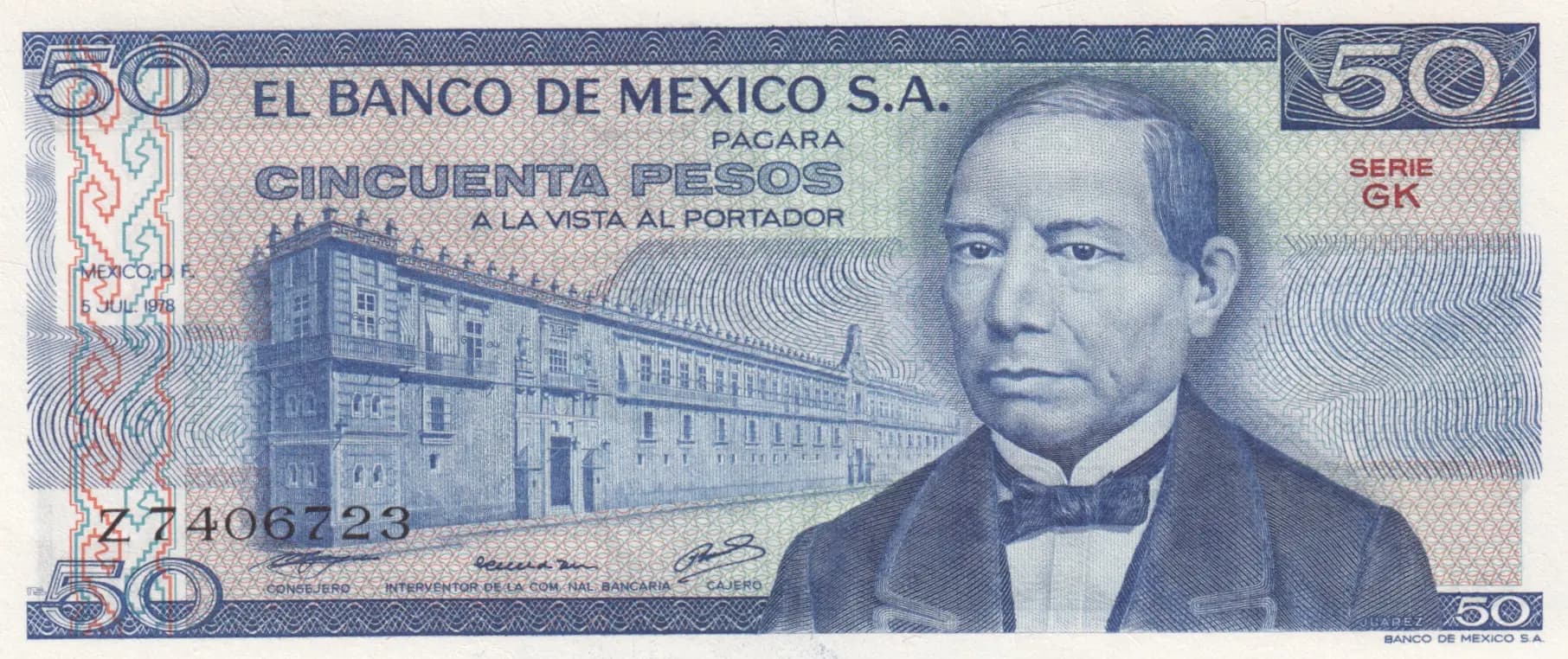
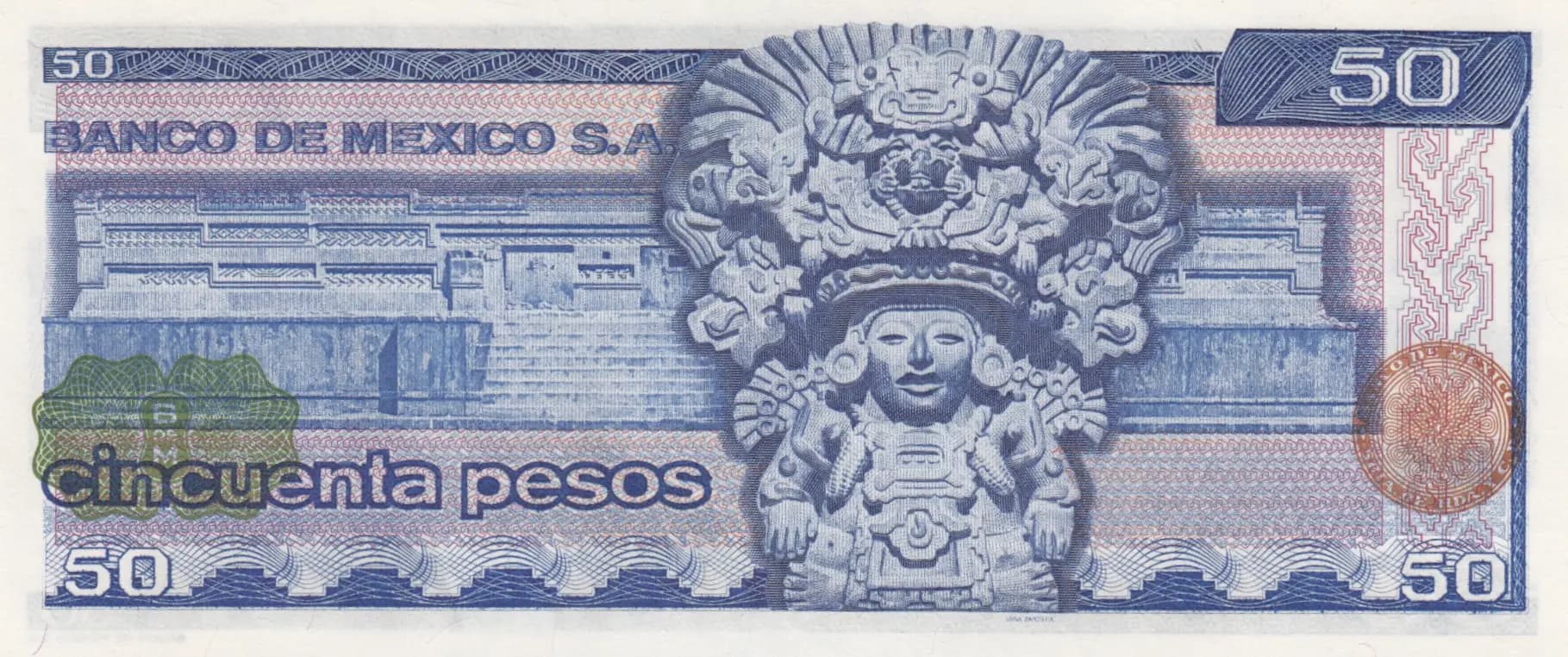
This is an uncirculated 1978 Mexican 50 pesos banknote (Pick P-67a) featuring the distinctive blue-dominant design characteristic of this series. The obverse displays a classical government building on the left and a portrait of Benito Juárez on the right, while the reverse showcases an elaborate Aztec ceremonial mask with temple architecture below—exemplifying Mexico's rich cultural heritage. The note exhibits pristine condition with sharp impressions, complex security patterns, and all original color vibrancy intact, making it an excellent representative example of this regular issue from Banco de México.
Common. This is a regular issue from the 1978 series with substantial print runs characteristic of a major denomination in active circulation. eBay market data supports this assessment, with UNC examples selling for $1.25-$2.75 in the 2011-2020 period and catalog values at $2 for UNC condition (2019). The series GK designation and standard serial numbering indicate no special limited printing. No records suggest this was a short-lived issue, recall, or error note that would elevate rarity.
Issued on July 5, 1978, this banknote reflects Mexico's commemoration of national cultural and political heritage during the late 1970s. The inclusion of Benito Juárez, the 19th-century reformist president, alongside Mesoamerican Aztec imagery demonstrates the Mexican government's emphasis on connecting pre-Columbian civilization with modern national identity—a common theme in Mexican currency design of this period.
The obverse features a formal three-quarter length portrait of Benito Juárez (1806-1872), Mexico's iconic Liberal reformist president, rendered in classical style with suit and bow tie, positioned prominently on the right side. To the left stands the Palacio Nacional (National Palace/Government Palace), the seat of Mexican executive power, rendered in detailed neoclassical architectural style with regular fenestration and ornamental roofline. The reverse displays a large reproduction of an Aztec ceremonial stone mask—likely from the National Museum of Anthropology—featuring elaborate headdress elements, scrollwork, and stylized facial features characteristic of Mesoamerican sacred art. Below this central sculptural element is depicted a stepped pyramid temple structure, reinforcing the archaeological theme. The entire design is rendered in blue as the dominant color with gray, white, and accent colors (red, brown, tan, green), utilizing intricate geometric patterns and guilloche work throughout for both aesthetic and security purposes.
FRONT: '50' (denomination in numerals) | 'EL BANCO DE MEXICO S.A.' (The Bank of Mexico S.A.) | 'CINCUENTA PESOS' (Fifty Pesos) | 'A LA VISTA AL PORTADOR' (Payable to Bearer on Demand) | 'SERIE' (Series) | 'GK' (Series designation GK) | 'MEXICO, D.F.' (Mexico City) | '5 JUL 1978' (Issue date: 5 July 1978) | 'Z 7 406723' (Serial number) | 'CONSEJERO' (Counselor/Advisor - signature line) | 'INTERVENTOR DE LA COM. NAL. BANCARIA' (Auditor of the National Banking Commission - signature line) | 'CAJERO' (Cashier - signature line). BACK: '50' (denomination in numerals) | 'BANCO DE MEXICO S.A.' (Bank of Mexico S.A.) | 'cincuenta pesos' (fifty pesos).
Intaglio engraving (recess printing), the standard method for high-security banknote production. The complex guilloche patterns, fine-line security features with varying line densities, and the crisp detail visible in both the portrait and architectural elements are characteristic of intaglio work. Printed by Banco de México's own printing facility (BdM), as noted in catalog data. The intricate background patterns and geometric security elements visible in the visual analysis confirm professional anti-counterfeiting measures typical of central bank production standards.
This specific example is identified as series GK with serial number Z 7 406723, issued July 5, 1978. The Pick P-67a designation may indicate a known variety within the 1978 50 pesos series (the 'a' suffix typically denotes a specific sub-variety). Known variations in this series include different signature combinations (three signatures are present on this note, as noted in catalog data) and different series letter designations. The GK series letters should be documented, as series letters can indicate print order and specific signature combinations. No overprints or other special markings are observed on this specimen.