100 pesos 1889
About This Note
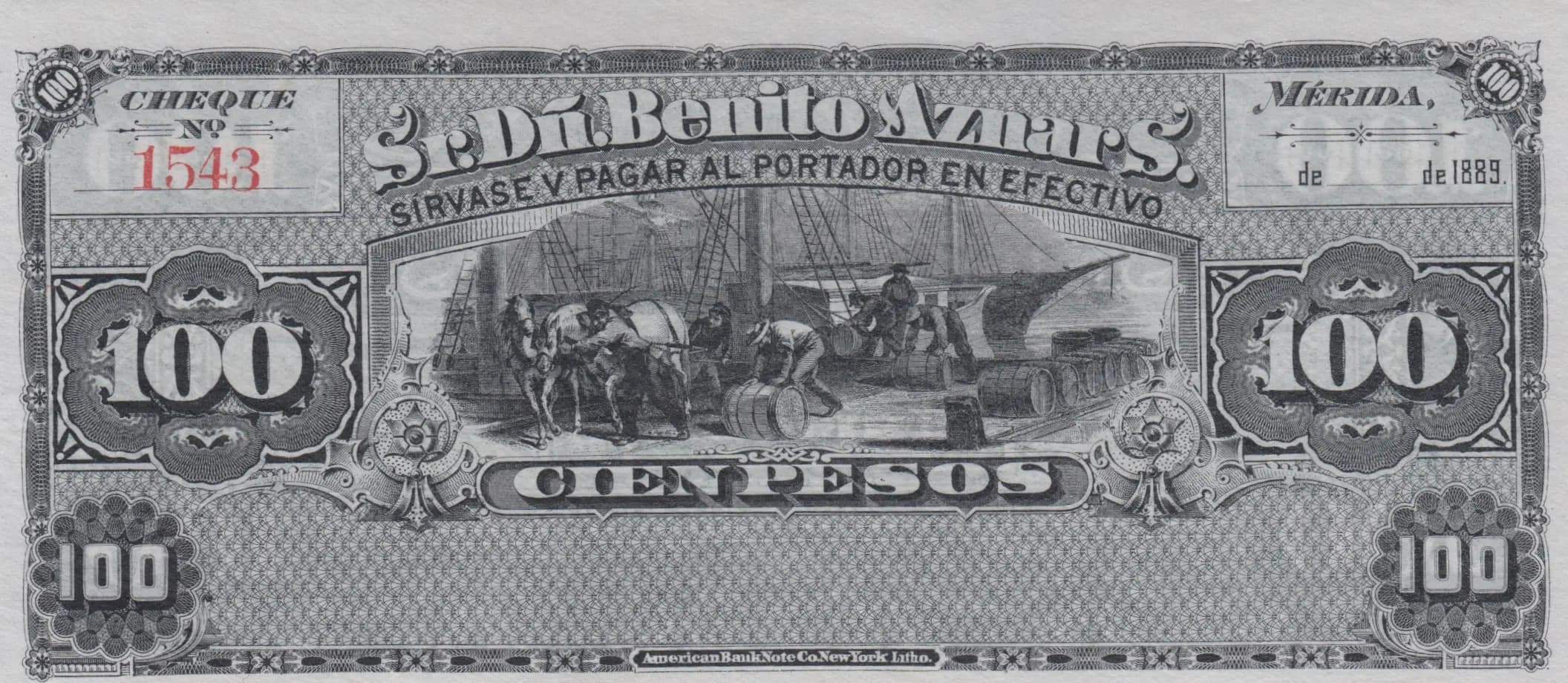
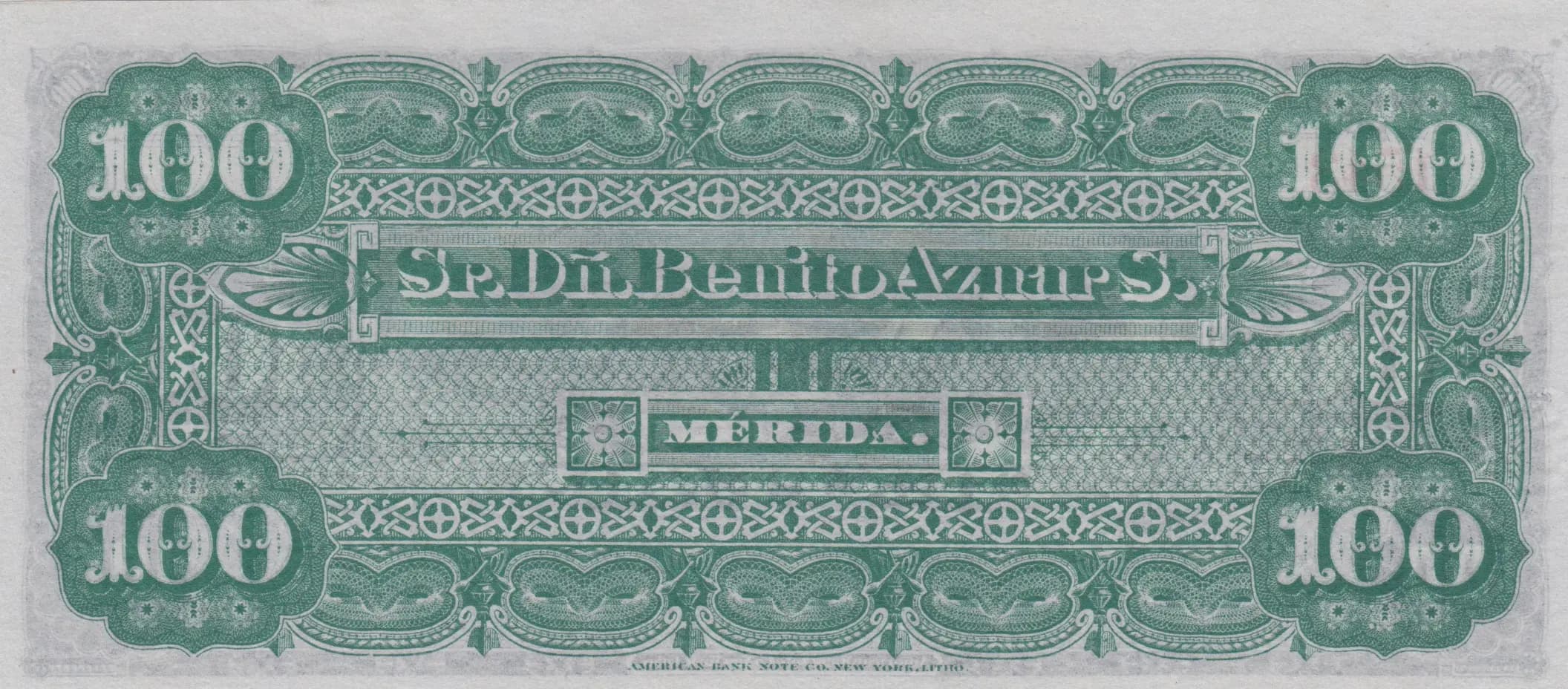
This is a striking 1889 Mexican 100 pesos banknote issued by Sr. Dn. Benito Aznar S., produced by American Bank Note Company of New York. The note features a beautifully engraved maritime commerce scene on the obverse depicting a sailing vessel with workers loading cargo at a port, rendered in black and gray on the front, while the reverse displays an ornate green design with denomination numerals in all four corners. In UNC condition, this unlisted Pick catalog note exhibits crisp printing, sharp details in the fine geometric and floral security patterns, and excellent color preservation, making it an important example of private Mexican banknote issuance during the late 19th century.
Common. While this note is unlisted in the standard Pick catalog, indicating it represents a private or regional issuance rather than a nationally-recognized banknote, there is no evidence of an exceptionally limited print run, early recall, or short operational period that would justify a rare classification. Private merchant notes and regional cheques of this era from Mexico were produced in reasonable quantities to facilitate local commerce. The absence from Pick's standard catalog likely reflects cataloging scope limitations rather than extreme scarcity. Absent specific data on print runs or documented market scarcity, this should be classified as a common private issuance from the period.
This note represents a transitional period in Mexican financial history when private merchants and local authorities issued their own banknotes, a practice that gradually declined as the national banking system centralized. The maritime commerce imagery—depicting the loading and unloading of goods from a multi-masted sailing vessel—reflects the economic importance of trade and shipping to Mexico during the 1880s, particularly for Yucatán's port cities like Mérida. Issued in Mérida and denominated in pesos, this cheque-like note (marked as 'Cheque Nº 1543') served as a locally-circulating medium backed by the credibility of Sr. Benito Aznar's commercial enterprise.
The obverse features an elaborate central vignette depicting a busy maritime port scene with a multi-masted sailing vessel positioned prominently, surrounded by workers, cargo barrels, and trading goods in active commerce. Multiple human figures are shown engaged in loading or unloading merchandise, emphasizing the commercial and mercantile purpose of the instrument. The note is framed by ornate decorative borders incorporating intricate geometric patterns, floral scrollwork, and elaborate medallions, with the denomination '100' displayed in four ornate corner cartouches. The reverse maintains strict symmetry with the same architectural design scheme, emphasizing the location 'MÉRIDA' in a central cartouche and repeating the denomination numerals in each corner. The overall design combines Victorian-era ornamental aesthetics with security-conscious fine-line engraving, typical of American Bank Note Company's production standards.
FRONT: 'CHEQUE Nº 1543' (Check No. 1543); 'MÉRIDA,' (Mérida); 'de _____ de 1889' (of _____ of 1889); 'Dr. Benito Vamps' (Dr. Benito Vamps); 'SIRVAS PAGAR AL PORTADOR EN EFECTIVO' (Please Pay to Bearer in Cash); '100' and 'CIEN PESOS' (One Hundred Pesos); 'American Bank Note Co. New York. Litho.' (American Bank Note Co. New York. Lithography). BACK: 'Sr. Benito Vamps S.' (Mr. Benito Vamps S.); 'MÉRIDA.' (Mérida); '100' (denomination); 'American Bank Note Co. New York. Litho.' (American Bank Note Co. New York. Lithography).
This note was produced using lithography (as indicated by the 'Litho.' credit on both sides) combined with line engraving techniques. American Bank Note Company of New York employed their sophisticated security printing methods, utilizing multiple passes to create the intricate geometric borders, fine-line patterns throughout, and detailed vignette work. The combination of lithographic color printing (evident in the green reverse) with engraved security elements represents the state-of-the-art security printing practices of the 1880s, designed to resist counterfeiting through elaborate decorative complexity and fine detail work.
This specific note is identified as a cheque variant (numbered 1543) issued by Sr. Dn. Benito Aznar S. in Mérida with a blank date field (de _____ de 1889), indicating it was issued as a pre-printed form to be filled in with specific transaction dates. The printer credit to American Bank Note Company New York is consistent across both sides. The inscription appears to list 'Dr. Benito Vamps' on the obverse and 'Sr. Benito Vamps S.' on the reverse, suggesting potential signature variants or name variations depending on the specific example. Serial number 1543 is visible on this example; other cheque numbers in the series would constitute distinct varieties within this issuer's output.