50 pesos 1898-1911
Market Prices
About This Note
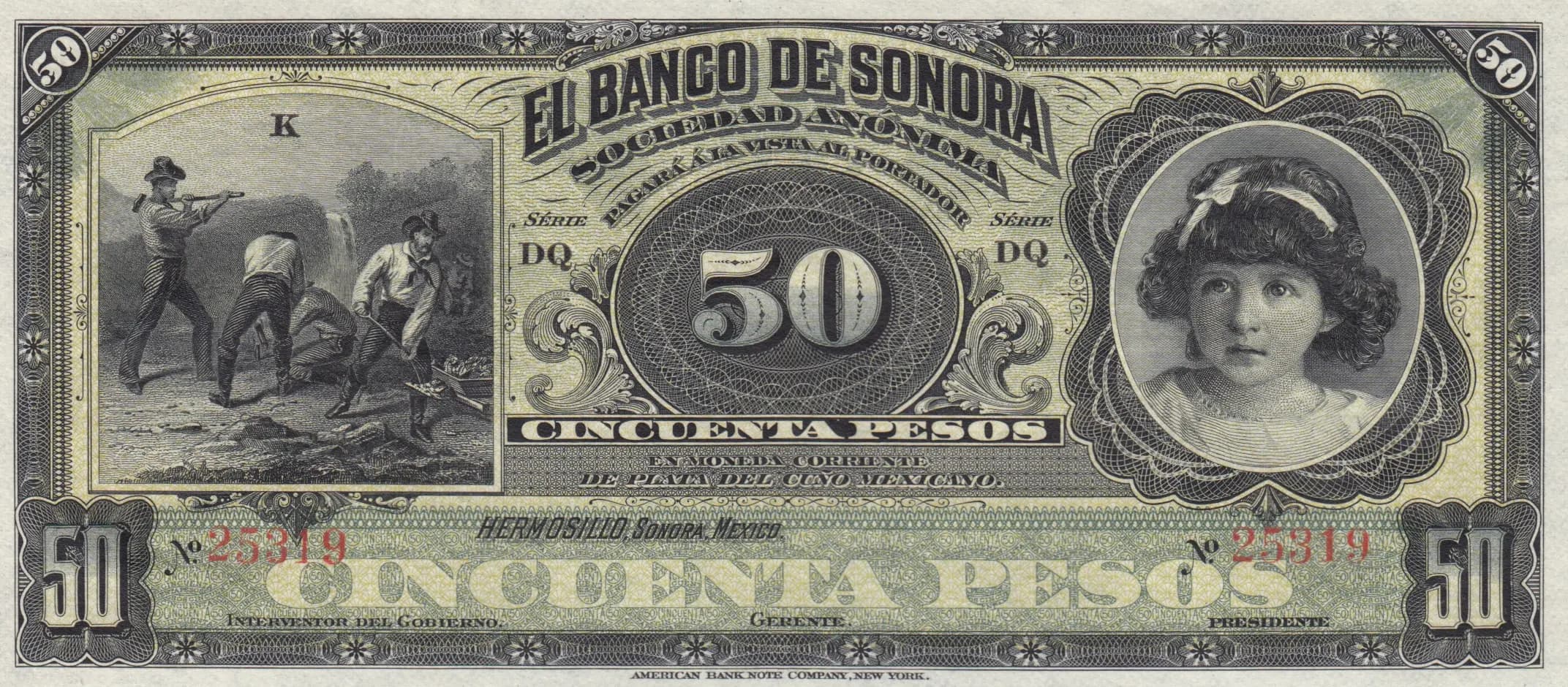
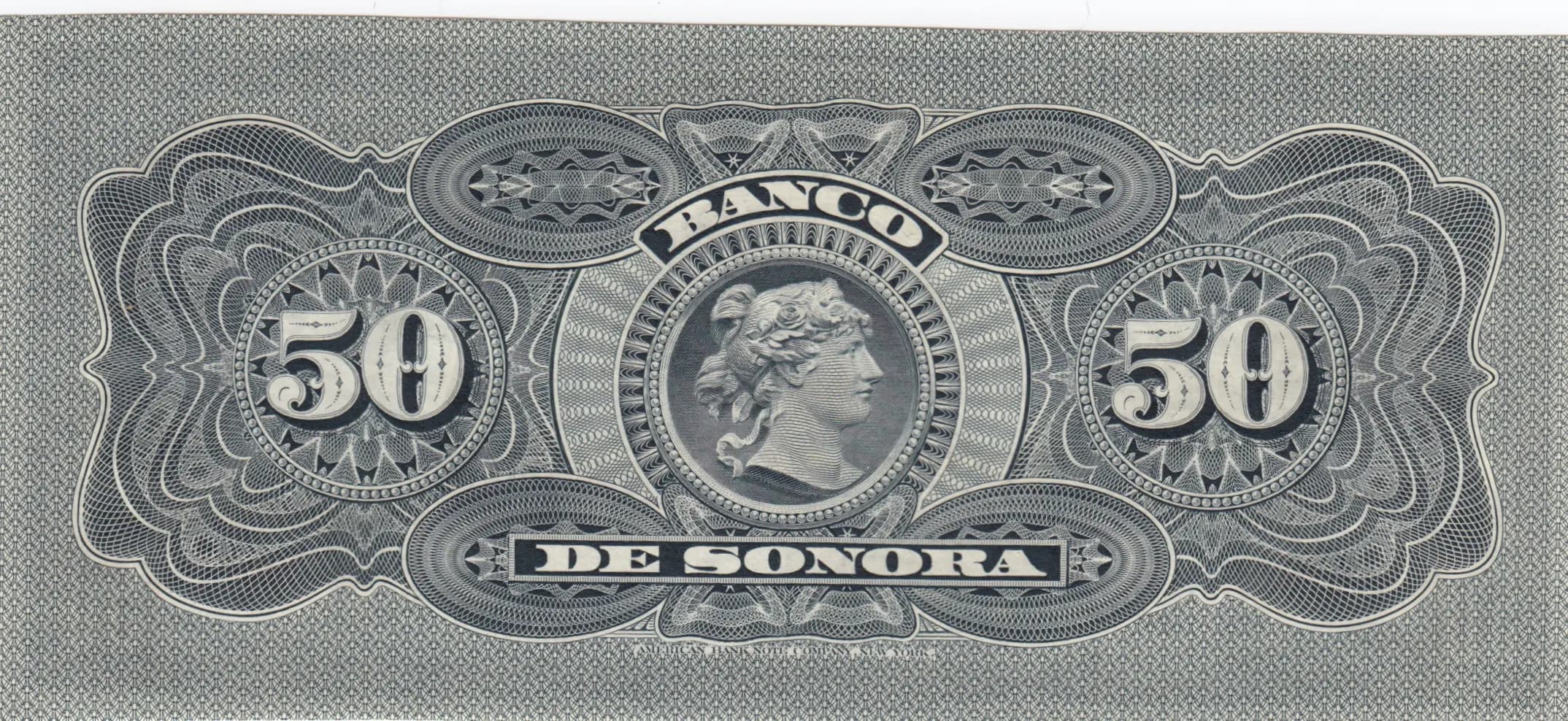
A handsome 50 pesos banknote from Banco de Sonora (1911), printed by the American Bank Note Company. The obverse features a striking industrial labor scene at left with a portrait of Hortensia C. Vélez at right, rendered in green, gray, and black with fine decorative borders. The reverse showcases a classical male profile in a circular frame with symmetrical '50' denominations. While the front shows expected signs of age with foxing and creasing, the reverse appears remarkably well-preserved, suggesting careful storage of this historical Mexican regional currency.
Common. eBay market data shows consistent sales across multiple condition grades, with UNC examples ranging from $8.99 to $298.00 USD, indicating a broad price range typical of available examples rather than extreme scarcity. The Banco de Sonora issued these notes over a 13-year period (1898-1911), and catalog notation identifies multiple series (DP-DT, DW, DX) suggesting substantial print runs. Remainder status and multiple sightings in the collector market support a common classification despite regional Mexican bank issuer status.
The Banco de Sonora operated during Mexico's late Porfirian era and early Revolutionary period, issuing regional currency from Hermosillo as one of Mexico's private regional banks. The mining/industrial labor scene depicted on the obverse reflects Sonora's economic foundation in mining and natural resource extraction during this prosperous pre-Revolutionary period. The note's existence through 1911 and its remainder status indicate the bank's currency issue spanned the turbulent transition from the Díaz regime into the Mexican Revolution.
The obverse depicts an allegorical scene of industrial labor or mining operations at left, central to Sonora's economic identity, with the portrait of Hortensia C. Vélez, a notable historical figure, positioned in a circular frame at right wearing a decorative headpiece. The reverse features a classical male profile portrait (allegorical or historical representation) in a large central circular frame, flanked symmetrically by two '50' denominations within ornate circular cartouches. Both sides employ elaborate geometric borders with eight-pointed stars, rosettes, and ornamental scrollwork characteristic of high-security banknote design. The overall aesthetic combines Mexican heraldic traditions with late 19th-century North American engraving conventions.
FRONT: 'EL BANCO DE SONORA' (The Bank of Sonora); 'SOCIEDAD ANONIMA' (Joint Stock Company); 'PARA LA RECAUDACION Y COBRANZA' (For Collection and Payment); 'CINCUENTA PESOS' (Fifty Pesos); 'MONEDA CORRIENTE DE PLATA DEL CINCO MEXICANO' (Current Currency of Silver of the Mexican Five); 'SERIE DQ' (Series DQ); 'No 223149' (Number 223149); 'HERMOSILLO, SONORA, MEXICO' (place of issue); 'INTERVENTOR DEL GOBIERNO' (Government Comptroller); 'GERENTE' (Manager); 'PRESIDENTE' (President); 'AMERICAN BANK NOTE COMPANY, NEW YORK' (printer). BACK: 'BANCO' (Bank); 'DE SONORA' (Of Sonora); '50' (denomination).
Intaglio engraving (steel plate engraving) via the American Bank Note Company, New York, as printed by ABNC. The note exhibits characteristic fine line engraving with detailed cross-hatching, multiple layering of decorative elements, and intricate geometric patterns typical of high-security banknote production of the 1890s-1910s era. The precision of the engraved details and ornamental work is consistent with ABNC's reputation as one of the world's premier security printers.
This specific example is identified as Pick P-S422r (remainder note), Series DQ, Number 223149. The series prefix 'DQ' is documented in realbanknotes.com reference data showing series DP-DT, DW, and DX as known varieties. The visual analysis confirms this is a remainder banknote (unissued, unpunched stock) rather than a circulated example. The catalog notation indicates reports of specific dates from 1897-1911 are sought by researchers, suggesting potential unresolved questions about the precise dating of certain series within this emission.