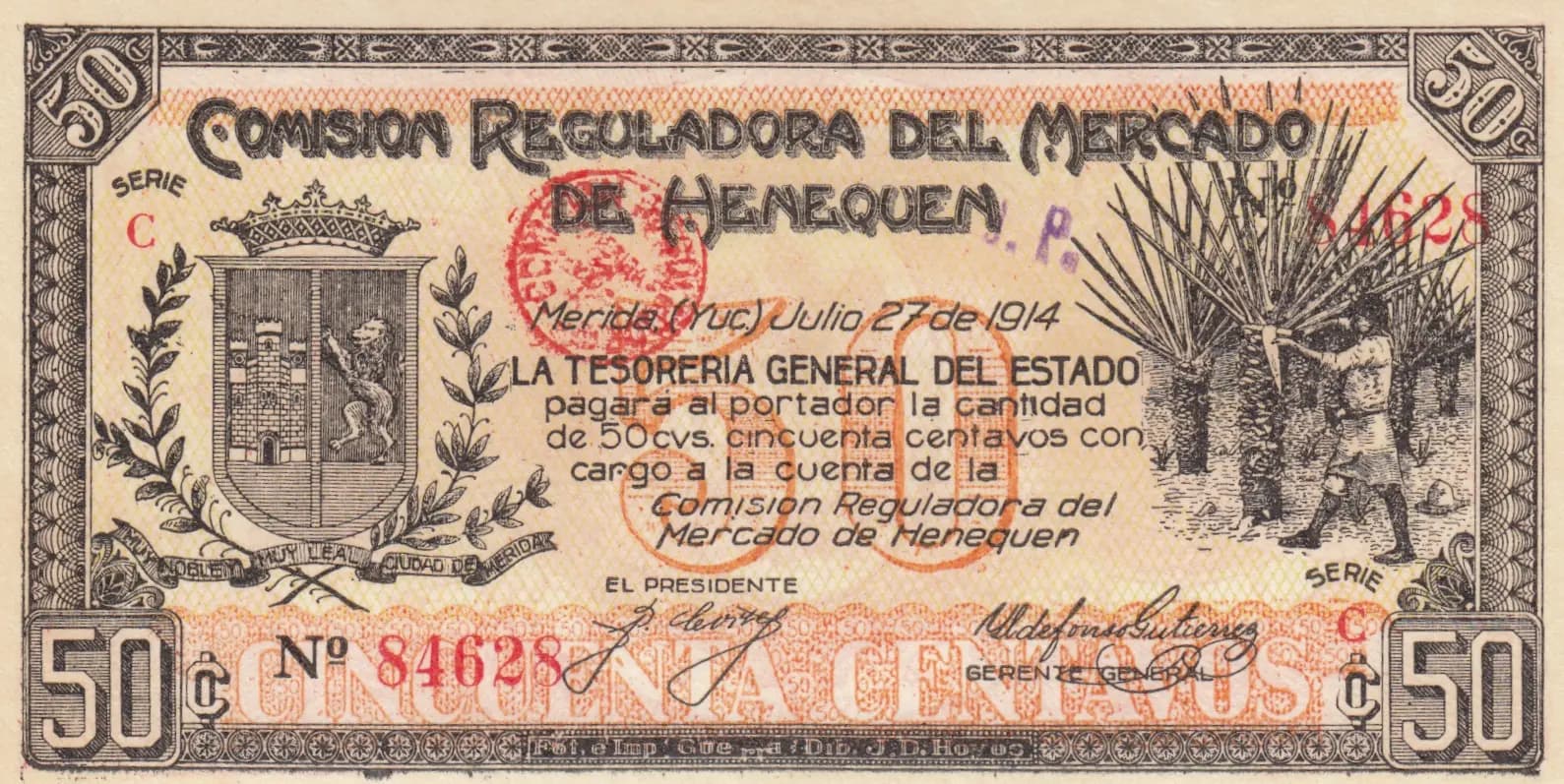
50 centavos 1914
About This Note
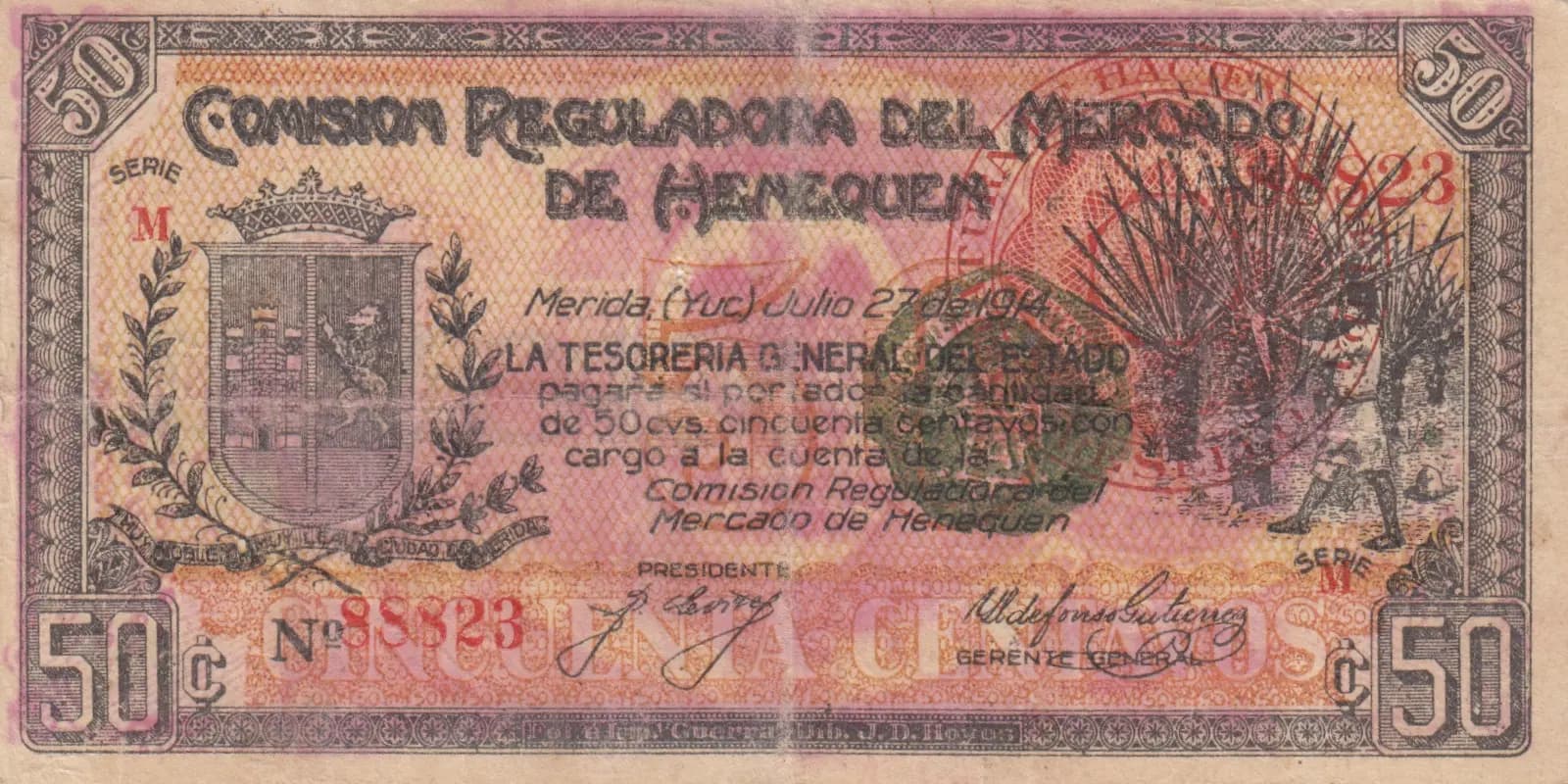
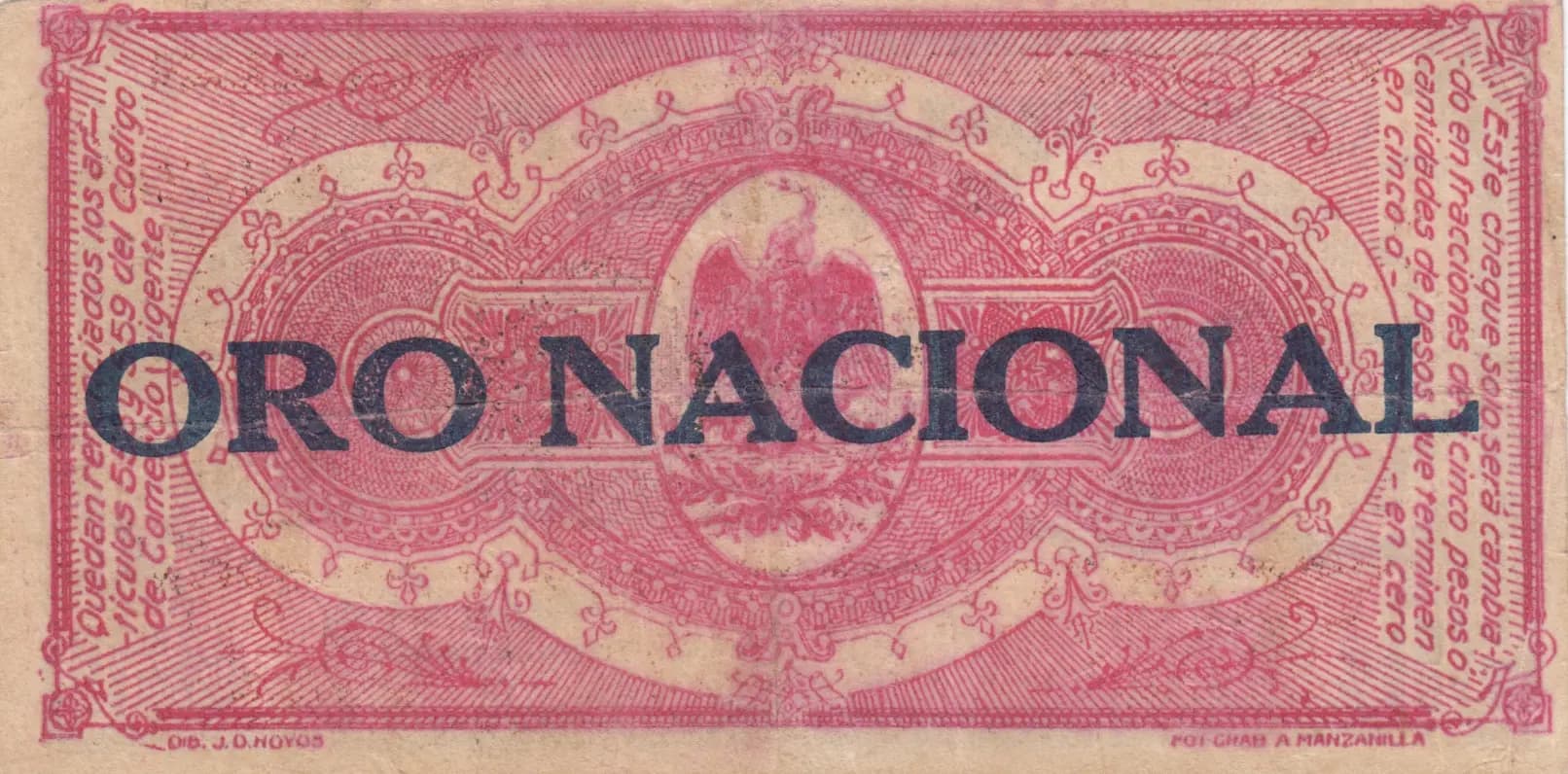
This 50 centavos note from 1914 issued by the Comisión Reguladora del Mercado de Henequén represents a fascinating piece of Mexican financial history during the Revolutionary period. The note exhibits heavy circulation wear consistent with its Fair grade, featuring extensive handwritten overprints and administrative signatures dated July 27, 1914 from Mérida, Yucatán, indicating use in official transactions related to henequen (sisal) market regulation. The ornate design with heraldic elements and the prominent 'ORO NACIONAL' overprint on the reverse underscore both the artistic quality of early 20th-century Mexican currency design and the economic importance of henequen exports during this turbulent period.
Common. This note represents a fairly standard issue from a regional Mexican authority during the Revolutionary period. While the issuer was specialized (henequen market regulation) rather than a general banking institution, the denomination and series are not documented as having extremely limited print runs. The heavy circulation evident in the Fair grade condition and the presence of administrative use-marking suggest these notes were produced in sufficient quantities for actual commercial circulation in Yucatán. Regional Mexican emergency currency from this period, while historically interesting, are generally available to collectors.
The Comisión Reguladora del Mercado de Henequén was established to regulate trade in henequen (sisal fiber), Yucatán's most valuable export commodity and primary source of wealth during the Porfiriato and Revolutionary periods. This 1914 issue reflects the regional autonomy and economic power of Yucatán during Mexico's Revolution, when local authorities maintained significant control over regional finances and trade. The handwritten date of July 27, 1914, places this note during a period of intense revolutionary activity when such locally-issued emergency currency served practical administrative and commercial purposes in Yucatán.
The obverse features a formal heraldic coat of arms on the left depicting a castle tower with crown and flanked by laurel wreaths, symbolizing Yucatán's regional authority and prosperity. A formal portrait of a dignified gentleman in profile appears on the right side, likely representing a prominent administrator or president of the Commission, though not specifically identified in historical records readily available. The ornate geometric and floral border patterns frame the design with decorative corner ornaments displaying the denomination '50'. The reverse showcases an impressive central oval medallion containing a heraldic eagle design symbolizing Mexico's national sovereignty, surrounded by intricate repeating floral and geometric guilloche patterns that demonstrate the sophisticated engraving techniques available to Mexican currency printers. The bold 'ORO NACIONAL' (National Gold) overprint across the center reinforces the note's backing by national treasury resources.
FRONT SIDE: 'COMISION REGULADORA DEL MERCADO DE HENEQUEN' (Regulatory Commission of the Henequen Market); 'Merida, (Yuc) Julio 27 de 1914' (Mérida, Yucatán, July 27, 1914); 'LA TESORERIA G.NERAL C.XPO' (The General Treasury); 'de 50 cvs. cincuenta centavos por cargo a la cuenta de la comision Reguladora del Mercado de Henequan' (of 50 centavos, fifty centavos charged to the account of the Regulatory Commission of the Henequen Market); 'PRESIDENTE' (President); 'GERENTE GENERAL' (General Manager); 'SERIE M' (Series M); '50 C' (50 Centavos); 'N° 8823' (Number 8823). REVERSE SIDE: 'ORO NACIONAL' (National Gold); 'DIB. J.O. NOVOS' (Drawn by J.O. Novos); 'FOLGRAN A MANZANILLA' (Engraved by Manzanilla); additional edge inscriptions partially visible in repeating pattern.
Intaglio engraving with multiple color printing, employing fine line guilloche work and detailed geometric pattern engraving typical of high-security banknote production of the period. The design credits 'DIB. J.O. NOVOS' (designer) and engraver 'MANZANILLA' indicate professional currency engravers were employed. The handwritten overprints, signatures, and date stamp were applied during issuance as administrative annotations typical of emergency currency practices in Revolutionary Mexico.
This example represents Pick catalog P-S1121b variety, identified by the specific handwritten overprints and administrative annotations dated July 27, 1914, with serial number N° 8823 in Series M. The presence of multiple handwritten signatures (Presidente and Gerente General) and the specific date and location stamp (Mérida, Yucatán) represent the administrative variety of this issue. Known varieties of this note may differ in signature combinations, serial number sequences, or dating variations, reflecting the handwritten nature of authorization on these institutional notes.