50 centavos 1914
About This Note
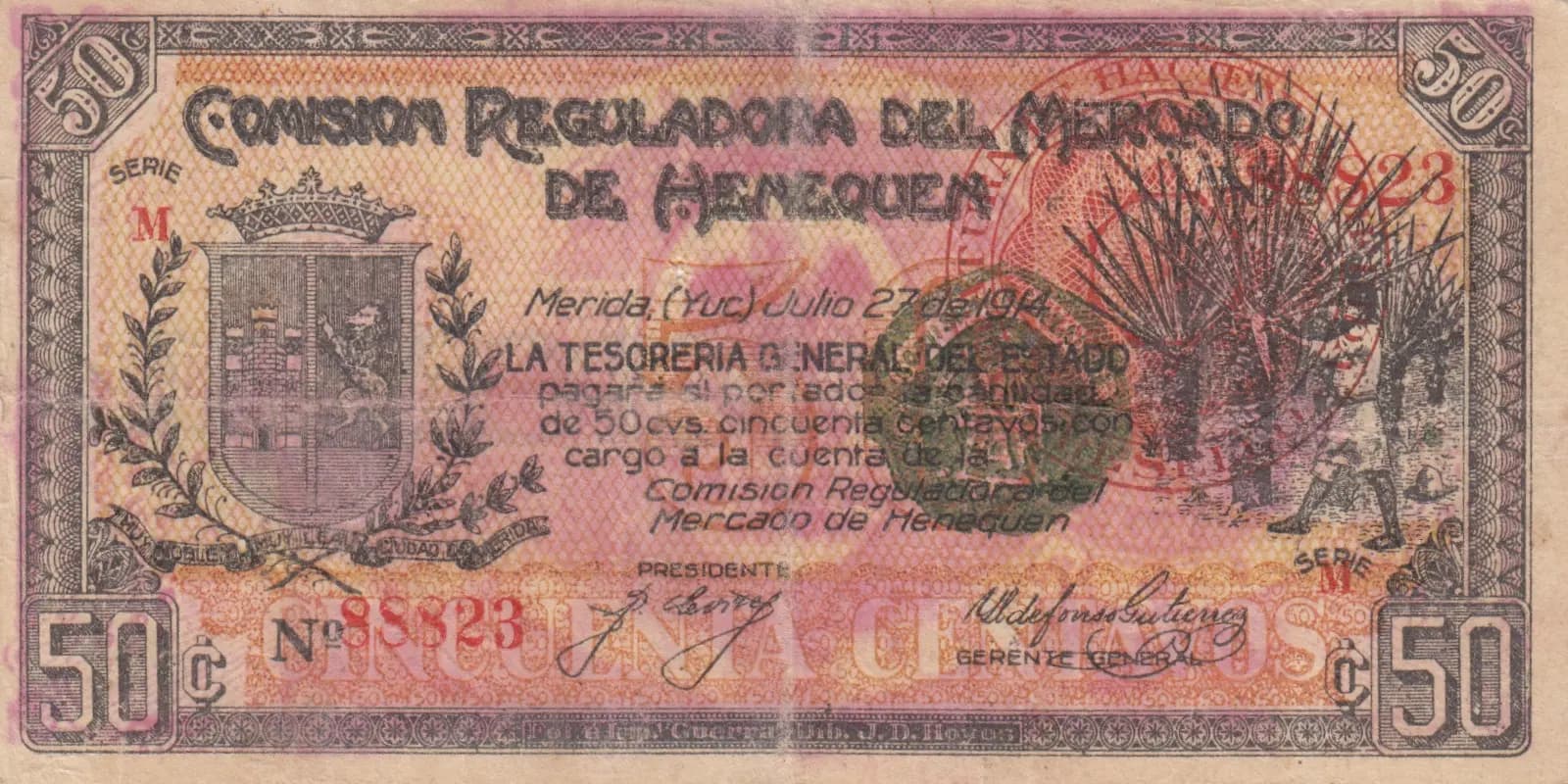
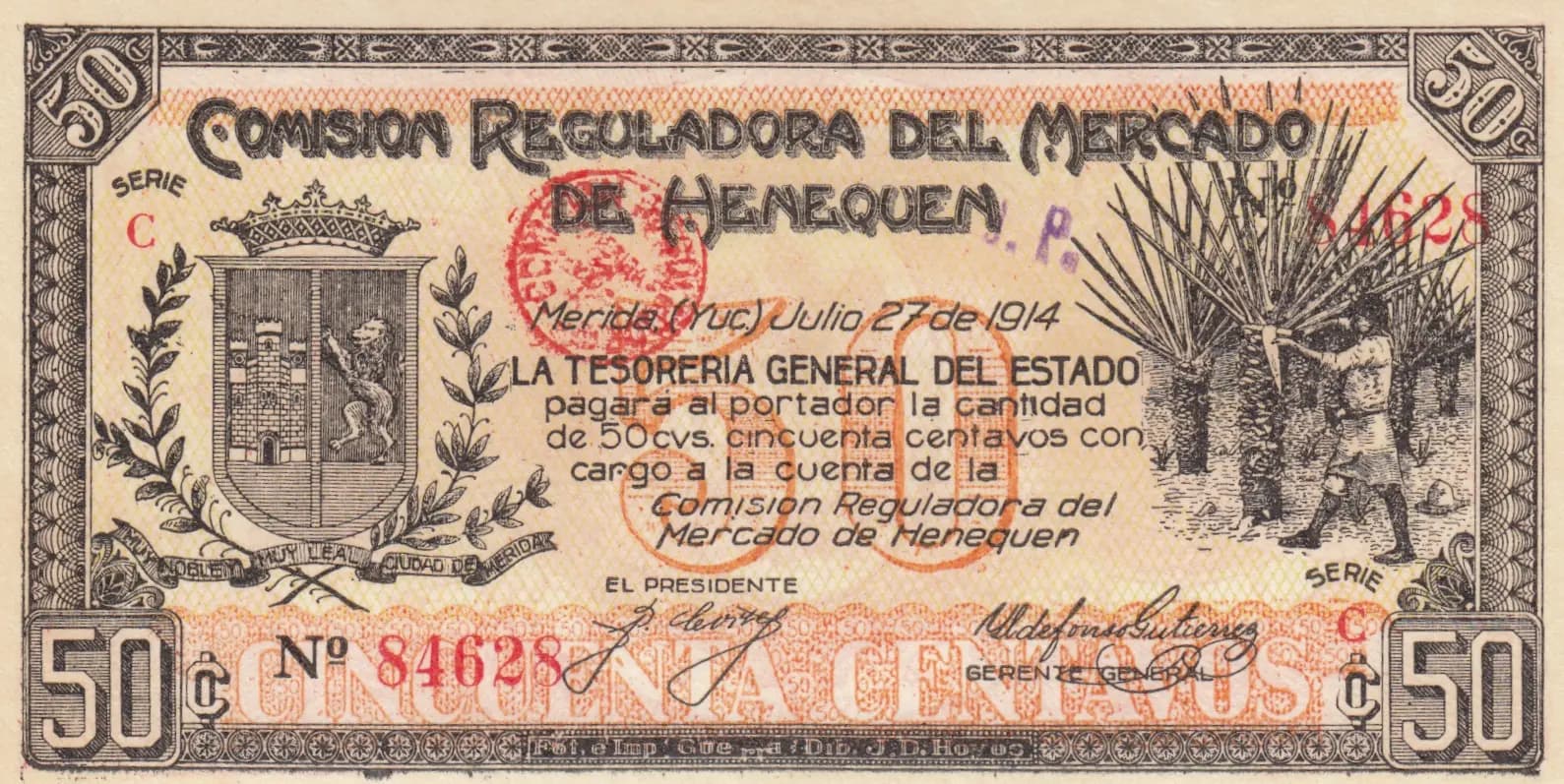
This is a 50 centavos banknote issued in 1914 by the Comisión Reguladora del Mercado de Henequén (Market Regulatory Commission of Henequén), a regional Mexican currency from the Yucatán state during the Mexican Revolution. The note features a distinctive fortress coat of arms, henequén plant illustration, and exhibits significant historical documentation including a red circular official stamp dated July 27, 1914 from Mérida, along with handwritten signatures and annotations in period ink. Despite the catalog grade of UNC, the note displays considerable aging patination consistent with its 110+ year age, with yellowing, discoloration, and manuscript overlays that enhance its historical authenticity and collector appeal.
common
This emergency currency was issued during the Mexican Revolution by the Yucatán state government through its henequén market commission, a response to the currency instability and shortages plaguing Mexico during this turbulent period. The fortress imagery in the coat of arms and the prominent henequén plant design reflect Yucatán's historical military importance and its dominant economic product—henequén fiber—which was critical to the region's economy and the nation's export revenue. The July 27, 1914 date places this note during the height of revolutionary instability, when regional and local authorities issued substitute currency to maintain commerce in their territories.
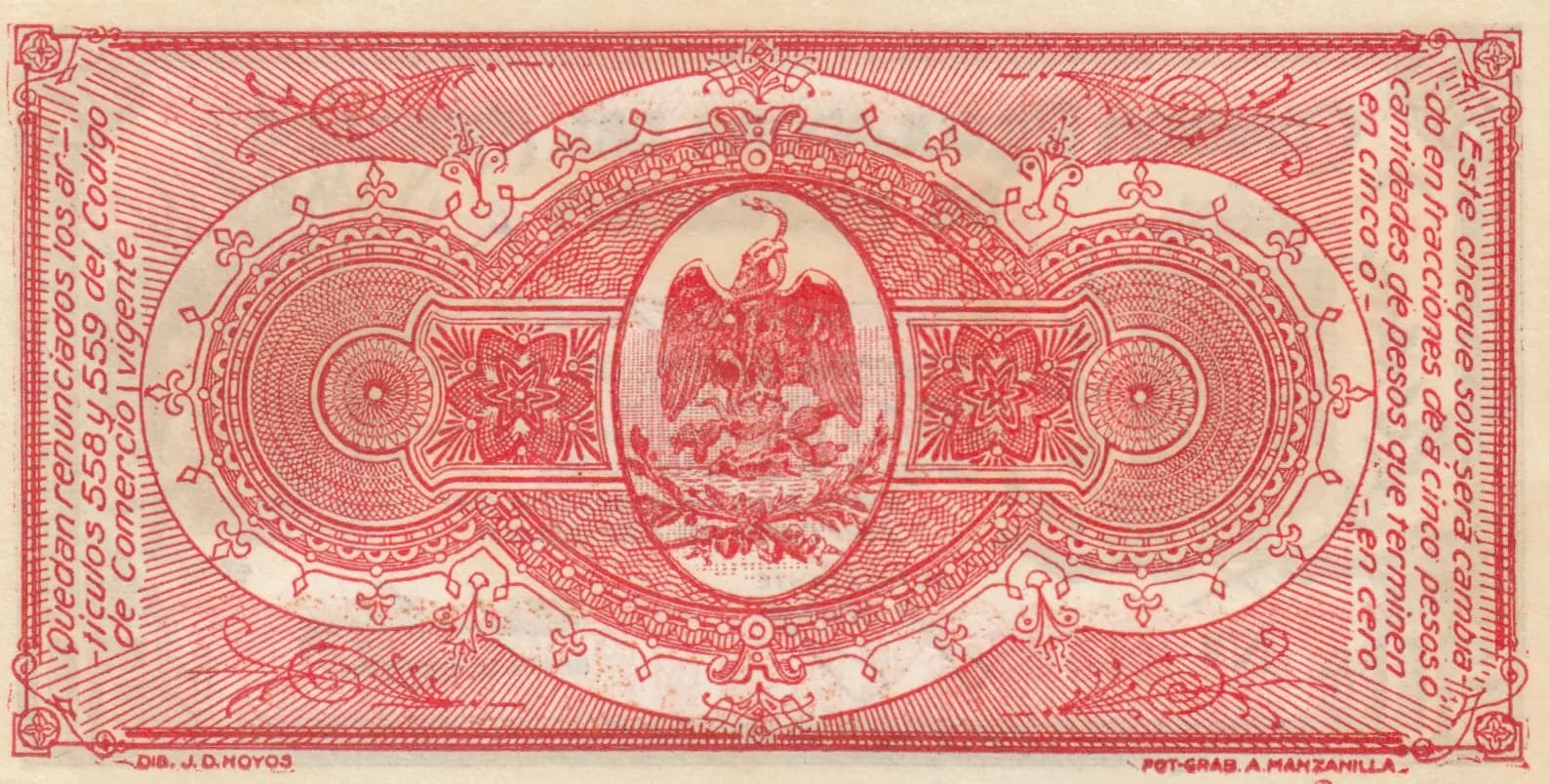
The obverse features an elaborate ornamental border with geometric patterns framing the central design. On the left is an escutcheon containing a fortified tower or fortress structure—likely representing the historical military significance of Mérida or Yucatán state—flanked symmetrically by laurel branches symbolizing triumph and honor. The center displays the issuing authority's name and purpose. The right side features an illustration of henequén plants (Agave fourcroydes), the fibrous agave species that was the economic lifeblood of Yucatán, used for cordage, twine, and rope production. A prominent red circular official stamp dated 'Mérida (Yuc) Julio 27 de 1914' dominates the upper center, providing official authorization. The denomination '50' appears in decorative frames at all four corners. The reverse features the Mexican national coat of arms—an eagle—centered within an ornate oval baroque frame, surrounded by elaborate radiating floral and geometric ornamental designs in red/pink ink on a cream background, demonstrating the high-quality lithographic work of the period.
FRONT SIDE: 'Comisión Reguladora del Mercado de Henequén' (Market Regulatory Commission of Henequén); 'Mérida (Yuc) Julio 27 de 1914' (Mérida, Yucatán, July 27, 1914); 'La Tesorería General del Estado pagará al portador la cantidad de 50 cvs. cincuenta centavos con cargo a la cuenta de la comisión Reguladora del Mercado de Henequen' (The General Treasury of the State will pay to the bearer the amount of 50 centavos, fifty cents, charged to the account of the Market Regulatory Commission of Henequén); 'Serie C' (Series C); 'No 84628' (Number 84628); 'El Presidente' (The President); 'Gerente General' (General Manager). BACK SIDE: 'Ordenado por el Presidente Interino del Estado' (Ordered by the Interim President of the State); 'Acuñación en los Talleres de la Compañía Litográfica de México' (Printed in the Workshops of the Lithographic Company of Mexico); 'Este billete circulará como papel moneda en el Estado de Yucatán' (This banknote will circulate as paper money in the State of Yucatán).
Lithography, specifically executed by the Compañía Litográfica de México (Lithographic Company of Mexico) as stated on the reverse. The ornate decorative patterns, fine line work, and the baroque-style ornamental designs are characteristic of lithographic printing of the era. The note exhibits the multi-color capabilities of lithographic production typical of early 20th-century Mexican currency, with careful registration of black, red/pink, and colored inks on cream-colored paper stock.
This specific note is identified as Series C, Number 84628. The Pick catalog designation P-S1121a indicates this is a recognized variety within the Henequén Commission's 50 centavos issue. The red circular official stamp with the July 27, 1914 date from Mérida is a consistent feature of this series. The handwritten signatures and manuscript annotations visible on this specimen appear to be authentic period documentation rather than varieties per se, though they document the note's administrative processing and circulation history. The presence of Series C and the specific serial number help distinguish individual specimens within this emission.