50 centavos 1914
About This Note
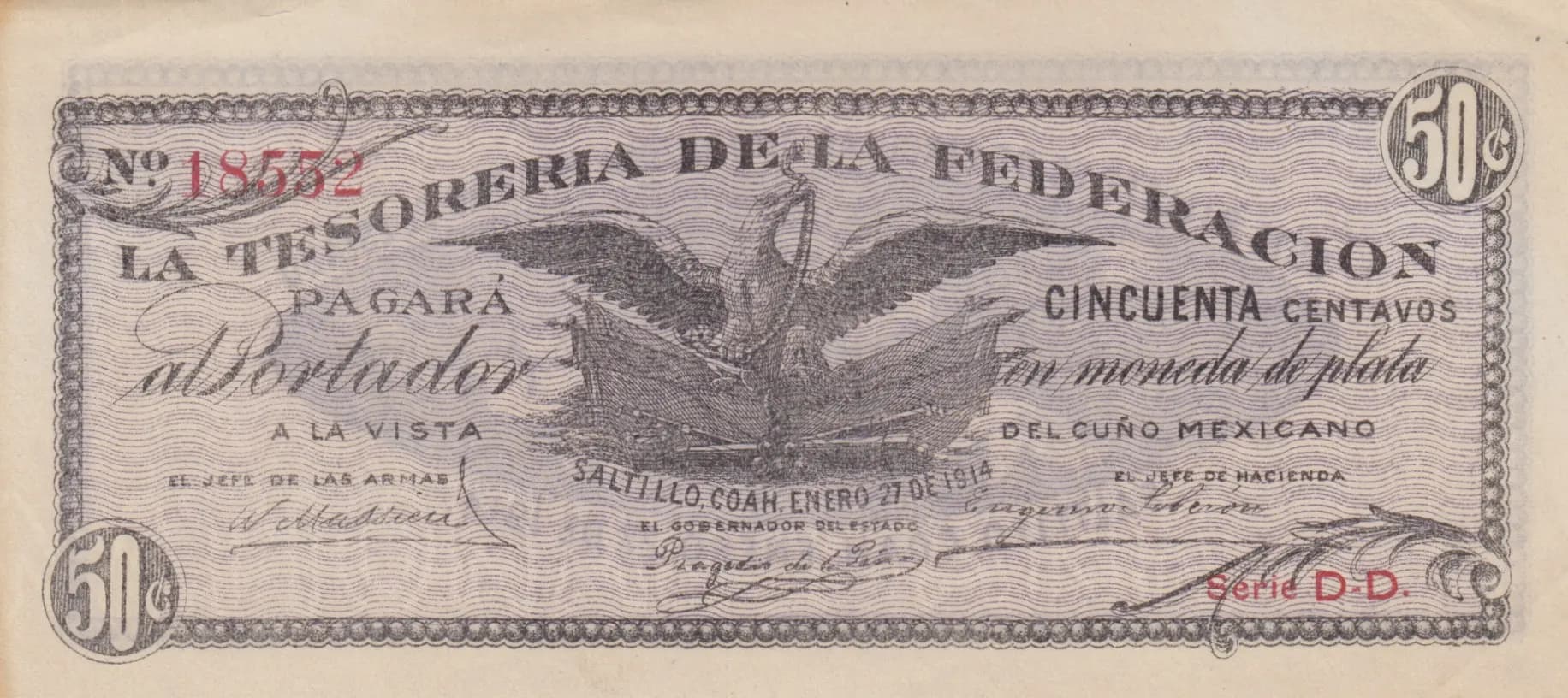
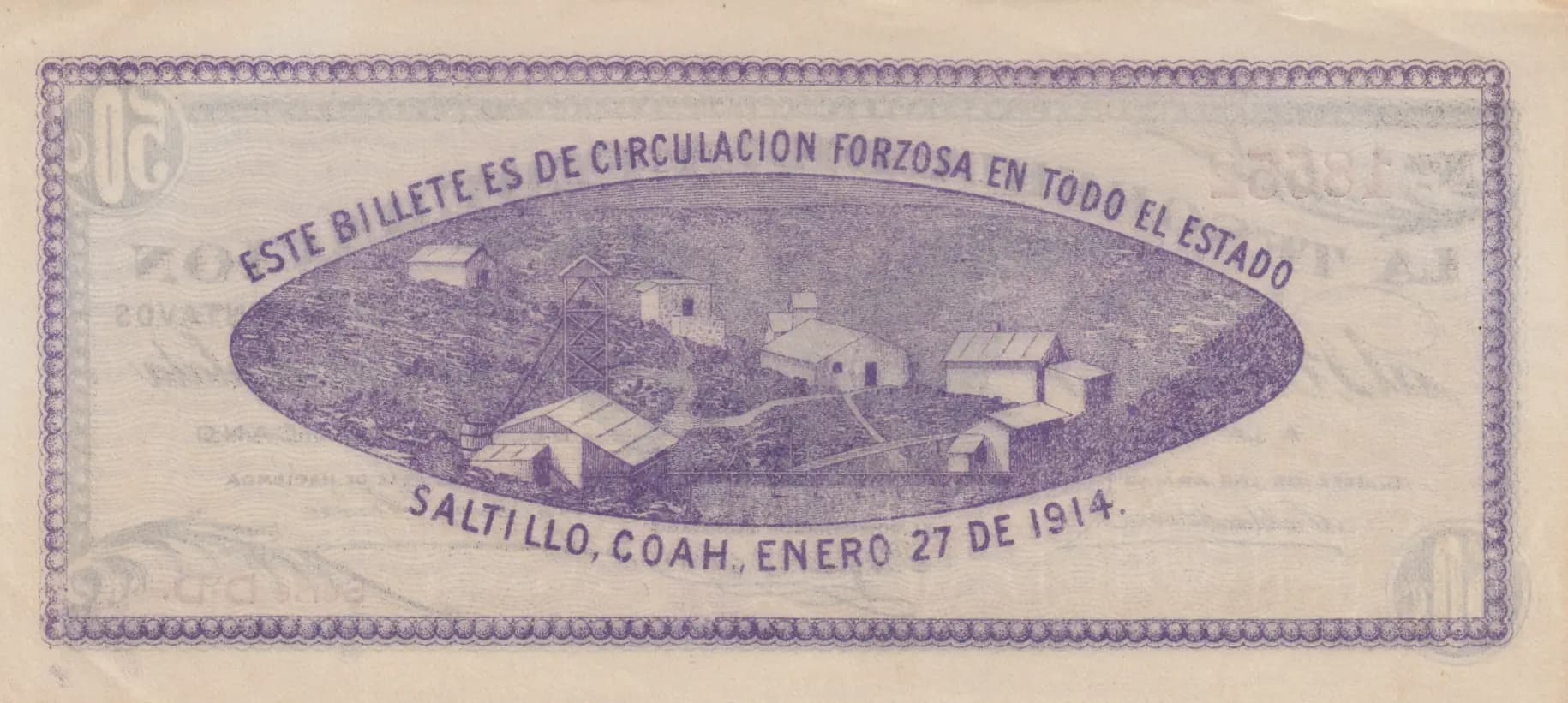
This 50 centavos note from January 27, 1914, issued by the Tesorería de la Federación in Saltillo during the Mexican Revolution, exemplifies the emergency currency produced by regional authorities during political turmoil. The AU condition grade reflects well-preserved printing with only moderate age-related patina and foxing, making it a desirable example of this historically significant issue. The note's dual-color design—black eagle on the obverse and purple landscape on the reverse—remains crisp and clearly legible, with handwritten serial markings adding authentic period character.
Common. While this note represents an important historical period during the Mexican Revolution and regional monetary fragmentation, Tresorería de la Federación issues from Saltillo circa 1914 were produced in sufficient quantities for general state circulation. The series DD designation and serial number 185552 suggest a significant print run. Revolutionary-era Mexican state notes, though historically significant, generally remain abundant in collector markets relative to pre-Revolutionary or early Republic currency. Absence of evidence of recalls, short production runs, or extreme scarcity in numismatic references supports a common classification.
Issued during Mexico's tumultuous Revolutionary period, this Saltillo-based note represents the Coahuila state government's assertion of monetary authority independent from the federal capital. The inscription declaring 'forced circulation throughout the entire state' reflects the regional fragmentation of Mexican authority circa 1914, when state governments and military commanders issued their own currency to finance operations and maintain economic control. The depicted rural landscape on the reverse may reference local Coahuilan geography or symbolize the state's agrarian character during this period of social upheaval.
The obverse features a central Mexican eagle with spread wings, a national symbol representing federal authority, rendered in black ink within a decorative border of intricate line patterns. Circular denomination markers displaying '50' occupy opposite corners in traditional banknote placement. The reverse presents an oval-framed landscape vignette in purple ink depicting a rural Coahuilan settlement with multiple buildings, a prominent tower or windmill structure, and hillside terrain—imagery symbolizing the state's agrarian base. Both sides employ wavy line background patterns and ornamental borders as period-appropriate security measures. The denomination 'Cincuenta Centavos' (Fifty Centavos) is prominently stated, with redemption terms ('al portador, a la vista') emphasizing bearer on-demand payment in silver.
FRONT: 'La Tesorería de la Federación pagará al portador a la vista cincuenta centavos en moneda de plata del cuño mexicano' (The Federal Treasury will pay the bearer on sight fifty centavos in Mexican silver coinage). 'El Jefe de las Armas' and 'El Jefe de Hacienda' (Chief of Arms and Chief of Finance) appear as signatory authorities. 'Saltillo, Coah., Enero 27 de 1914' (Saltillo, Coahuila, January 27, 1914). Series DD, Serial No. 185552. BACK: 'Este billete es de circulación forzosa en todo el estado' (This banknote is of forced circulation throughout the entire state). 'Saltillo, Coah., Enero 27 de 1914' (Saltillo, Coahuila, January 27, 1914).
Intaglio printing, evidenced by the crisp line work in the decorative borders, eagle rendering, and landscape vignette details. The black obverse and purple reverse demonstrate two-color intaglio printing typical of early 20th-century emergency currency. No major security printer attribution is definitively established for this Pick catalog number; Saltillo regional printing facilities or Mexican government printers likely produced the note in-house. The handwritten elements (serial numbers in red ink, series designation) were added post-printing for individual note identification.
Series DD is noted; this example carries serial number 185552. Known varieties for Pick S644 include different series designations (A through D reported). The January 27, 1914 date is consistent with the initial issue; later dated impressions from 1914 represent additional varieties. Signature varieties may exist corresponding to different officials serving as 'Jefe de las Armas' and 'Jefe de Hacienda,' though specific signature identification requires direct comparison with cataloged examples. The red handwritten notations appear to be standard issue numbering rather than overprints distinguishing separate varieties.