50 centavos 1914
About This Note
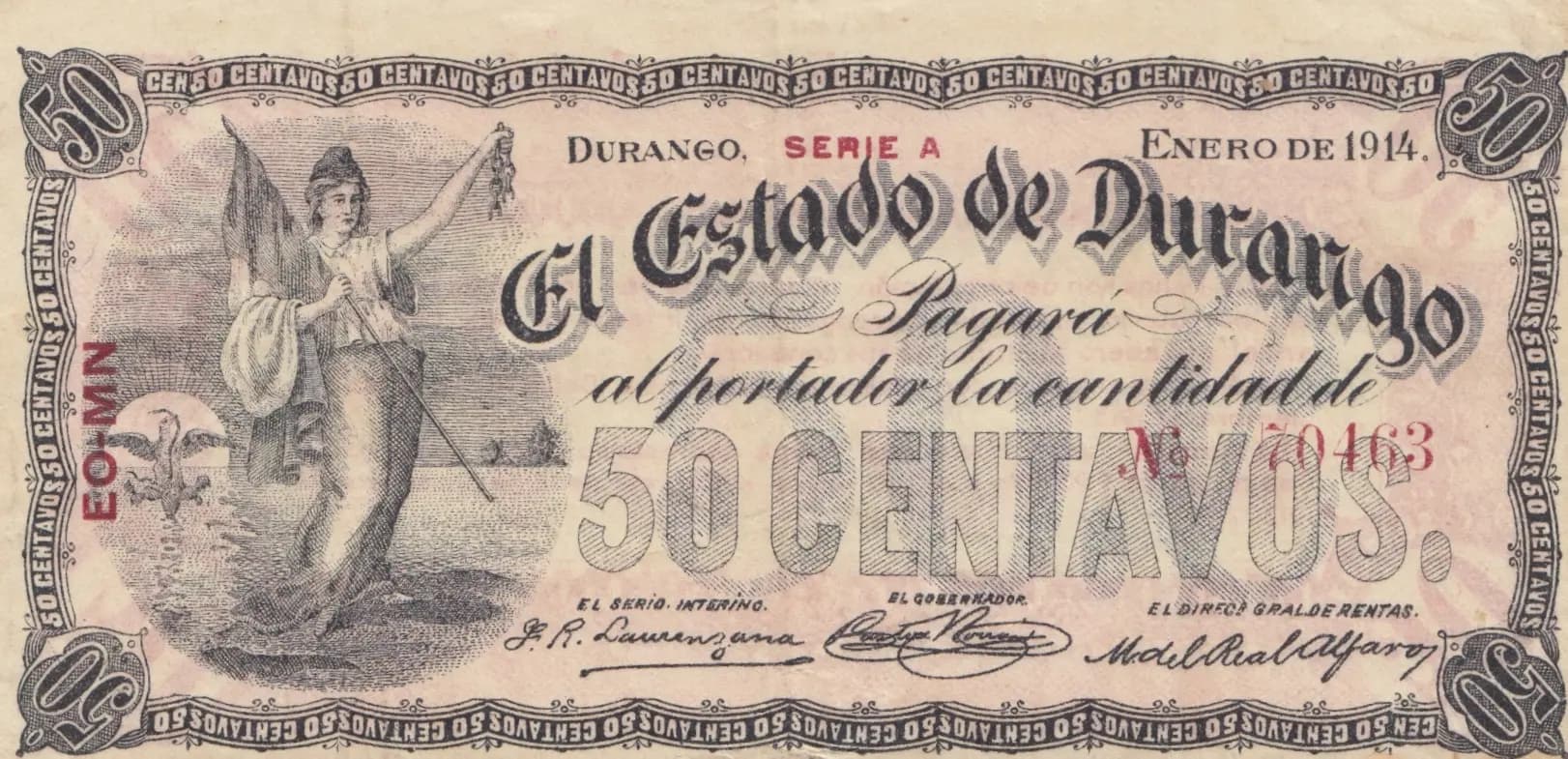
This 50 centavos note from Estado de Durango (January 1914, Series A) presents an exceptional example of Mexican Revolutionary-era state currency, featuring a classical allegorical Liberty figure on the obverse and detailed legal text on the reverse. The VF condition grade is appropriate, with visible age-related yellowing, foxing, and minor wear consistent with a note over a century old; the crisp engraving and strong impression of both sides remain clearly legible. This is a significant example of Mexican emergency currency issued during the tumultuous early years of the Mexican Revolution.
Common. Estado de Durango issued multiple denominations of these emergency bonds in 1914, and this denomination appears with reasonable frequency in collections of Mexican Revolutionary currency. While these notes have historical significance and represent an important chapter of Mexican numismatic history, they were produced in quantities sufficient to meet state circulation demands during the period, and examples survive in various condition grades. The VF condition grade is desirable but not exceptionally scarce, and such notes typically realize modest prices reflecting their common status among specialized collectors of Mexican emergency currency rather than commanding premiums associated with genuinely rare issues.
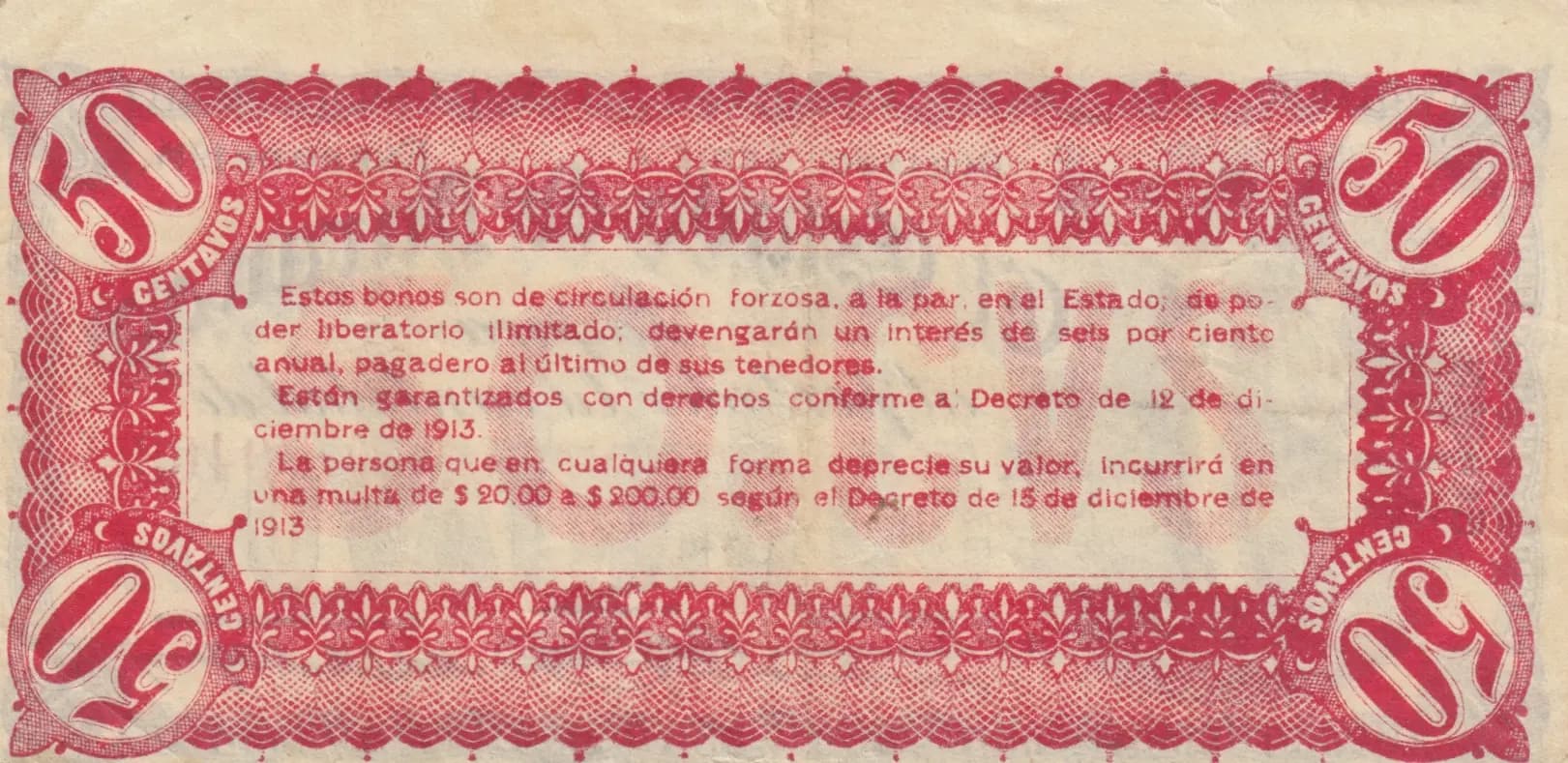
Issued during the height of the Mexican Revolution when federal currency was scarce and unstable, the Estado de Durango issued this bond-like currency (boleta) as forced circulation legal tender within the state. The reverse text explicitly declares the bonds carried 6% annual interest and unlimited liberatory power, backed by a December 1913 decree; the threat of fines up to 200 pesos for depreciation underscores the state government's desperate need to maintain confidence in its emergency money. The classical allegorical imagery of Justice holding scales and a sword reflects Mexico's aspirations toward constitutional order even amid the chaos of civil war.
The obverse features a classical allegorical female figure representing Liberty or Justice, rendered in the neoclassical style common to Mexican state bonds of the era. She is depicted wearing flowing classical robes and a decorative headdress, holding aloft a sword in one hand and the scales of justice in the other—symbolizing both the power and fairness of the Durango state government. An eagle emblem appears on the left side, representing Mexican sovereignty. The entire design is framed by ornamental borders with the denomination 'Cincuenta Centavos' repeated along the top and bottom edges in fine engraved lettering. A red 'Boleta' (bond/ballot) stamp is prominently applied to the left side. The reverse is dominated by large ornamental numerals '50' positioned in all four corners, with the central area filled by dense legal text explaining the bond's terms. Symmetrical decorative geometric and floral patterns form an intricate border, typical of security printing of the period. The color scheme—black and red on cream paper—provides strong contrast and aided authentication in an era before modern security features.
FRONT SIDE: 'Cincuenta Centavos' (Fifty centavos) / 'Durango' / 'Serie A' (Series A) / 'Enero de 1914' (January 1914) / 'El Estado de Durango' (The State of Durango) / 'Para al perdedor la cantidad de 50 Centavos' (For the loser the amount of 50 centavos) / Serial number 'No 20463' / Signature lines for 'El Secretario Interino' (The Interim Secretary), 'El Gobernador' (The Governor), and 'El Director Gral de Rentas' (The General Director of Income) with names J.R. Lamaygana, Carlos Mounte, and Madel Real Alfaro / 'Boleta' (Ballot/Bond ticket, stamped in red). BACK SIDE: 'Cincuenta Centavos' (Fifty centavos) / 'Estos bonos son de circulación forzosa, á la par, en el Estado, de poder liberatorio ilimitado; devengarán un interés de seis por ciento anual, pagadero al último de sus tenedores' (These bonds are of forced circulation, at par, in the State, with unlimited liberatory power; they shall accrue an interest of six percent annually, payable to the last of their holders) / 'Están garantizados con derechos conforme á Decreto de 12 de diciembre de 1913' (They are guaranteed with rights according to Decree of December 12, 1913) / 'La persona que en cualquiera forma deprecie su valor, incurrirá en una multa de $ 20.00 á $ 200.00 según el Decreto de 15 de diciembre de 1913' (The person who in any way depreciates its value shall incur a fine of $20.00 to $200.00 according to the Decree of December 15, 1913).
This note was produced using intaglio engraving (copperplate printing), evidenced by the fine line work, intricate detail, and consistent impression visible in both the allegorical figure and the ornamental borders throughout the design. The precision of the repeated text borders and the depth of the engraved lines are characteristic of high-security intaglio production. The printer is not identified on the note itself; however, such state emergency currency during the Mexican Revolution was typically produced either by Mexican government printing establishments or by commercial printers contracted by state governments. The quality of the engraving suggests professional security printing rather than hasty wartime production.
This example is identified as Series A (Serie A), dated January 1914, with serial number 20463. The three signatories—J.R. Lamaygana, Carlos Mounte, and Madel Real Alfaro—occupy the positions of Interim Secretary, Governor, and General Director of Income respectively. Known varieties for P-S729 may include different series designations and varying signature combinations as different officials served throughout 1914; collectors should cross-reference the specific series, date, and signature combination against other documented examples to identify all catalogued varieties for this denomination.