50 centavos 1914
About This Note
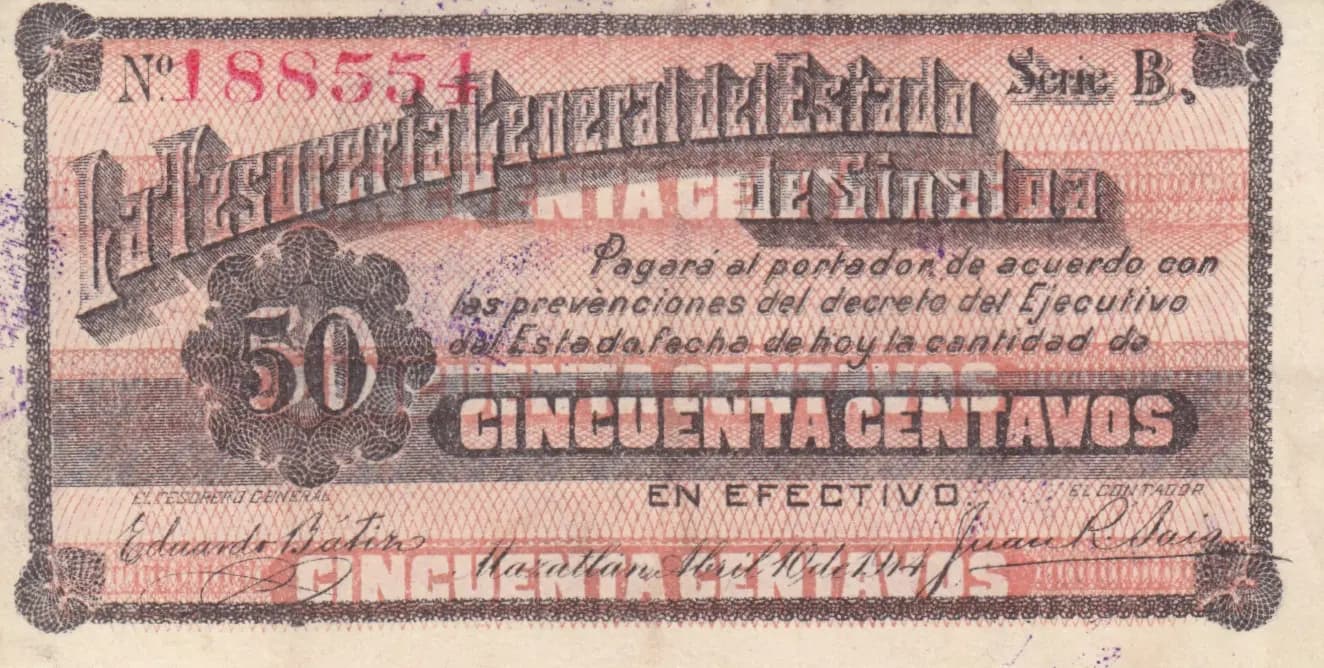
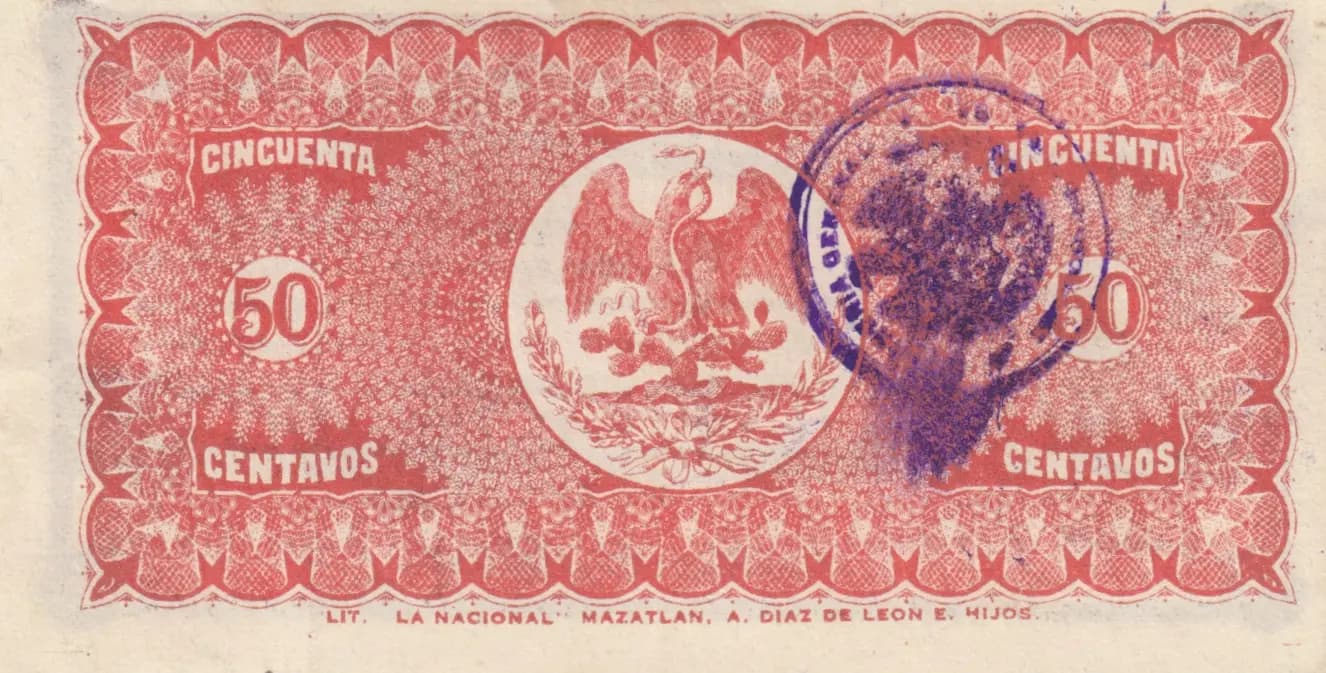
This is a 50 centavos banknote issued by the Tesoreria General del Estado de Sinaloa in 1914, during Mexico's revolutionary period. The note displays the characteristic pinkish-red obverse with ornamental corner designs and handwritten signatures of Eduardo Vatiús and Juan R. Ruiz, while the reverse features the Mexican eagle coat of arms within a decorative wreath on a crimson background. In AU condition, the note shows expected age-related patina with foxing and browning, though the note bears a prominent blue circular cancellation stamp across the reverse that significantly impacts its collectibility.
Common. State-issued banknotes from the Mexican Revolutionary period, while historically significant, were produced in substantial quantities by their respective regional authorities. The series designation (Serie B) and relatively high serial number (188554) suggest a significant print run. Despite its age and historical interest, this note type does not command premium prices typical of rare issues. The presence of a cancellation stamp, while reducing appeal to some collectors, does not indicate rarity—such stamps were applied to many circulated examples of this series.
This state-issued banknote emerged during the Mexican Revolution when central government authority was fragmented and regional authorities, including Sinaloa, issued their own currency. The note's promise to 'pay to bearer in accordance with the provisions of the decree of the Executive of the State' reflects the decentralized fiscal authority of the period. The lithographic printing by La Nacional in Mazatlán and the handwritten signatures of state officials underscore the emergency conditions and local control characteristic of revolutionary-era Mexican currency.
The obverse features a classical architectural element (likely a government building) in the upper portion, surrounded by ornamental corner rosettes and decorative flourishes typical of early 20th-century Mexican banknote design. The denomination is prominently displayed in the center with the state's obligation text. The reverse displays the Mexican national coat of arms—the eagle perched on a cactus—enclosed within a circular wreath of laurel or similar botanical design, serving as a patriotic symbol affirming the note's legitimacy despite its provincial origin. The entire design is framed by repeating banner or flag-like ornamental patterns creating a formal, official appearance. The pinkish-red and crimson color scheme was typical of Mexican currency of this period.
FRONT: 'Cincuenta Centavos en Efectivo' (Fifty Centavos in Cash); 'Pagará al portador de acuerdo con las prevenciones del decreto del Ejecutivo del Estado, fecha de hoy la cantidad de' (Will pay to bearer in accordance with the provisions of the decree of the Executive of the State, dated today the amount of); Serial number 'No 188554'; 'Serie B' (Series B); Signatures: 'Eduardo Vatiús' and 'Juan R. Ruiz'. BACK: 'Cincuenta Centavos' (Fifty Centavos); Denomination '50'; 'Lit. 'La Nacional' Mazatlán, A. Díaz de León e. Hijos' (Lithography 'La Nacional' Mazatlán, A. Díaz de León and Sons).
Lithography, as explicitly credited on the reverse to 'La Nacional' printing house in Mazatlán under the direction of A. Díaz de León and Sons. The fine line work visible in the ornamental borders, the detailed wreath design around the eagle, and the overall character of the design are consistent with chromolithographic printing techniques employed for this note.
This example is identified as Serie B based on the visible inscription. The serial number 188554 places it within the documented range for this series. The specific signatures of Eduardo Vatiús and Juan R. Ruiz may represent a particular signing variety, as Sinaloa state notes sometimes exhibit variations in authorized signatories reflecting changes in state administration. The blue circular cancellation stamp is a collecting variety that distinguishes this specimen from uncanceled examples, though cancellations were commonly applied to circulated notes of this era by banks or government agencies to prevent reuse.