20 pesos 1913
Market Prices
3 salesAbout This Note
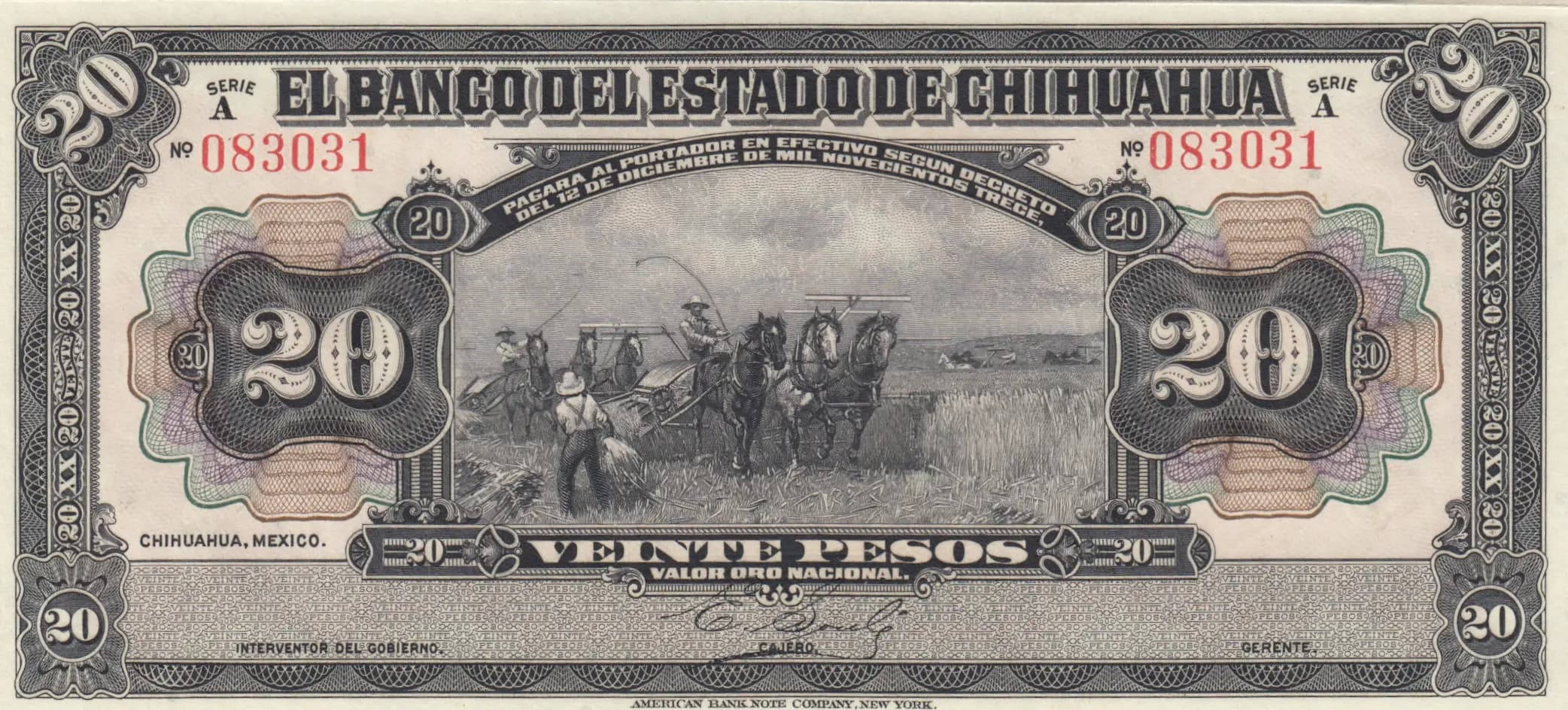
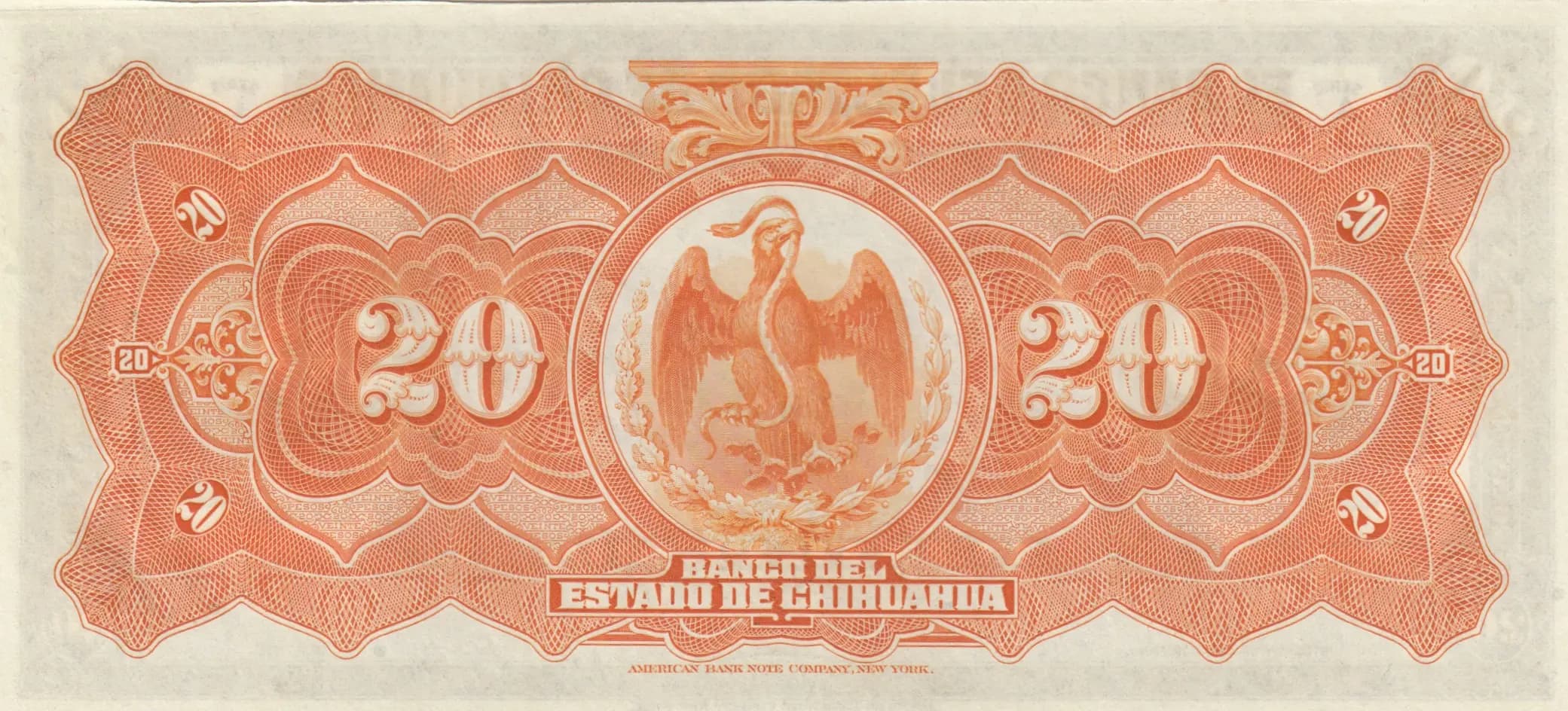
This is an AU-graded 20 peso note from Banco del Estado de Chihuahua, issued in 1913 by the American Bank Note Company. The obverse features a striking rural harvesting scene with multiple figures and horses in an agricultural landscape, rendered in black and green tones with crisp engraving detail. The reverse displays Mexico's national eagle within an ornate oval medallion surrounded by a wreath, printed in distinctive salmon-pink tones. The note shows excellent preservation with sharp printing, clear inscriptions, and no visible wear, making it a desirable example of this regional Mexican state bank issue.
Common. Although this is a regional Mexican state bank note from the revolutionary era, eBay price tracking data shows recent sales ranging from $102.50 to $187.50 for grades PMG 53-66, indicating steady collector demand and adequate supply. The note was issued by a legitimate state bank with the backing of a major international security printer (ABNC), suggesting reasonable print quantities. No evidence suggests limited circulation, recall, or extreme scarcity. The AU condition grade observed here would likely fetch $150-200 based on recent comparable sales, consistent with pricing for common banknotes in premium condition.
This note was issued during a tumultuous period in Mexican history, just three years into the Mexican Revolution (1910-1920). Banco del Estado de Chihuahua, a regional state bank, issued currency during this era when multiple regional authorities and private banks were competing to provide circulating currency across Mexico. The prominent depiction of rural agricultural labor on the obverse reflects Chihuahua's economy and identity as a primarily agrarian state during the early 20th century, while the Mexican national eagle on the reverse asserts the bank's legitimacy as a Mexican financial institution.
The obverse features an ornate border with decorative scrollwork in the corners framing a central vignette depicting a rural harvesting or agricultural scene with approximately four to five male laborers and horses working in an open field landscape. Large ornamental cartouches containing the denomination '20' are positioned on both left and right sides. The note is printed primarily in black with green and brown/tan accents. The reverse displays a highly symmetrical design dominated by Mexico's national eagle (águila mexicana) depicted facing right with spread wings, centered within an oval medallion surrounded by a decorative wreath. The eagle is rendered in light cream/pink tones against a darker salmon-pink background. Matching ornamental cartouches with the numeral '20' flank the central composition. The entire design showcases intricate geometric and floral ornamental patterns characteristic of late 19th and early 20th century banknote design.
FRONT: 'EL BANCO DEL ESTADO DE CHIHUAHUA' (The Bank of the State of Chihuahua), 'SERIE A' (Series A), 'No 083031' (Serial number 083031), 'VEINTE PESOS' (Twenty Pesos), 'VALOR ORO NACIONAL' (National Gold Value), 'CHIHUAHUA, MEXICO', 'AMERICAN BANK NOTE COMPANY, NEW YORK' (printer attribution), with signature lines labeled 'INTERVENTOR DEL GOBIERNO' (Government Interventor), 'CAJERO' (Cashier), and 'GERENTE' (Manager). BACK: '20' (denomination numeral), 'BANCO DEL ESTADO DE CHIHUAHUA' (Bank of the State of Chihuahua), and 'AMERICAN BANK NOTE COMPANY, NEW YORK' (printer attribution).
Intaglio engraving (line engraving), the standard security printing method employed by the American Bank Note Company. The visual analysis confirms fine line engraving throughout with complex ornamental patterns, multiple color printing achieved through the intaglio process, and intricate vignette engraving. The multiple color tones (black, green, brown, pink) visible on both sides indicate separate plates or passes for different color applications, which is consistent with ABNC's multi-color intaglio production methods of the era.
This example is identified as Series A with serial number 083031 printed in red ink. The catalog reference indicates this is an 'Issued note with 1 signature,' suggesting signatures of a single official appear on the note (likely the Cashier or Manager based on the signature lines visible). Pick catalog number P-S134 designates this as the standard regular issue for this denomination and issuer. No overprints, date variations, or other known varieties are indicated for this Pick number; the 1913 date and Series A designation appear to be constants for this issue.