100 pesos 1915
About This Note
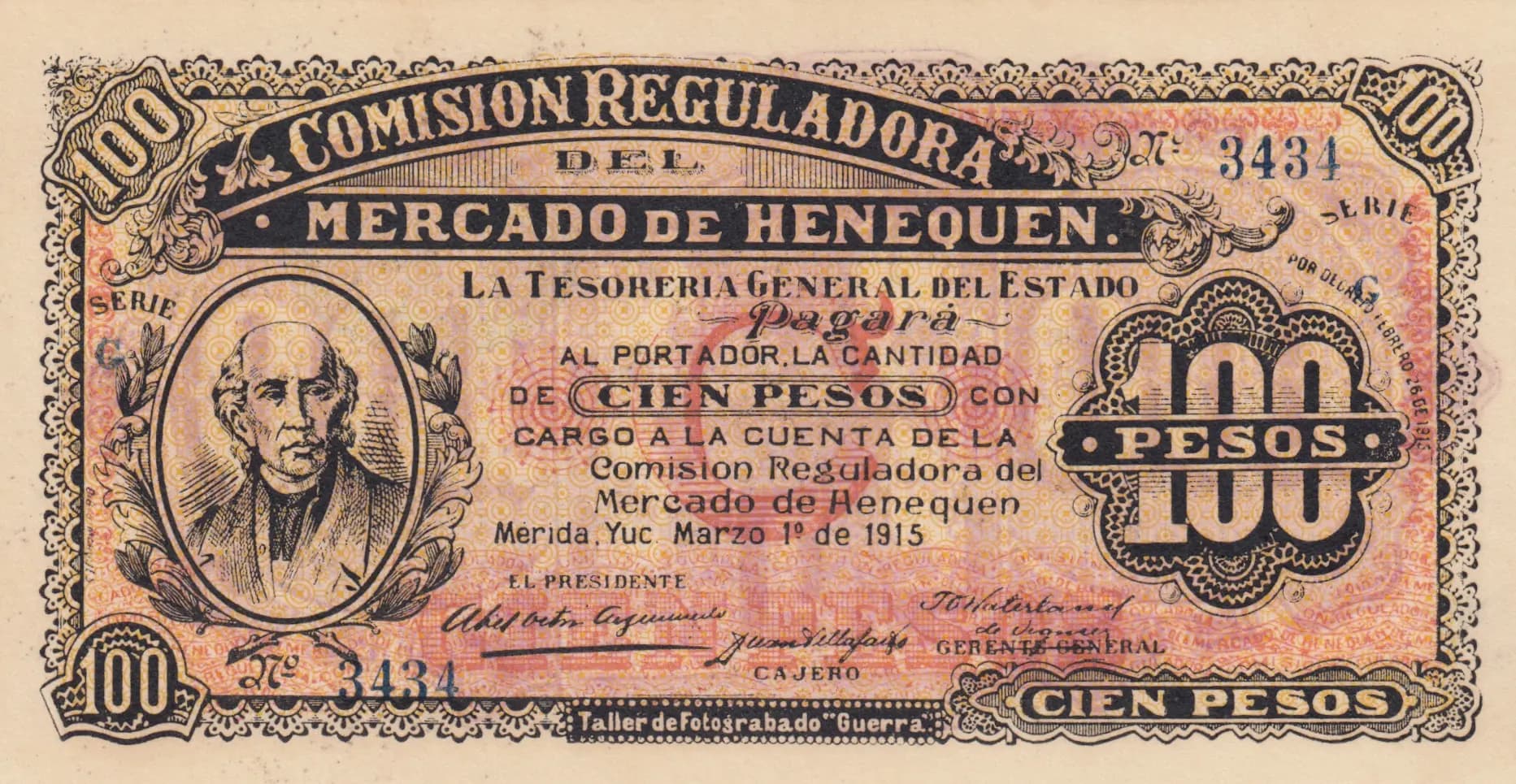
A striking 100 pesos note issued by the Comisión Reguladora del Mercado de Henequén in 1915, during Mexico's Revolutionary period. The note features ornate engraved design with a portrait on the obverse and a detailed colonial church architecture on the reverse, printed in tan/beige and purple color schemes. Despite significant age-related foxing, staining, and paper brittleness consistent with early 20th-century currency storage, the note retains clear impressions of its complex security features and fine engraving work by Guerra's workshop.
Common. While this represents a regional emergency issue from a specific commodity commission during the Mexican Revolution, the Comisión Reguladora del Mercado de Henequén issued currency for several years during this period, and reasonable quantities of the 100 pesos denomination appear in the market. The UNC condition grade is less common than lower grades for notes of this age, but the Pick catalog designation (P-S1125) indicates this is a cataloged, established issue rather than an obscure emergency note. Regional Mexican Revolutionary currency from this issuer and denomination is widely collected but not scarce.
Issued during the Mexican Revolution by the Yucatán state's henequén (sisal fiber) market regulatory commission on March 1, 1915, this note represents an emergency monetary instrument created during regional political and economic upheaval. The depicted colonial church architecture reflects Yucatán's Spanish colonial heritage, while the henequén industry was a critical regional economic asset. The note's issuance by a specialized commodity commission rather than a central bank reflects the fragmented financial conditions during Mexico's revolutionary period when multiple competing authorities issued currency.
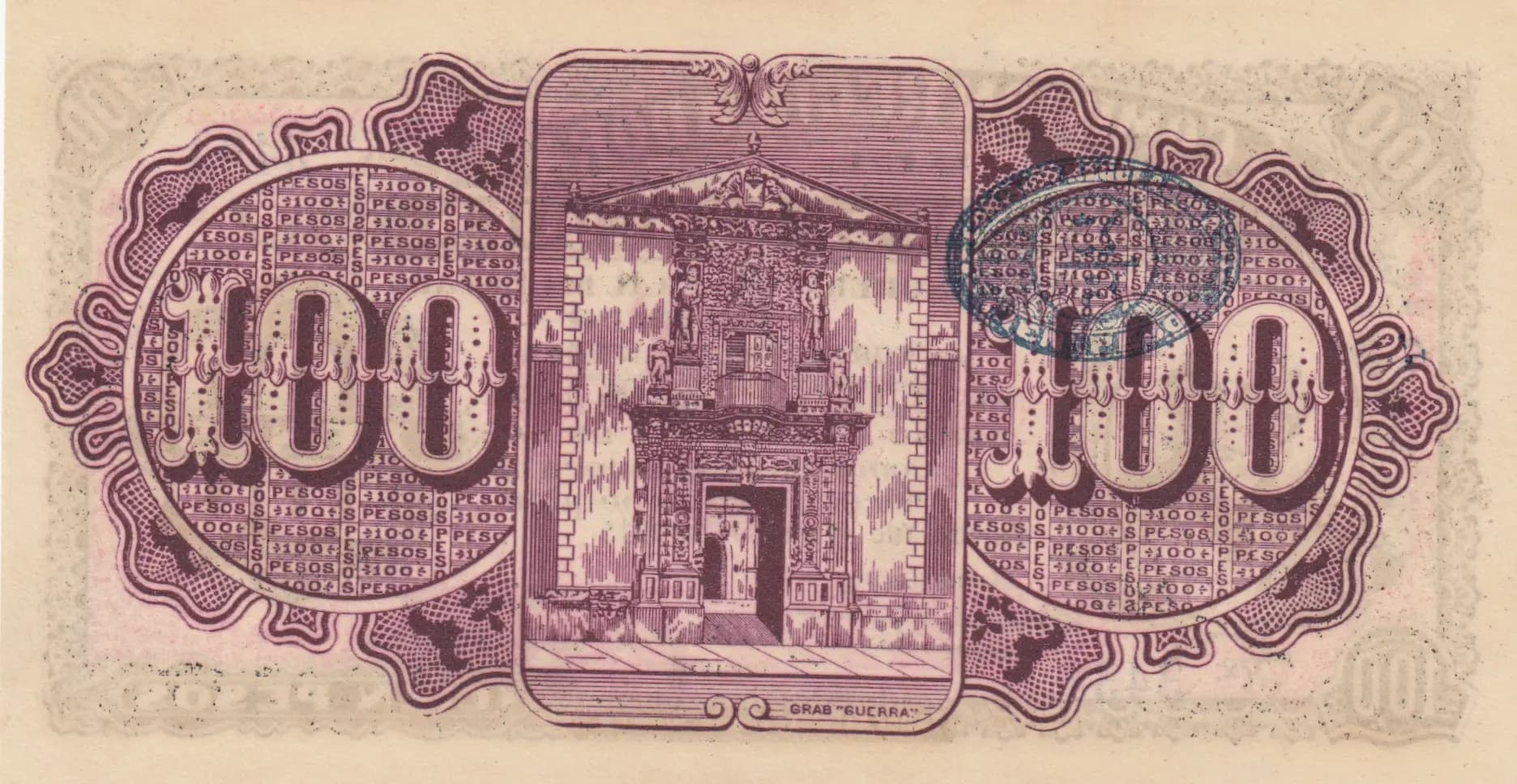
The obverse features an oval-framed portrait of an older gentleman in left profile with receding hairline, flanked by laurel wreaths symbolizing authority and honor. Large ornamental cartouches in the top-left and bottom-right corners display the denomination '100 PESOS' in decorative script. The center text layout announces the promise to pay in both numerical ('100') and textual ('CIEN PESOS') forms, with administrative signature lines for the President, General Manager, and Cashier. The reverse showcases a detailed architectural engraving of a colonial-era church or cathedral, likely representing a significant structure in Mérida, Yucatán, with distinctive arched entrances, twin flanking towers, and multi-level decorative stonework typical of Spanish colonial ecclesiastical architecture. The denomination cartouches on the reverse are circular rather than ornamental, and the background is filled with repetitive 'PESOS' text as a security measure.
FRONT SIDE: 'Comisión Reguladora del Mercado de Henequén' (Henequén Market Regulatory Commission) / 'La Tesorería General del Estado pagará al portador la cantidad de cien pesos con cargo a la cuenta de la Comisión Reguladora del Mercado de Henequén' (The General Treasury of the State will pay to the bearer the amount of one hundred pesos charged to the account of the Henequén Market Regulatory Commission) / 'Mérida, Yuc. Marzo 1º de 1915' (Mérida, Yucatán. March 1st, 1915) / 'El Presidente' (The President) / 'Gerente General' (General Manager) / 'Cajero' (Cashier) / 'Serie 3434' (Series 3434) / 'Taller de fotograbado Guerra' (Guerra Photogravure Workshop). REVERSE SIDE: '100 PESOS' (denomination, appears twice in circular cartouches) / 'PESOS' (repeated as security pattern throughout ornamental borders) / 'GRAB GUERRA' (Guerra Engraving).
Photogravure (fotograbado) engraving process, as explicitly credited to the 'Taller de fotograbado Guerra' (Guerra Photogravure Workshop) on the obverse. This technique involved photographic transfer of design elements to engraved plates, allowing for fine detail reproduction and intricate security features including the portrait, architectural rendering, and repetitive microtext pattern. The note exhibits characteristics consistent with early 20th-century photogravure work: fine line detail, subtle gradations in the engraved portraits and architecture, and complex decorative borders.
Series 3434 is noted on this example. While the visual analysis does not reveal overprints or obvious major variants, collectors should note that Mexican Revolution-era regional currency often exists with signature variety (different officials signed different printings). The specific dating of 'Marzo 1º de 1915' (March 1, 1915) is fixed for this issue. This appears to represent a mid-run example from the initial 1915 printing series. Further variety research would require comparison of other examples' signature combinations and serial number ranges.