100 pesos 1965
Market Prices
7 salesAbout This Note
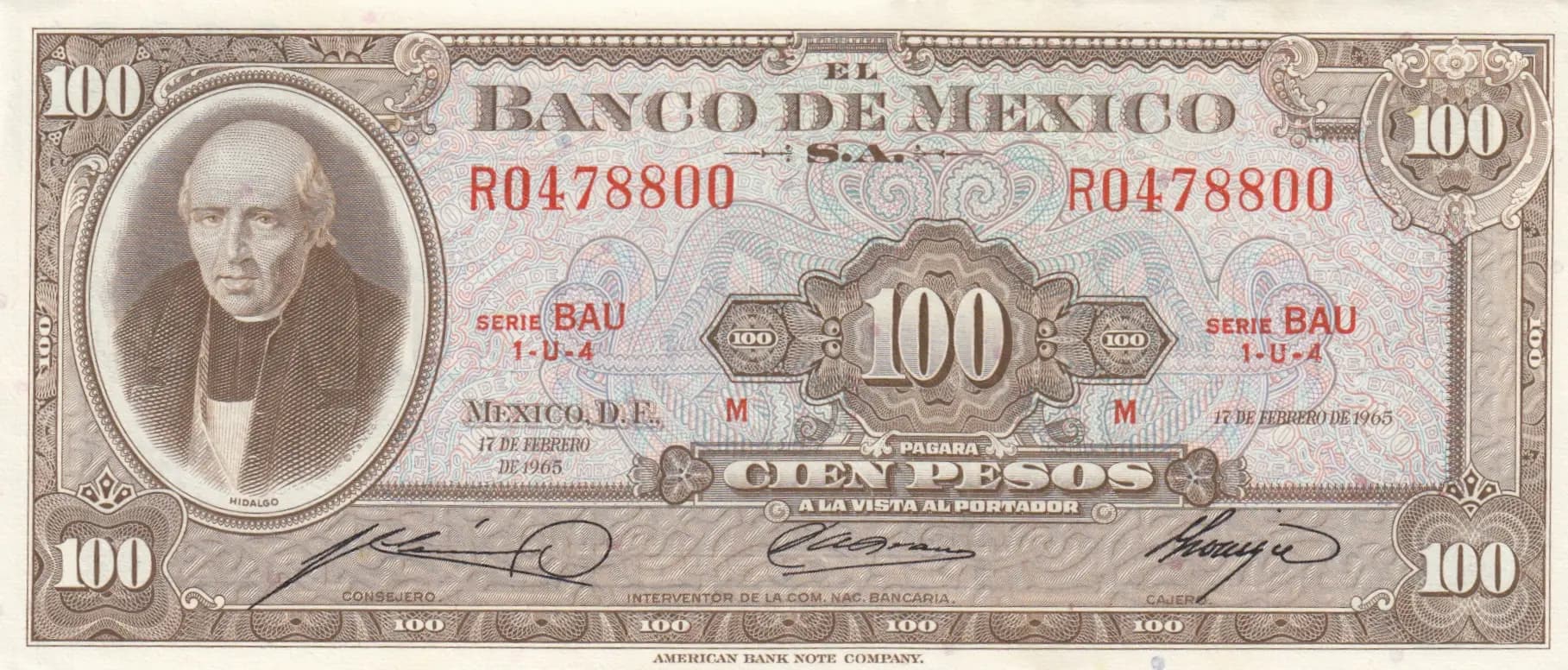
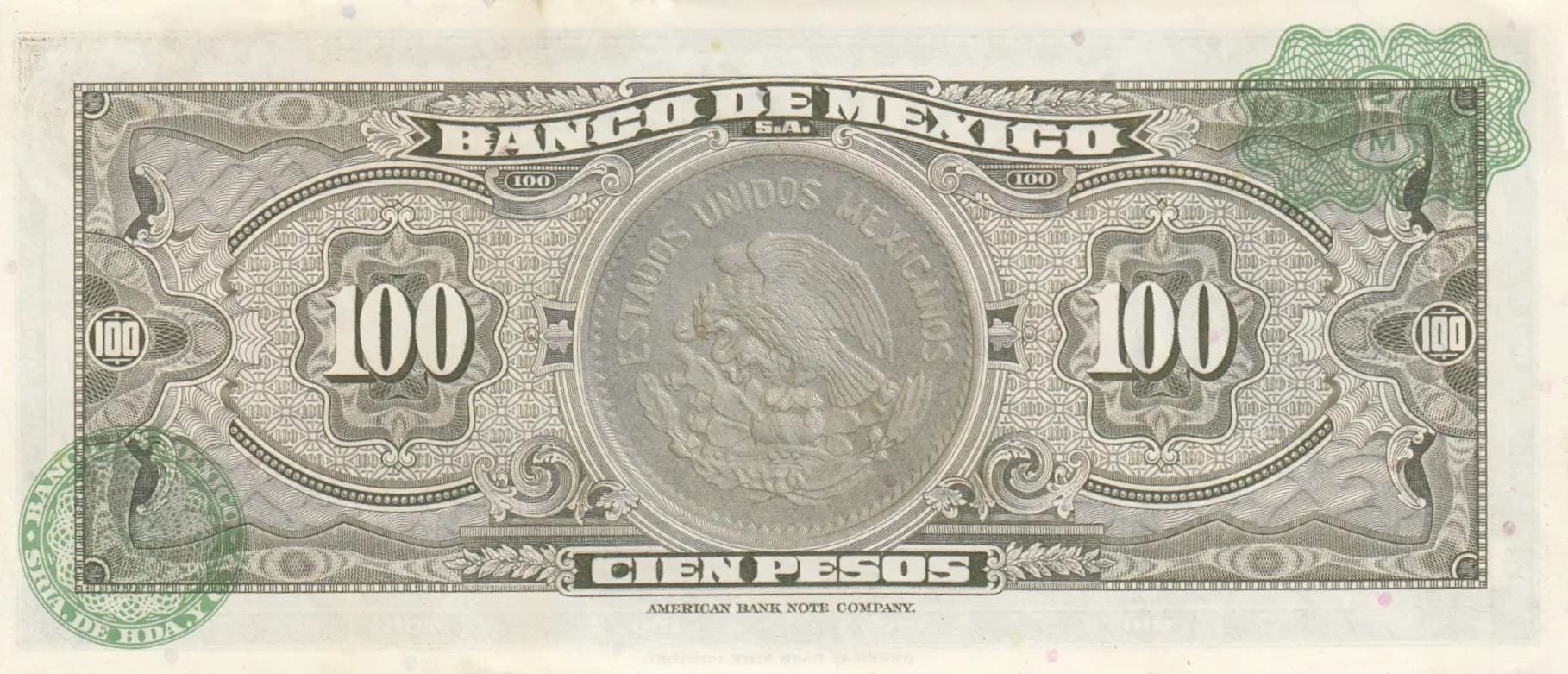
This is a Mexican 100 pesos banknote from 1965 (Pick P-61c), printed by the American Bank Note Company in Series BAU. The note is presented in uncirculated condition with sharp, clear printing throughout and no visible wear, creases, or damage. The design features ornate brown and multicolor engraving with a formal portrait medallion on the obverse and an eagle emblem within a circular central medallion on the reverse, exemplifying the high-quality intaglio security printing standards of mid-20th century Mexican currency.
Common. This is a regular-issue banknote from a major denomination produced by the Banco de México with multiple series variants (BAQ-BCD noted in catalog data, with this example in Series BAU). Market data from eBay sales shows UNC examples selling for $8-18 (2012-2019), with PMG-graded examples in the $23-56 range, indicating healthy collector availability. The 1965 100 pesos notes were produced in substantial quantities for circulation. No evidence of recall, short print run, or scarcity in the available data.
Issued on February 17, 1965, this banknote represents Mexico's monetary system during a period of economic development in the 1960s. The Banco de México, as the nation's central bank, continued commissioning international security printers like ABNC to produce high-quality currency featuring national symbols including the eagle emblem (likely representing Mexico's national coat of arms). The notation 'A LA VISTA AL PORTADOR' (payable to bearer on sight) reflects the bearer-note conventions typical of this era in Mexican banking practice.
The obverse features an ornate brown and multicolor engraved design with an oval portrait medallion positioned on the left side containing a male figure in formal attire, possibly a historical Mexican dignitary or official. Large decorative '100' numerals appear in hexagonal frames, with the denomination text 'CIEN PESOS' prominently displayed at the bottom. The reverse displays an eagle emblem (Mexico's national coat of arms) within a large circular central medallion, flanked by decorative hexagonal frames containing '100' numerals on both sides. Both sides feature intricate floral and scroll ornamental patterns throughout the design, with green-colored security seals or stamp impressions visible on the reverse margins. The overall design employs classical engraved border work characteristic of ABNC production standards.
OBVERSE: 'EL BANCO DE MEXICO' (The Bank of Mexico); 'CIEN PESOS' (One Hundred Pesos); 'A LA VISTA AL PORTADOR' (Payable to bearer on sight); 'PAGARA' (Will pay); 'CAJERO' (Cashier); 'CONSUERO' (Signatory title); 'INTERVENTOR DE LA COM. NAC. BANCARIA' (Comptroller of the National Banking Commission); 'MEXICO, D.F.' (Mexico City); '17 DE FEBRERO DE 1965' (February 17, 1965); Serial number 'R0478800'; Series designation 'SERIE BAU 1-U-4'; Printer mark 'AMERICAN BANK NOTE COMPANY'. REVERSE: 'BANCO DE MEXICO' (Bank of Mexico); 'CIEN PESOS' (One Hundred Pesos); 'S.A.' (Sociedad Anónima/Joint Stock Company); 'AMERICAN BANK NOTE COMPANY'; Denomination numerals '100'.
Intaglio engraving (steel plate engraving), with multicolor printing on both obverse and reverse. The note exhibits the characteristic sharp line work, fine detail reproduction, and depth of impression typical of high-security banknote production. Produced by American Bank Note Company (ABNC), one of the world's leading security printers, as indicated by the printer's mark on both sides. The red serial number printing and green security seals/stamp impressions represent additional color separations typical of the era's security printing methodology.
This note is identified as Pick P-61c, representing a variant characterized by series letters positioned below the serial number (as opposed to earlier variants). The specific series designation visible here is 'SERIE BAU 1-U-4', placing it within the BAU series range. The catalog notation indicates series range BAQ-BCD for this Pick number, with this example in the BAU series. The note dates to the February 17, 1965 issue date standard for this type. No overprints or special markings beyond standard institutional signatures and security features are observed.