100 pesos 1898-1911
Market Prices
1 saleAbout This Note
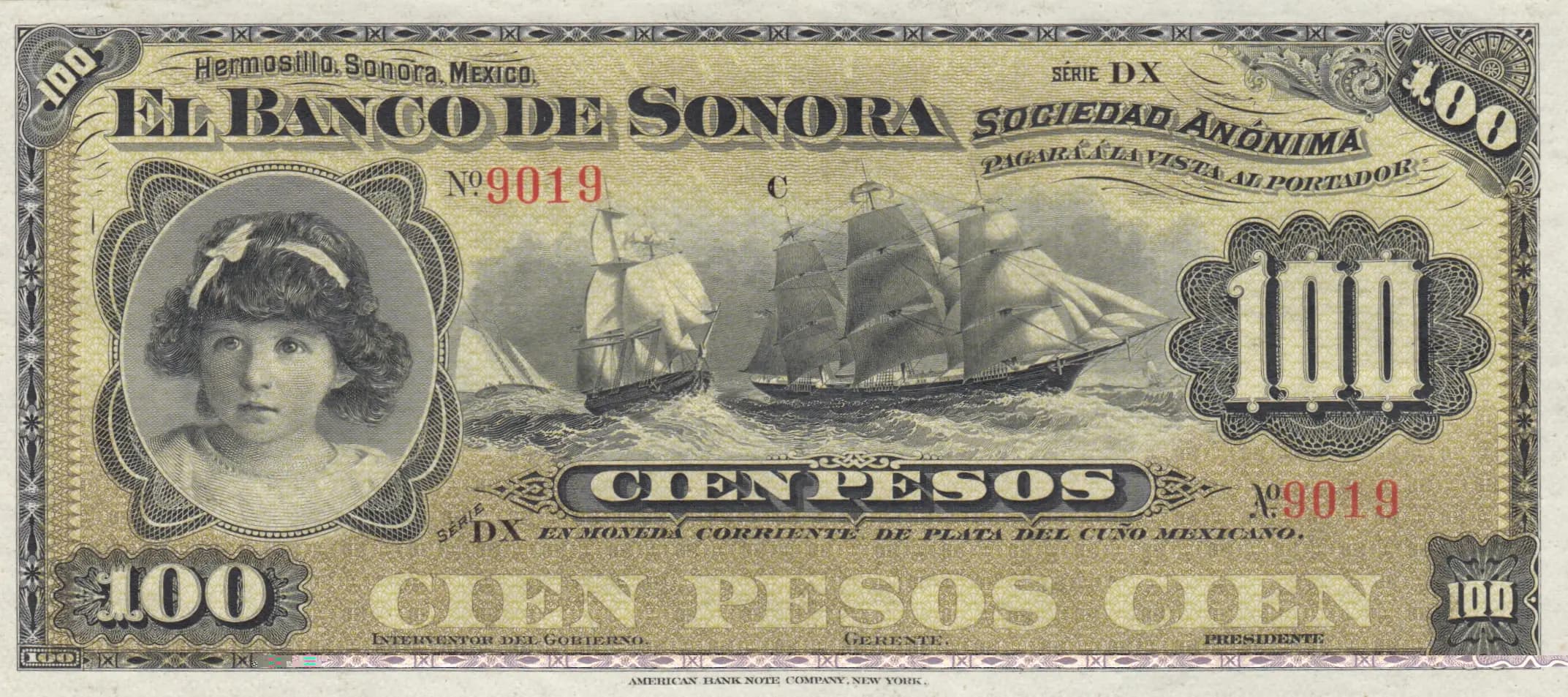
An outstanding example of the 1911 Banco de Sonora 100 pesos note (Pick S423r) in AU condition, featuring a striking portrait of Hortensia C. Vélez within an ornate circular frame and a dynamic maritime scene with full-rigged sailing ships at the center. The note displays the characteristic yellowish-green and black color scheme with exceptional clarity and no visible signs of wear, circulation, or aging, representing a well-preserved specimen of this Mexican regional bank currency.
Common. While this is a regional Mexican banknote from a defunct issuer, the Pick S423r designation indicates these were produced in significant quantities by ABNC. The eBay reference data shows similar VF condition examples selling for approximately $112, a price point typical of common regional Mexican banknotes. The 'remainder' notation (unsold notes from the original issue) further suggests adequate production volumes. No evidence of scarcity, small print runs, or recall status that would elevate the rarity grade.
The Banco de Sonora operated during Mexico's late Porfirian era and early revolutionary period (1898-1911), issuing banknotes to facilitate commerce in the resource-rich northern state of Sonora. The maritime imagery featuring sailing ships reflects Sonora's geographic and economic ties to Pacific coastal trade, while the bank's headquarters in Hermosillo represented the modernization of provincial Mexican financial infrastructure in the pre-revolutionary period. This remainder note was produced by the American Bank Note Company, reflecting the international standard for high-security banknote production at the time.
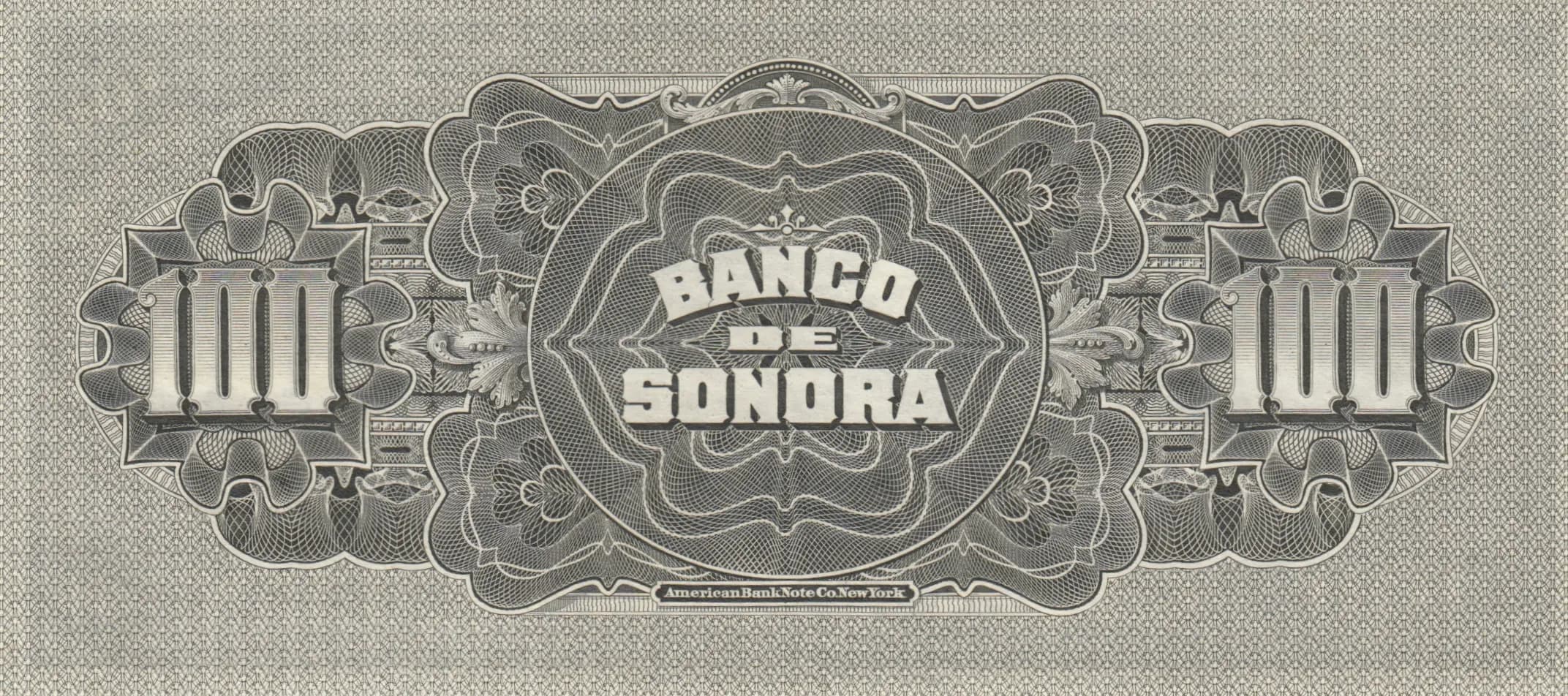
This 100 pesos banknote showcases the aesthetic standards of early 20th-century Mexican regional banking. The obverse features a finely engraved portrait of Hortensia C. Vélez, a prominent figure from Sonora, positioned within an ornate circular medallion frame on the left side. The central design depicts a maritime scene with multiple sailing ships under full sail on open water, emphasizing Sonora's connection to Pacific commerce and trade. Denomination numerals (100) appear in large scalloped rectangular frames with prominent placement, while the reverse presents a more austere design with the bank's name prominently displayed in an ornate central cartouche flanked by large denominational numerals. Throughout both sides, fine geometric border patterns and decorative corner elements demonstrate the security engraving techniques characteristic of ABNC production.
FRONT: 'El Banco de Sonora' (The Bank of Sonora), 'Sociedad Anónima' (Anonymous Society/Limited Company), 'Hermosillo, Sonora, Mexico' (location), 'Pagará al Vista al Portador' (Payable on Demand to the Bearer), 'Cien Pesos' (One Hundred Pesos), 'Serie DX' (Series DX), 'No 9019' (Number 9019), 'DX en Moneda Corriente de Plata del Cuño Mexicano' (DX in Current Mexican Silver Currency), 'American Bank Note Company, New York' (printer attribution). BACK: 'Banco de Sonora' (Bank of Sonora), '100' (denomination), 'American Bank Note Co. New York' (printer attribution).
Intaglio engraving (line engraving/copperplate) combined with letterpress, produced by American Bank Note Company (ABNC) in New York. The visual analysis confirms fine line engraving throughout with complex geometric patterns, multiple colors (black on olive-brown and yellow underprint), and detailed security engraving elements characteristic of high-security banknote production. The precision of the maritime scene, portrait medallion, and border work are consistent with ABNC's renowned intaglio standards of the period.
This example is identified as Series DX, serial number 9019, from the 1911 issue (catalog indicates 1898-1911 date range with possible production spanning multiple years). The catalog notes multiple known series for this Pick number: DR, DT, DV, DW, DX, and DZ. This specimen represents the DX series variety. The 'Remainder' designation indicates these were unsold notes from the original bank issue, rather than notes released into circulation, which explains the exceptional preservation state (AU condition with no circulation wear).