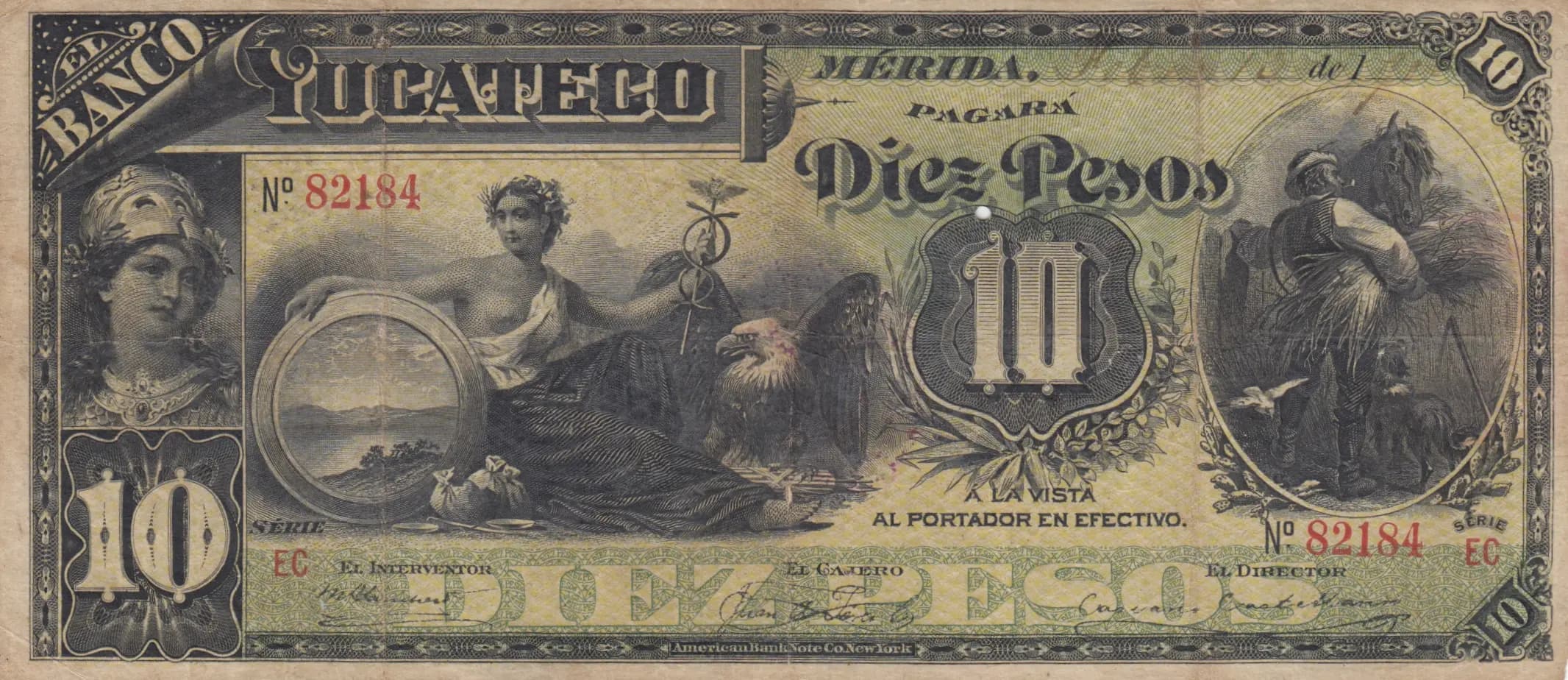
10 pesos 190?
Market Prices
About This Note
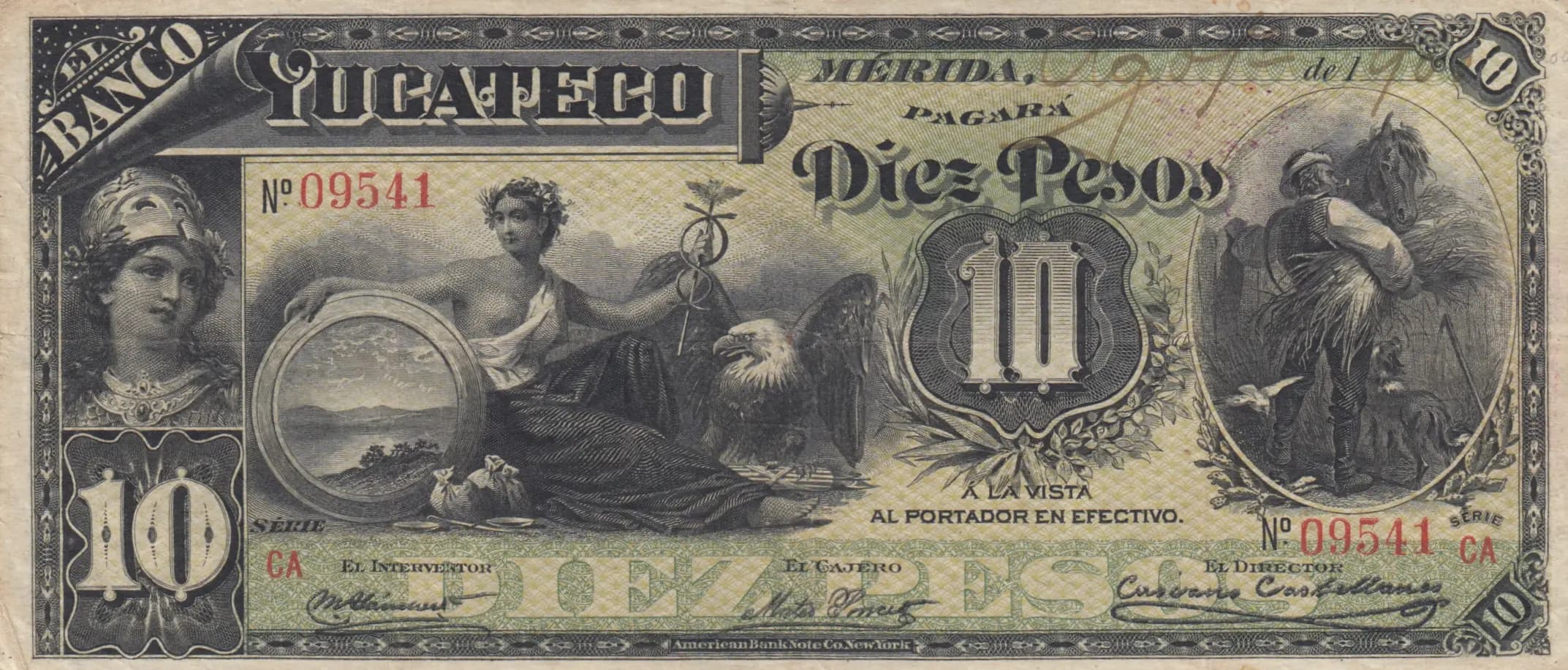
A 10 Pesos banknote from Banco Yucateco (Mérida, Yucatán) printed by American Bank Note Company, featuring classical allegorical imagery including a crowned female profile, a central figure with caduceus beside an eagle, and a landscape medallion. The note exhibits aged patina with yellowing and light staining consistent with historical circulation, graded as Fair (F), making it a representative example of Mexican regional banking currency from the 1890-1903 period.
Common. While regional Mexican banknotes from this period are historically significant, Banco Yucateco notes were issued in reasonable quantities across multiple documented dates (1900-1901 per catalog references). eBay market data shows substantial price variation ($7.99 to $300.00) reflecting condition differences rather than scarcity, with Fair condition examples typically trading in the $40-$100 range. The existence of multiple known serial numbers and series designations (Series CA documented) confirms regular production runs. This note's Fair condition and moderate pricing are consistent with common-to-uncommon classification.
Banco Yucateco was a regional issuing bank operating in Mexico's Yucatán Peninsula during the late 19th and early 20th centuries, when private banks were still permitted to issue their own currency. The allegorical imagery—featuring Minerva (goddess of wisdom) and national emblems including the Mexican eagle—reflects the classical design conventions favored by American Bank Note Company and symbolizes Mexico's sovereignty and progress during this modernizing era. The note's denomination display in both Spanish and numerical form, along with the 'AL PORTADOR EN EFECTIVO' (to bearer in cash) clause, demonstrates the legal tender status of regional bank notes in Mexico before centralized currency control.
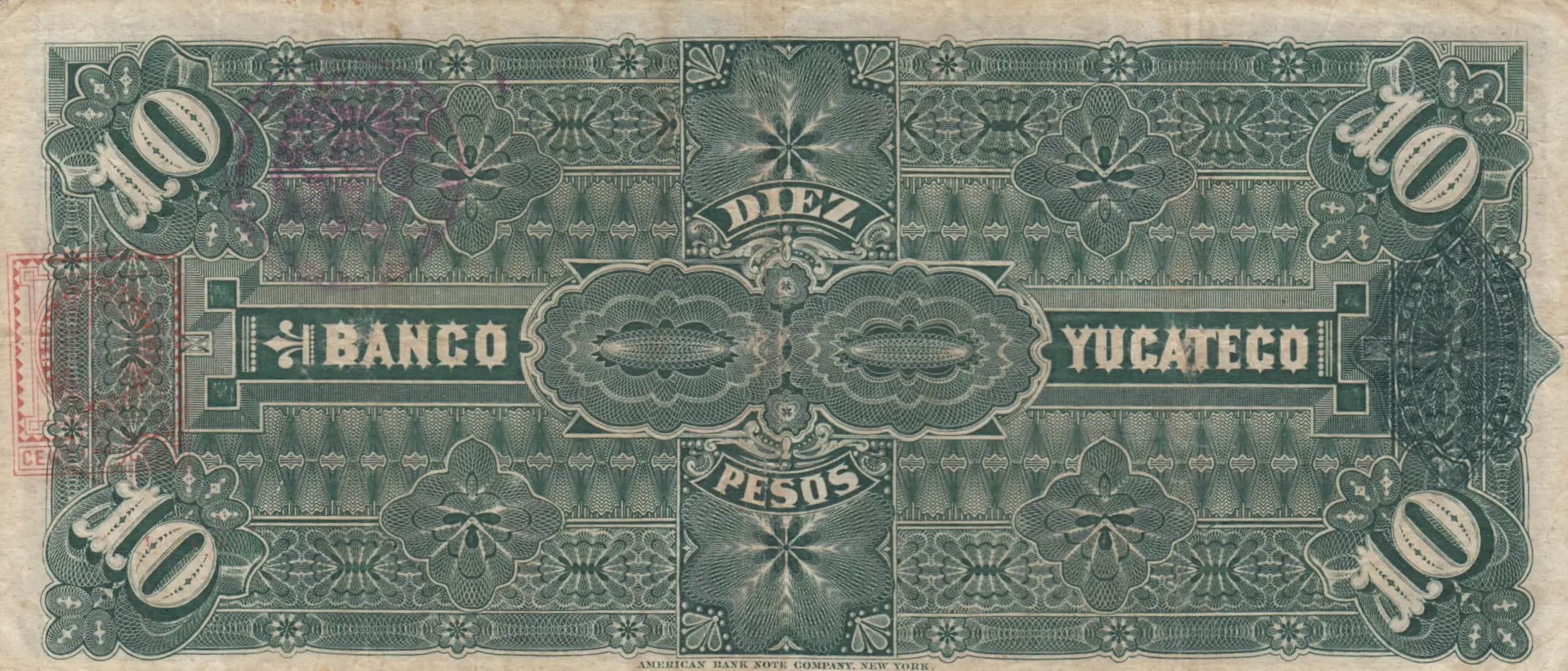
The obverse features three principal allegorical figures representing national identity and commercial authority: on the left, a profile portrait of Minerva wearing a classical crown and ornate headdress (the 'Minerva No. 3' design type), symbolizing wisdom; in the center, a seated allegorical female figure representing National Emblems, holding a caduceus (staff with intertwined serpents symbolizing commerce and medicine) and positioned beside the Mexican national eagle; and on the right, an additional classical figure completing the allegorical composition. A circular landscape medallion displaying what appears to be a coastal or valley scene occupies a prominent central position. The reverse displays an elaborate, symmetrical security design in dark green intaglio with repeated floral and geometric patterns, ornamental cartouches inscribed with bank name and denomination, and large '10' numerals within decorative circles at the corners. The color scheme consists of black and cream/beige on the front with green and cream on the reverse, typical of ABNC security printing of this era.
FRONT: 'BANCO YUCATECO' (Yucatán Bank), 'Diez Pesos' (Ten Pesos), 'MERIDA de YUCATAN' (Mérida of Yucatán), 'Nº 09541' (Serial Number 09541), 'A LA VISTA' (On Demand/At Sight), 'AL PORTADOR EN EFECTIVO' (To the Bearer in Cash), 'El Interventor' (The Auditor), 'El Cajero' (The Cashier), 'El Director' (The Director), 'SERIE CA' (Series CA), 'American Bank Note Co. New York' (printer attribution). BACK: 'BANCO YUCATECO' (Yucatán Bank), 'PESOS' (Pesos), '10' (denomination numeral), 'American Bank Note Company, New York' (printer attribution).
Intaglio engraving (line engraving and fine-line security printing), executed by American Bank Note Company (ABNC), New York. The elaborate symmetrical patterns on the reverse and the precise allegorical detail on the obverse are characteristic of high-security banknote intaglio production. Multiple impressions are evident from the visual analysis, indicating separate plates for obverse (black on colored underprint) and reverse (dark green) designs.
Series CA, Serial Number 09541. Catalog reference P-S468a indicates this is a documented variety. The visual analysis confirms the 1890-1903 design period with features consistent with ABNC printings dated 1900-1901. Multiple known printing dates are documented in catalog data (13.10.1900, 1.11.1900, 29.6.1901, 28.9.1901), suggesting this note falls within the regular issue period. Series and serial number combinations vary; the CA series and mid-range serial number (09541) suggest middle-period production.