10 pesos 1902-14
Market Prices
About This Note
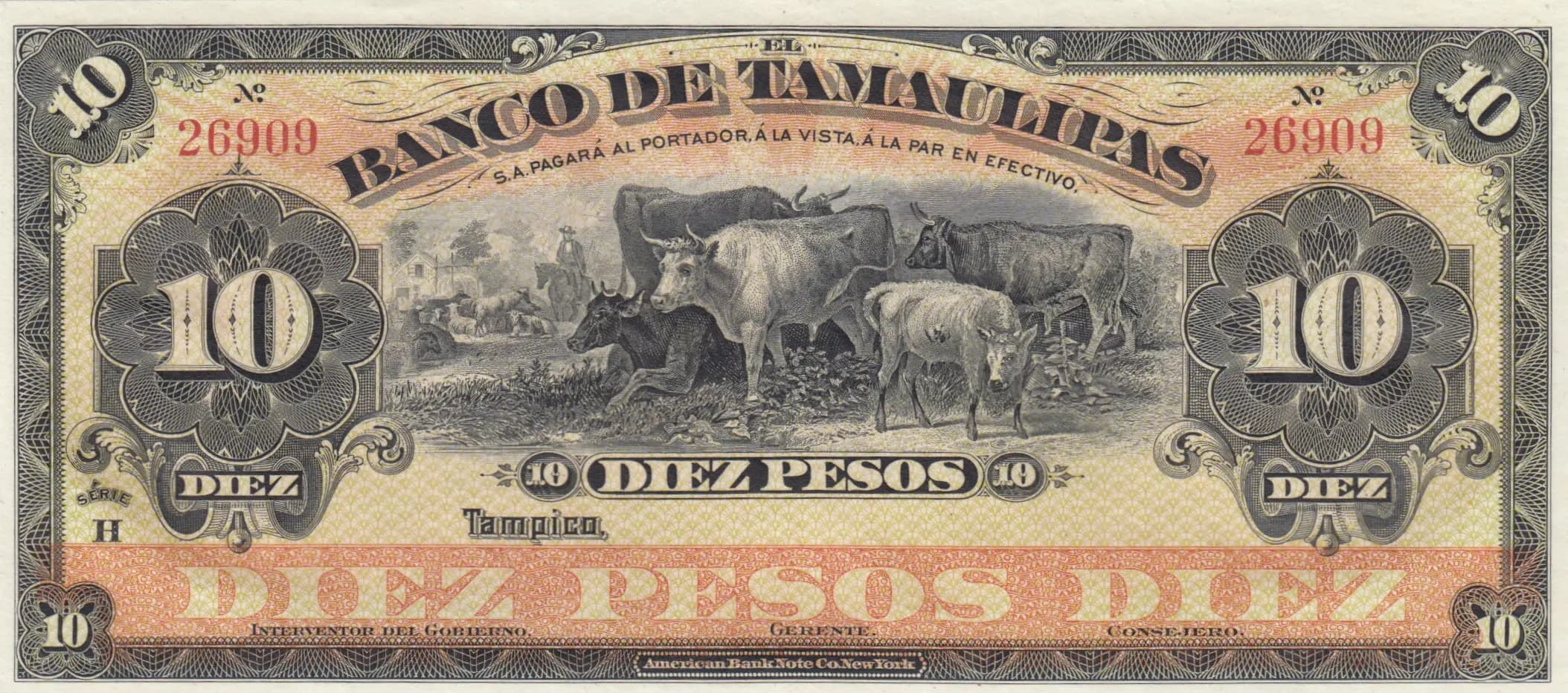
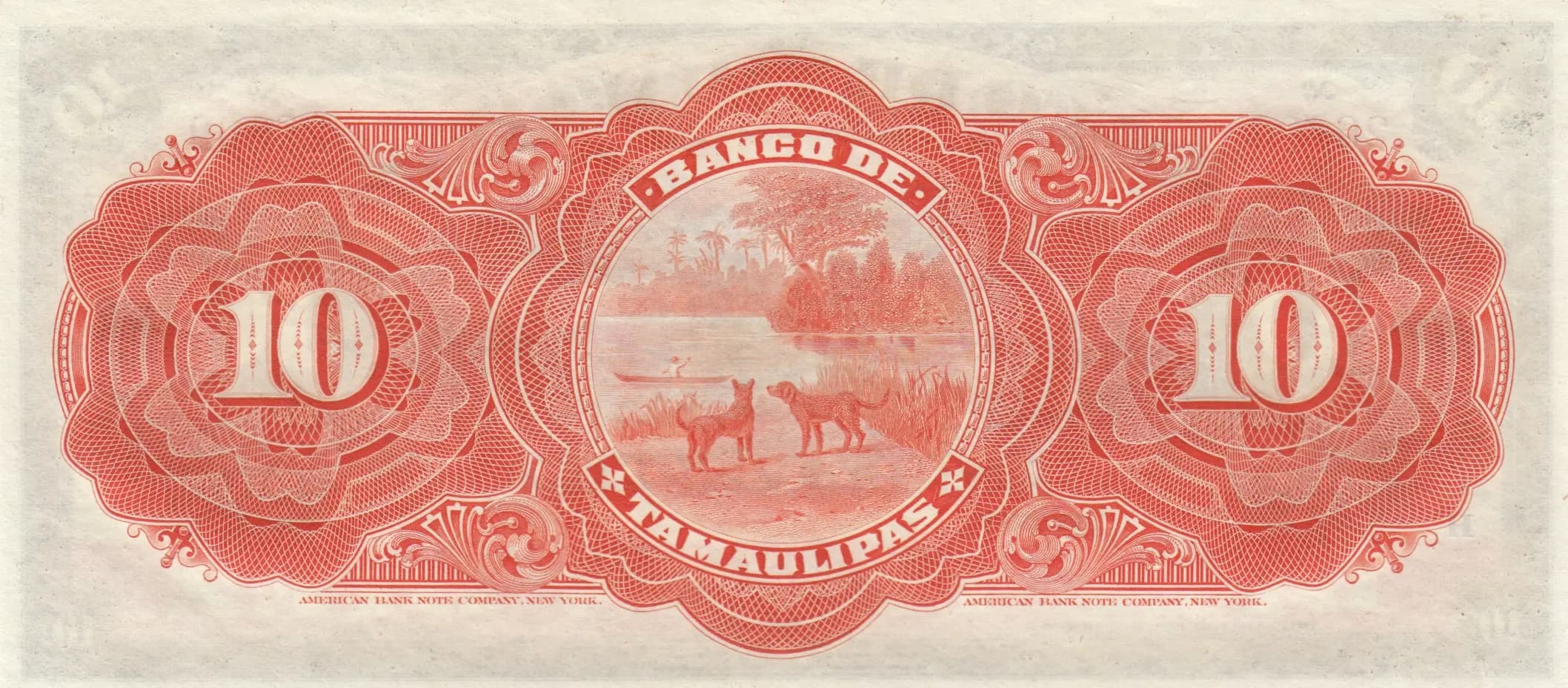
This is an exceptional example of a 10 pesos note from the Banco de Tamaulipas, issued in 1902 and printed by the American Bank Note Company. The note displays the characteristic pastoral imagery of the era with cattle and goats on the obverse and a scenic landscape with dogs and a canoe on the reverse, rendered in the bank's distinctive black-on-orange/green and red color schemes. In UNC condition, this Series H specimen exhibits pristine presentation with sharp engraving, vibrant colors, and no visible wear—making it a premium example of early Mexican regional banking currency.
Common. This is a regular issue note from a major Mexican regional bank with a substantial print run spanning 1902-1914 (the 'Series H' designation indicates multiple series were produced). eBay market data shows wide price dispersion ($17.95–$260.37 USD across grades), with multiple UNC examples available, suggesting adequate supply. The denomination (10 pesos) and long circulation period support common status. The note's value derives primarily from condition (UNC premium pricing) and collector interest in Mexican regional currency rather than intrinsic scarcity.
The Banco de Tamaulipas operated during Mexico's pre-Revolutionary era when regional banks issued their own currency under federal oversight. The pastoral and riverine imagery depicted on this note—cattle grazing, dogs on the shoreline, and a man in a canoe—reflect Tamaulipas's economy rooted in agriculture, livestock, and river commerce along the Río Bravo region. The inclusion of 'Tampico' on the obverse underscores this northeastern port city's importance as a commercial center during the early 20th century.
The obverse features an elaborate ornamental border in black, gray, and tan with floral and geometric scrollwork framing a central pastoral vignette depicting cattle and goats grazing beside a rural building structure in an idyllic countryside setting. Decorative cartouches on both sides contain the denomination '10' in ornamental frames. The reverse displays a bold red/coral background with intricate geometric and floral ornamental patterns, centering on a circular medallion containing a landscape scene with two dogs standing on a grassy shoreline near water, with tropical vegetation and trees visible—a composition emphasizing the Tamaulipas region's natural features. Both sides feature fine-line engraved security elements typical of ABNC's high-quality production standards.
OBVERSE: 'BANCO DE TAMAULIPAS' (Bank of Tamaulipas) | 'S.A. PAGARÁ AL PORTADOR A LA VISTA, A LA PAR EN EFECTIVO' (S.A. will pay the bearer on sight, at par in cash) | 'DIEZ PESOS' (Ten Pesos) | 'SERIE H' (Series H) | 'Tampico' (City name) | 'DIEZ PESOS DIEZ' (Ten Pesos Ten) | 'INTERVENTOR DEL GOBIERNO' (Government Interventor) | 'GERENTE' (Manager) | 'CONSEJERO' (Counselor) | Serial number '26909'. REVERSE: '10' (denomination) | 'BANCO' (Bank) | 'ET FLUVIUS' (And the River—Latin) | 'AMERICAN BANK NOTE COMPANY, NEW YORK' (Printer identification).
Steel plate intaglio engraving with multi-color printing (chromatic printing using separate plates for different color zones). Printed by the American Bank Note Company (ABNC), New York, a world-leading security printer of the period. The obverse combines black primary engraving with orange and light green underprints; the reverse uses red/coral as the dominant color. Fine line work, detailed vignette rendering, and ornamental border complexity are hallmarks of ABNC's sophisticated anti-counterfeiting methodology.
This specimen is Series H, as indicated by the 'SERIE H' marking on the obverse. The Pick catalog (P-S430c) designation 'c' likely indicates a series variant within the 1902-1914 issue range. Serial number 26909 is noted. No overprints, date variations, or signature varieties are apparent in the visual analysis. Collectors should note that multiple series (A through H and possibly beyond) were produced, each potentially constituting distinct Pick varieties; the 'c' suffix suggests this represents Series H specifically within the catalog's hierarchical classification.