10 pesos 1902-14
Market Prices
About This Note
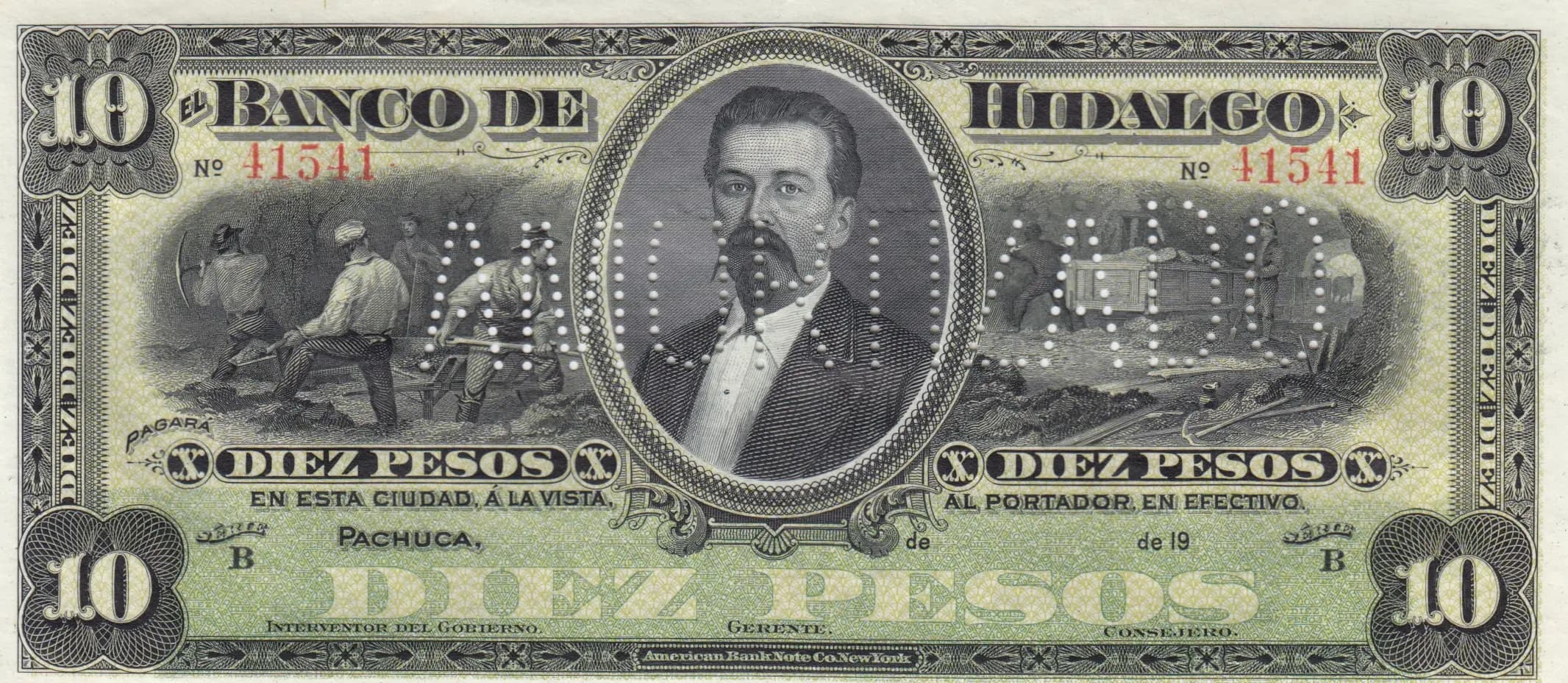
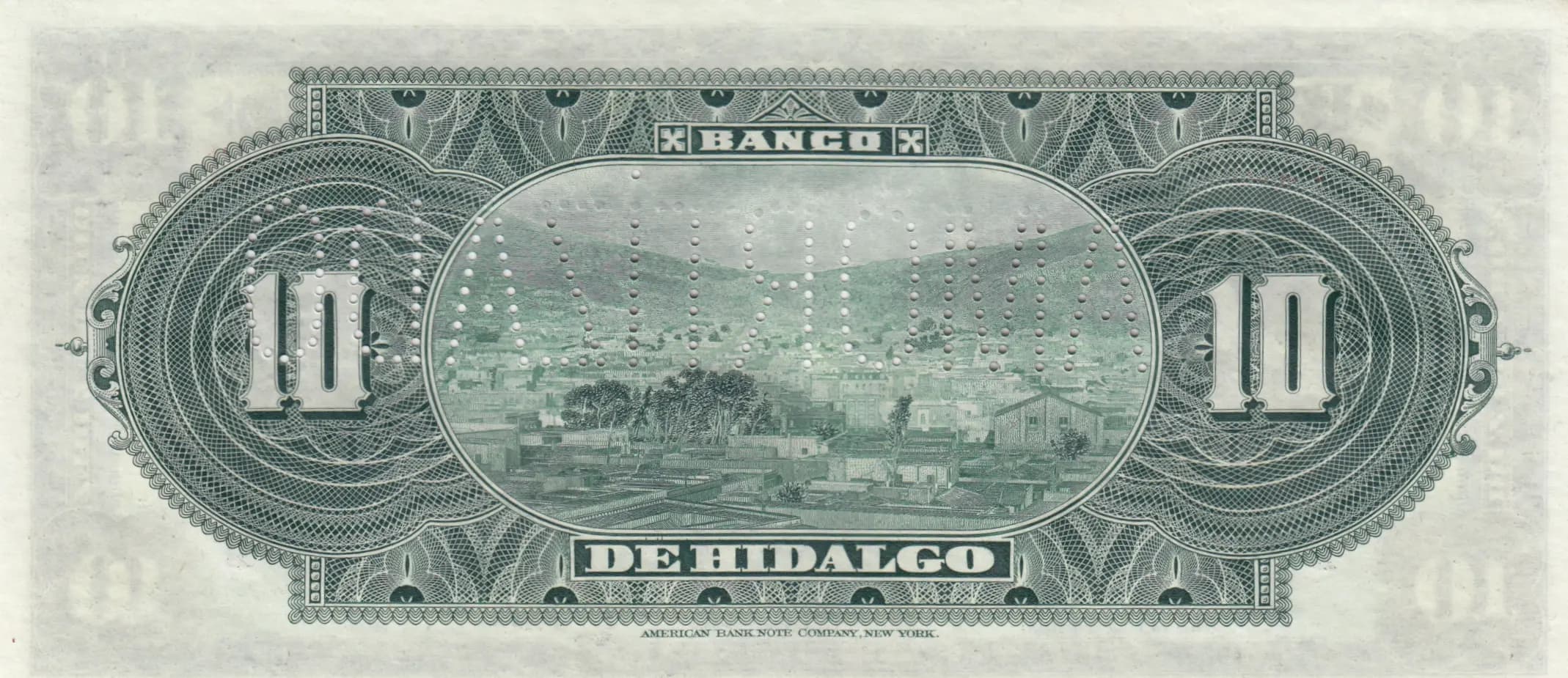
This is an exceptional example of a 10 pesos banknote from Banco de Hidalgo (1902-14), presented in pristine uncirculated condition with crisp printing and no visible wear. The note features a striking central portrait of Juan C. Doria surrounded by allegorical vignettes of miners on the obverse, while the reverse showcases an intricate engraved cityscape of Pachuca. The fine line engraving work by the American Bank Note Company and the complex ornamental designs make this a notable example of early 20th-century Mexican regional banking currency.
Common. While this is a regional bank note from an early 20th-century Mexican issuer, the eBay market data provided shows a wide range of prices from $17.95 to $260.37 for various condition grades, with multiple examples in circulation indicating reasonable availability. The catalog designation as a regular issue (not overprinted or commemorative) and the fact that examples appear regularly in the secondary market suggest this is a commonly encountered note for the series. Regional Mexican banknotes from this period, while historically significant, were issued in quantities sufficient for regular trade and remain relatively available to collectors.
This note was issued during a pivotal period in Mexican history when regional banks still maintained significant circulating authority, approximately a decade before the Mexican Revolution would fundamentally reshape the nation's financial system. The imagery of miners in the vignettes reflects Hidalgo's historical importance as a mining center, particularly for silver extraction, which formed the economic foundation of the region. The city view of Pachuca on the reverse represents the state capital and the administrative center of this mining-rich region.
The obverse features a classical oval portrait medallion of Juan Carlos Doria, the prominent historical figure associated with Hidalgo, rendered in formal 19th-century style with detailed dotted background shading. Flanking this central portrait are allegorical vignettes depicting miners at work, representing the labor and industry fundamental to the region's economy. The design is framed by elaborate ornamental borders featuring baroque scrollwork, geometric patterns, and botanical motifs. Large decorative numerals '10' appear in all four corners within circular ornamental frames. The reverse showcases a detailed landscape engraving of Pachuca's cityscape at the center, featuring identifiable architecture, vegetation, and terrain of the Hidalgo region, with matching corner denominations and ornamental frame designs in green ink.
FRONT: 'BANCO DE HIDALGO' (Bank of Hidalgo), 'DIEZ PESOS' (Ten Pesos), 'EN ESTA CIUDAD, A LA VISTA' (In this city, on sight), 'AL PORTADOR, EN EFECTIVO' (To the bearer, in cash), 'PACHUCA' (city name), 'de 19' (of 19[02-14]), 'INTERVENTOR DEL GOBIERNO' (Government Intervener), 'GERENTE' (Manager), 'CONSEJERO' (Counselor), 'PAGARA' (Will Pay), serial number 'No 41541', series letter 'B'. BACK: 'BANCO' (Bank), 'DE HIDALGO' (of Hidalgo), denomination '10', 'AMERICAN BANK NOTE COMPANY, NEW YORK' (printer attribution).
This note was produced using intaglio line engraving, the standard security printing method for high-quality banknotes of this era. The fine parallel line work visible throughout, the intricate dot patterns in portrait backgrounds, and the complex geometric and botanical borders are all characteristic of the intaglio engraving process. The printer, American Bank Note Company (ABNC) of New York, was one of the world's premier banknote security printers and is credited on the reverse. The precision of the engraving and the quality of the impression indicate professional banknote production standards.
This specific example is identified as Series B from the 1902-14 period, as indicated by the 'B' series letter visible on the note. The serial number 41541 is unique to this individual impression. According to the catalog reference, this note comes from the perforated 'AMORTIZADO' (amortized/cancelled) variety, which would typically indicate it was officially cancelled or withdrawn from circulation at some point. The visual analysis confirms the note's excellent state of preservation, suggesting this particular specimen may have been removed from circulation and preserved before any significant handling damage could occur.