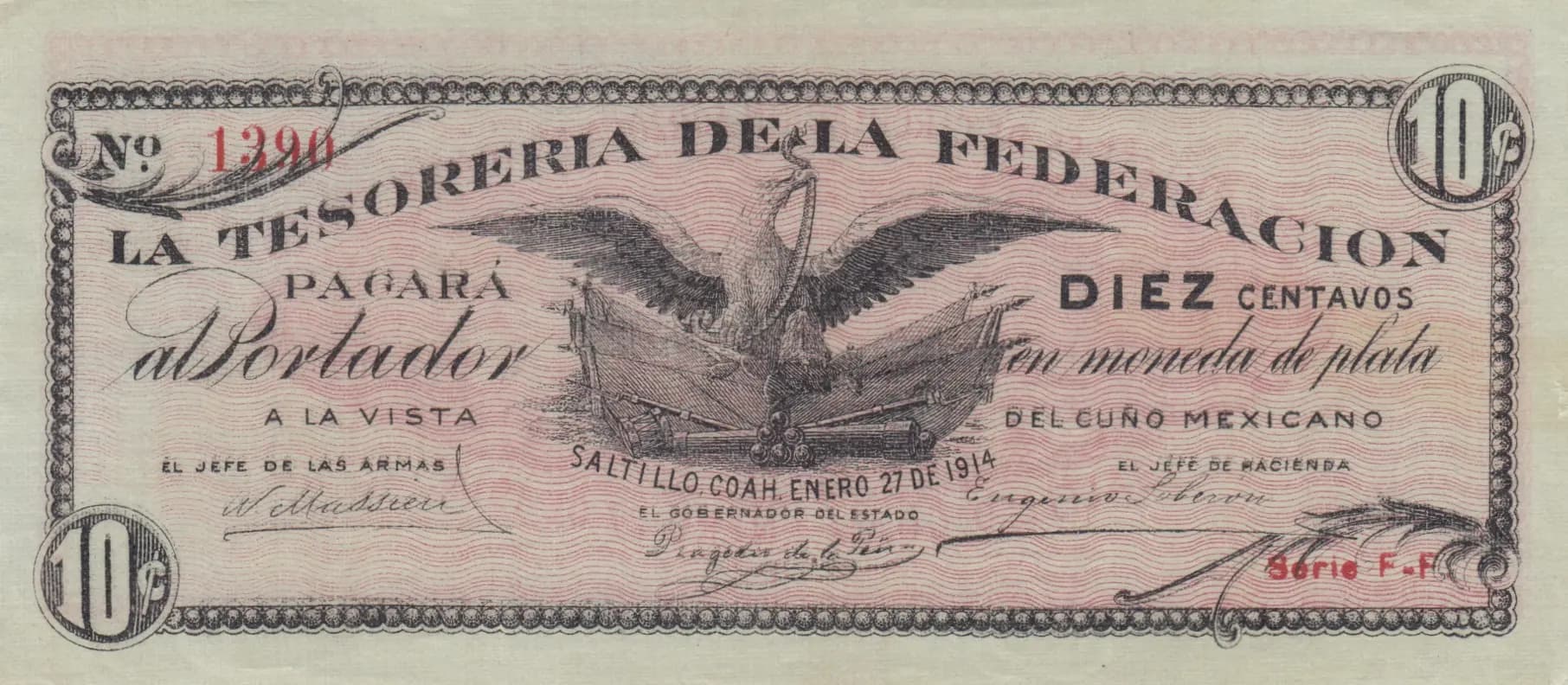
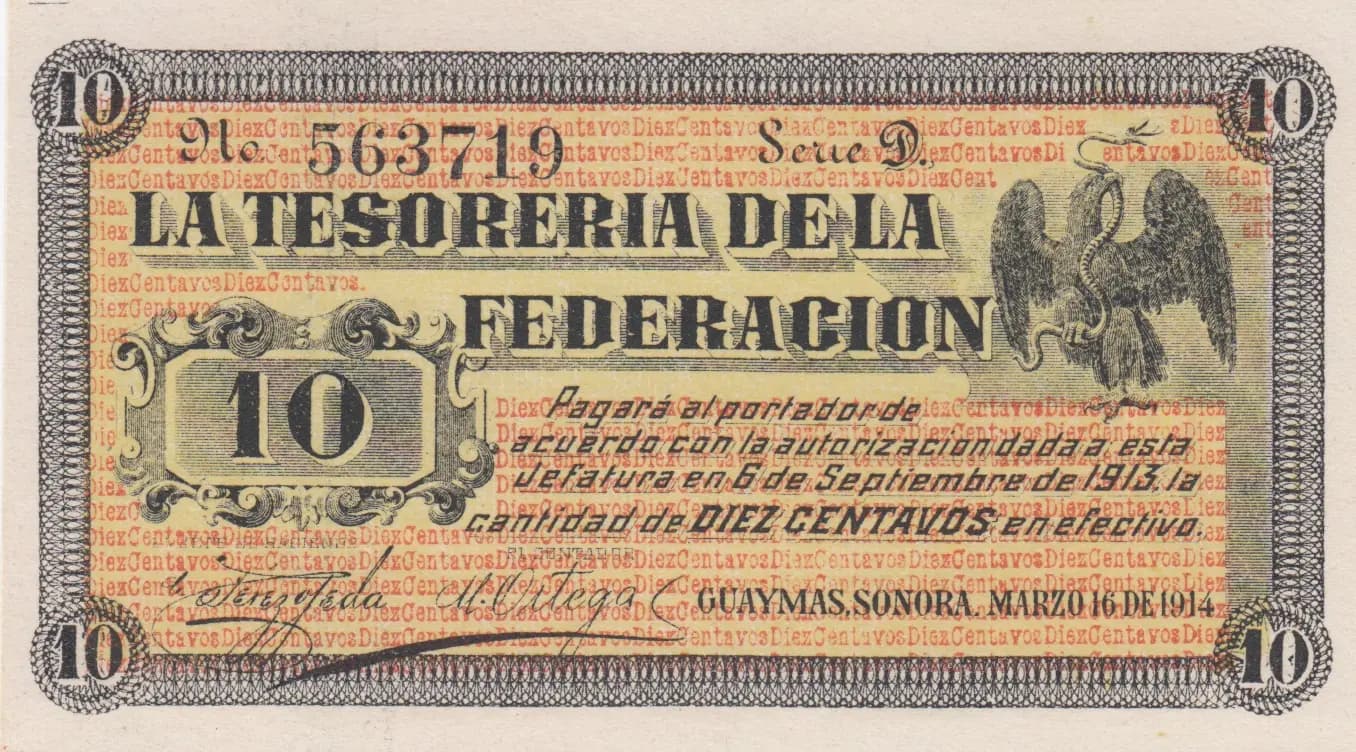
10 centavos 1914
About This Note
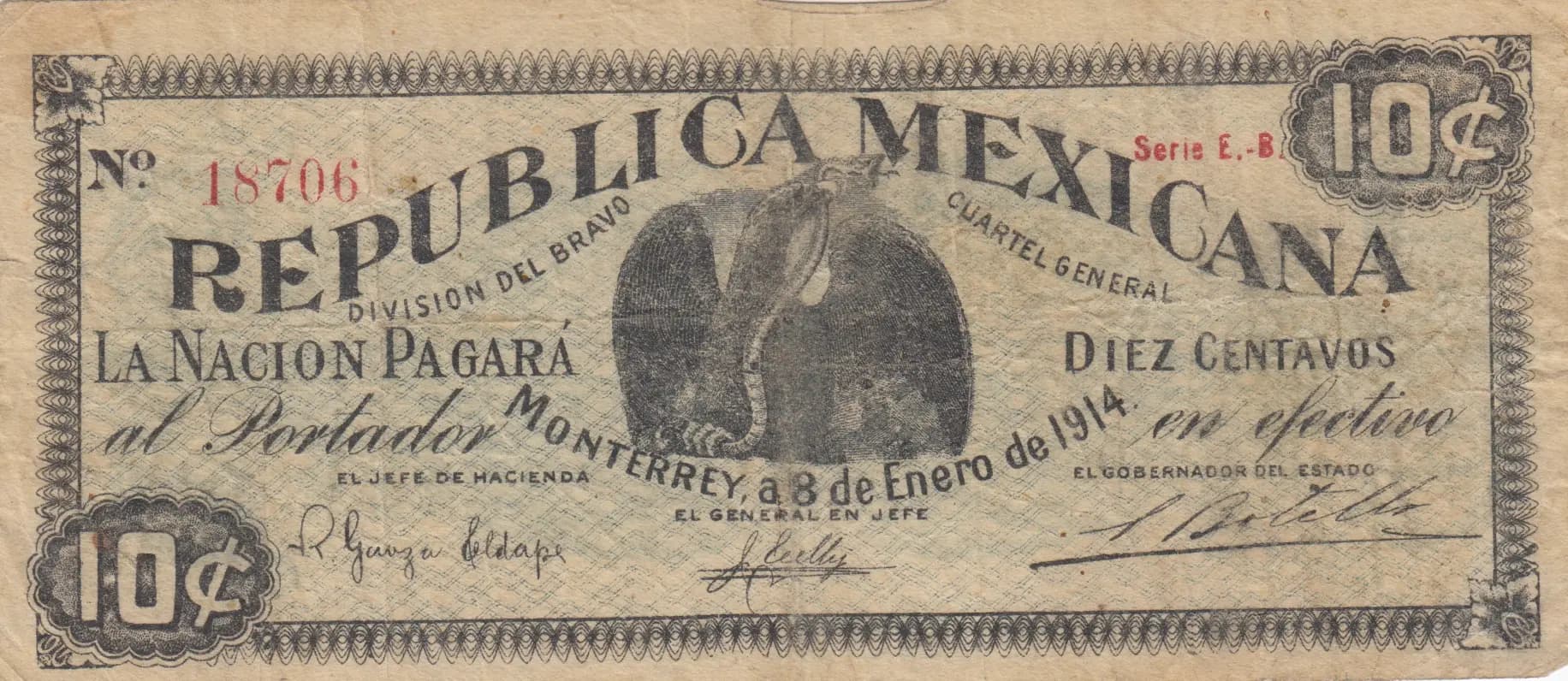
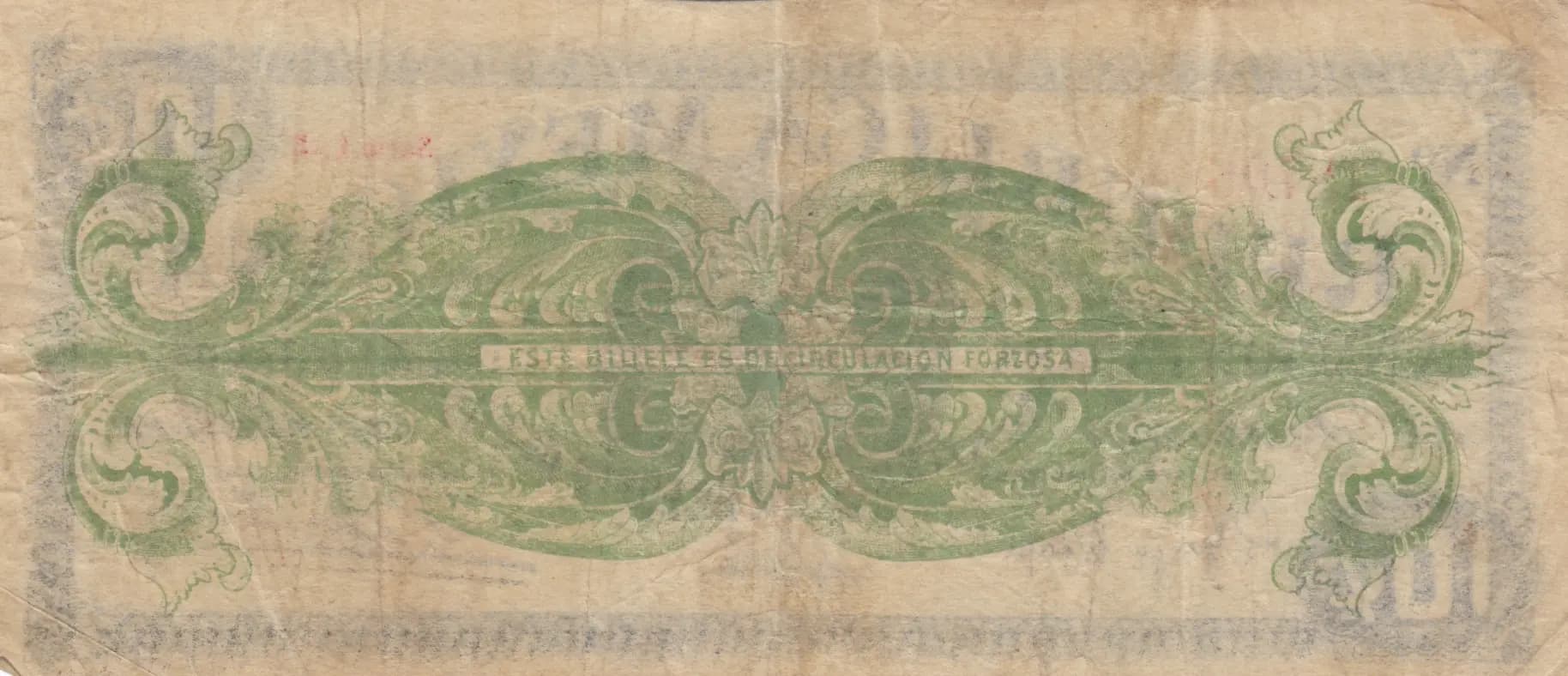
This is a 10 centavos banknote issued by División del Bravo on January 8, 1914, during the Mexican Revolution, from Monterrey headquarters. The note features a portrait of a historical figure in profile on the front with ornate geometric borders, while the reverse displays elegant green scrollwork and floral motifs. In Fair condition, the note displays significant aging with foxing, discoloration, creases, and multiple handwritten signatures in period ink, reflecting its status as a heavily handled historical financial instrument from one of Mexico's most turbulent eras.
Common. División del Bravo emergency currency from 1914 was issued in substantial quantities during the Mexican Revolution to facilitate military administration and troop payments across occupied northeastern territories. Notes from this issuer and period, particularly in lower denominations like 10 centavos, circulated widely and many examples survive. The Fair condition grade and series designation (E.B) suggest this is a typical circulation example rather than a rare variety.
This banknote was issued during the Mexican Revolution by División del Bravo, the military command controlling northeastern Mexico under the constitutionalist forces. The inscription 'ESTE BILLETE ES UNIFICACION FORZOSA' (This banknote is forced consolidation) on the reverse indicates this was part of efforts to unify and stabilize currency during the conflict, when various military factions issued their own notes. The date of January 8, 1914, places this in the early phase of the Revolution when regional military authorities exercised financial control over occupied territories.
The front features a left-facing profile portrait of an unidentified historical figure shown from shoulders up, centered on the note. The design employs a classical rectangular format with ornamental corner flourishes featuring scrollwork and leaf-like designs, and a repeating geometric border pattern along the top edge. Large ornamental frames containing the denomination '10¢' appear in the upper right and lower left corners. The reverse presents a symmetrical, horizontally-oriented decorative design in green ink featuring elaborate scrollwork and floral botanical motifs, with matching corner flourishes. The overall aesthetic is consistent with turn-of-the-century Mexican banknote design, emphasizing security through intricate engraving work.
FRONT: República Mexicana (Mexican Republic) | Nº 18706, Serie E.B (Number 18706, Series E.B) | 10¢ / Diez Centavos (10 Centavos) | La Nación Pagará (The Nation Will Pay) | División del Bravo, Cuartel General (Division of the Bravo, General Headquarters) | al Portador (To Bearer) | Monterrey (Monterrey) | 8 de Enero de 1914 (January 8, 1914) | en oficina (in office) | El Jefe de Hacienda (The Finance Chief) | El General en Jefe (The General in Chief) | El Gobernador del Estado (The State Governor) | [Multiple handwritten signatures] BACK: Este Billete es Unificacion Forzosa (This banknote is forced consolidation)
This note was produced using engraved intaglio printing, evidenced by the fine line work visible in the decorative patterns, border details, and scrollwork elements. The separation of colors (black/tan on front, green on back) indicates separate printing passes. Multiple signatures and notations were added by hand in period ink after printing. The intricate scrollwork and geometric patterns were designed to serve as anti-counterfeiting measures through their complexity and difficulty of reproduction.
This is Series E.B, Number 18706, dated January 8, 1914, from Monterrey headquarters. The note bears three handwritten signatures corresponding to the Finance Chief (Jefe de Hacienda), General in Chief (General en Jefe), and State Governor (Gobernador del Estado), which was standard for División del Bravo issues. The signatures appear in period ink and are characteristic of this issuing authority's administrative practice. Variations in signature individuals and ink colors may indicate different administrative periods, though the January 8, 1914 date is consistent with early revolutionary currency issuance.