10 centavos 1914


About This Note
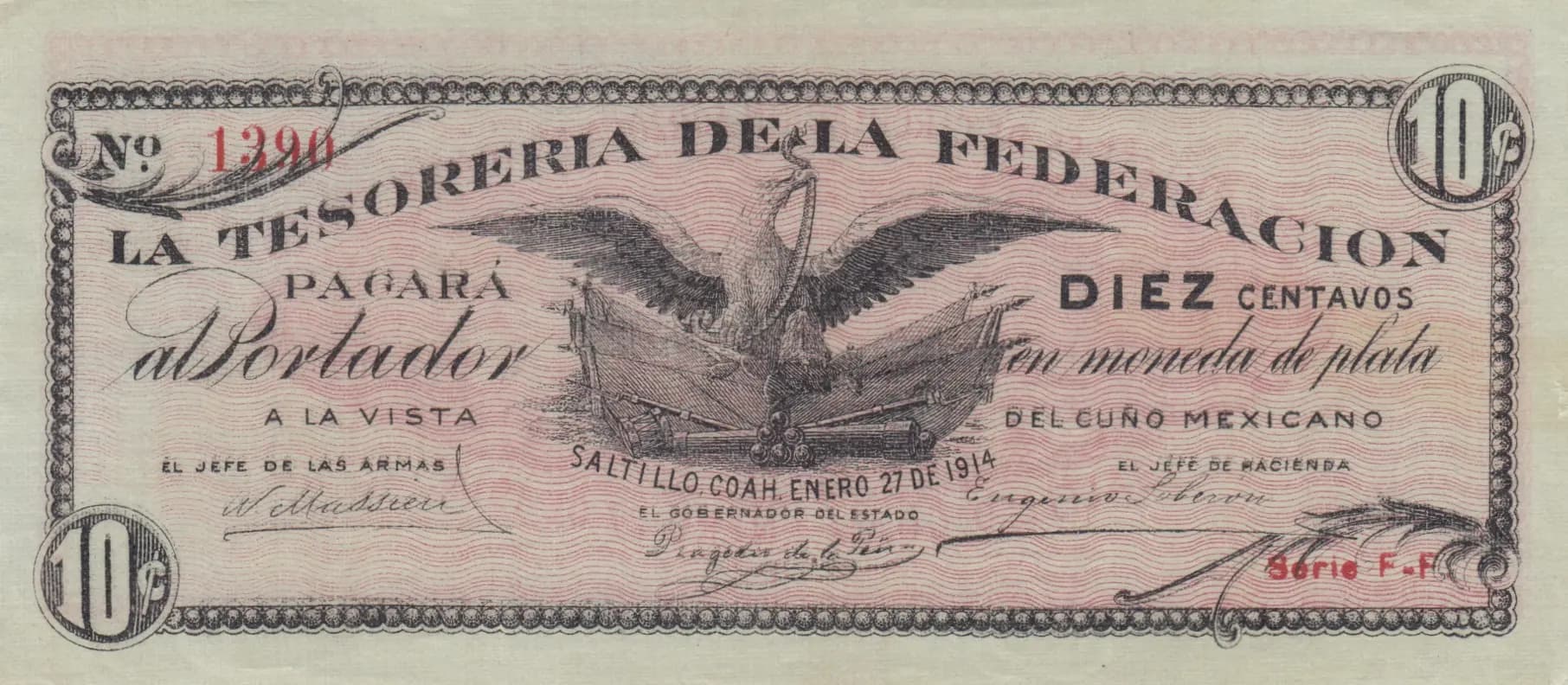
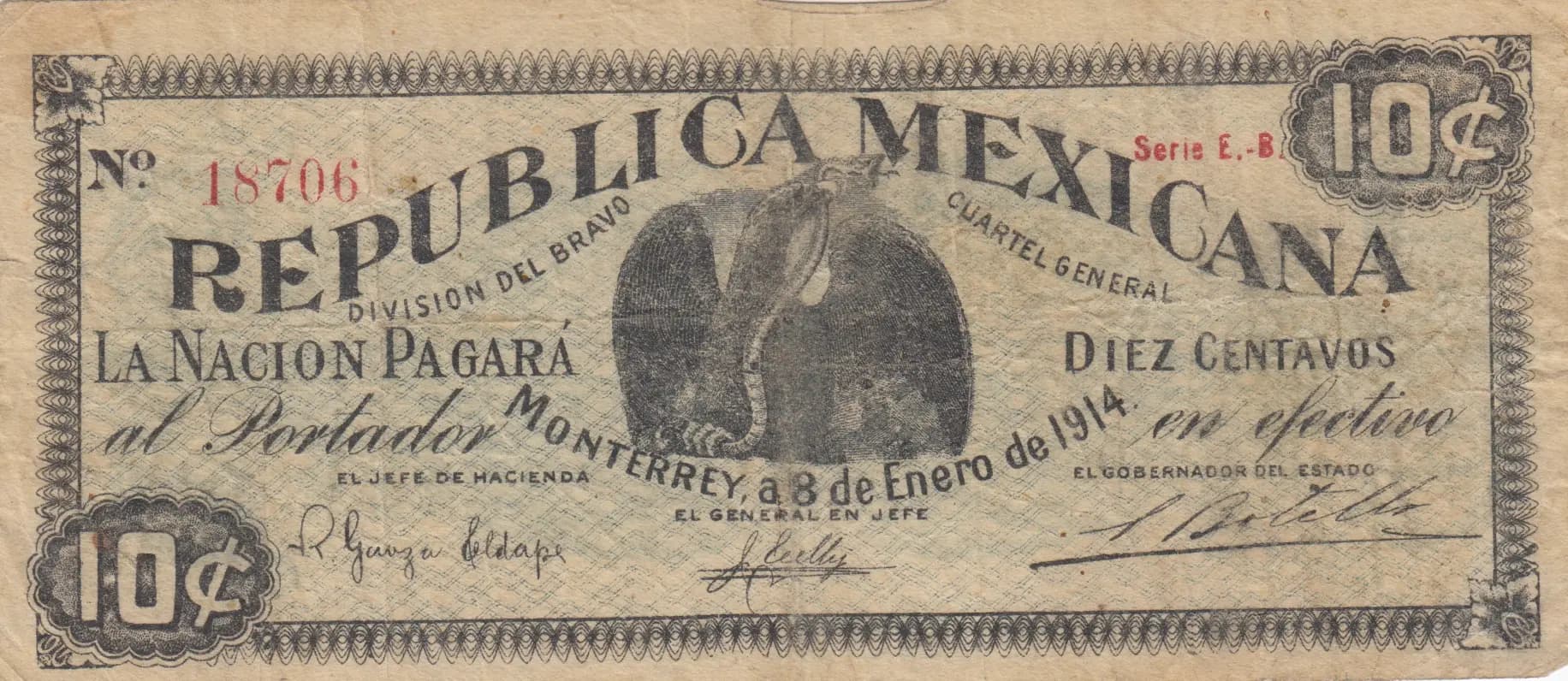
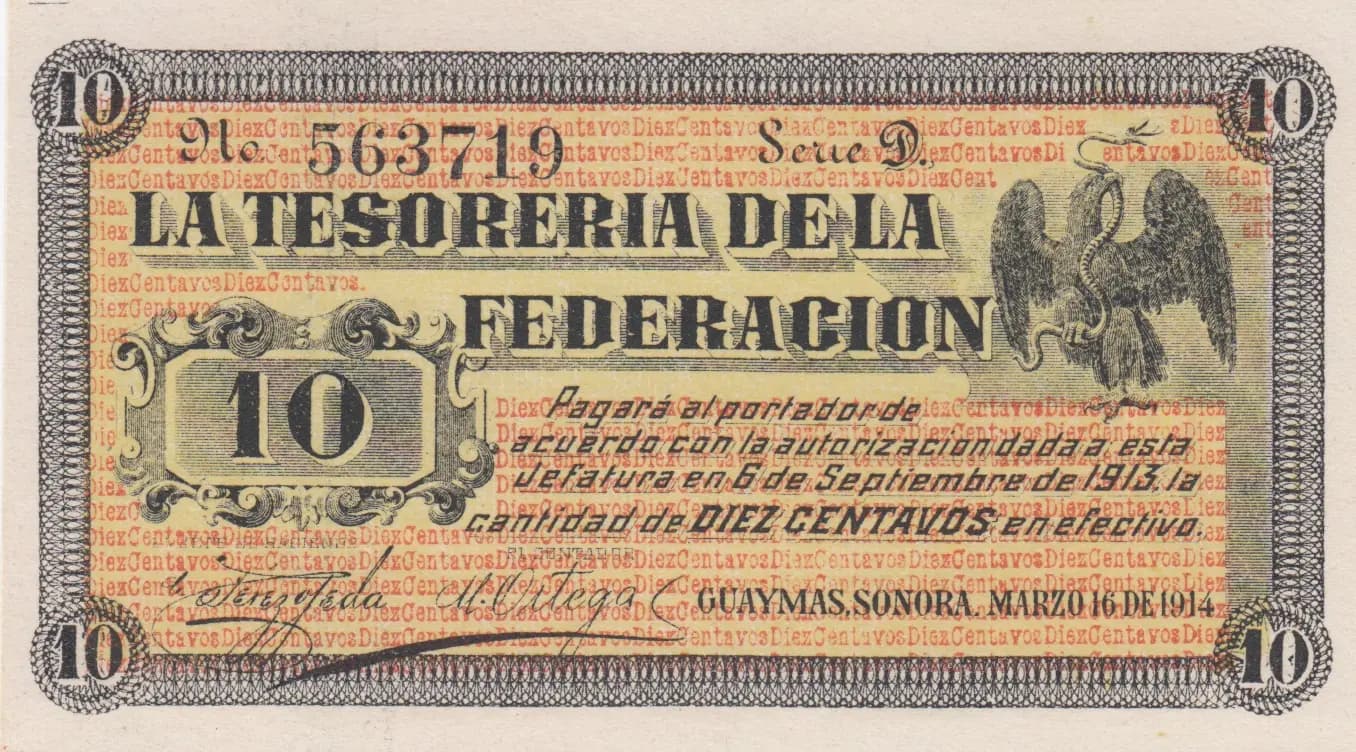
This is a VF-graded 10 centavos note from the Gobierno Provisional de Mexico (1914), featuring classical allegorical imagery and the iconic Mexican coat of arms. The note displays characteristic period printing with ornate borders, an allegorical female figure on the obverse, and exhibits red stamp overprints typical of provisional government circulation notes. The visible wear, creasing, and aging patina are consistent with authentic period circulation and early 20th-century handling.
Common. The Gobierno Provisional de Mexico issued substantial quantities of low-denomination centavo notes during 1913-1915 to facilitate everyday transactions during the period of political reorganization. While these notes are historically significant, surviving examples in circulated condition (VF grade) remain relatively abundant in the collector market. No evidence of restricted print runs or recalls makes this a standard-issue provisional note rather than a scarce variety.
Issued during Mexico's turbulent Revolutionary period under the Provisional Government, this note represents an interim currency measure during political instability. The predominant use of the Mexican national emblem—the eagle with serpent—on the reverse reflects the government's assertion of legitimacy and national sovereignty during the transition. The Veracruz imprint and Series H designation indicate regional distribution under provisional authority before the establishment of the Banco de Mexico in 1925.
The obverse features a classical allegorical female figure in neoclassical dress positioned on the left side, symbolizing the Mexican state or republic—a common motif in early Mexican currency design. The reverse displays the central Mexican coat of arms: an eagle perched on a cactus with a serpent in its beak, enclosed within an ornate circular medallion. Both sides are framed by elaborate decorative borders incorporating scrollwork, floral patterns, and quatrefoil ornaments typical of late 19th and early 20th-century security printing. The entire design is executed in grayscale lithography with red overprint stamps applied for validation or cancellation purposes.
FRONT: 'GOBIERNO PROVISIONAL DE MEXICO' (Provisional Government of Mexico); 'X' (Roman numeral for ten); 'SERIE H XII' (Series H 12); 'VERACRUZ' (city/region of issue). BACK: 'GOBIERNO PROVISIONAL REPUBLICA MEXICANA' (Provisional Government Mexican Republic); 'DIEZ CENTAVOS' (Ten Centavos).
Lithographic printing in grayscale with applied red overprint stamps. This Pick number (P-S698) represents notes from the American Bank Note Company or similar security printers commonly contracted for Mexican provisional currency during the Revolutionary period. The multi-color lithographic process and ornate engraved borders are characteristic of high-security currency production of the era.
Series H XII is noted on the obverse, indicating the twelfth series within the H sequence of provisional issues. The red overprint stamp with circular emblem and 'C' marking may represent a specific bank or regional validation authority. The Veracruz imprint is consistent with notes distributed through that port city during provisional government control. No known major varieties for Pick P-S698 beyond standard series and overprint variations.