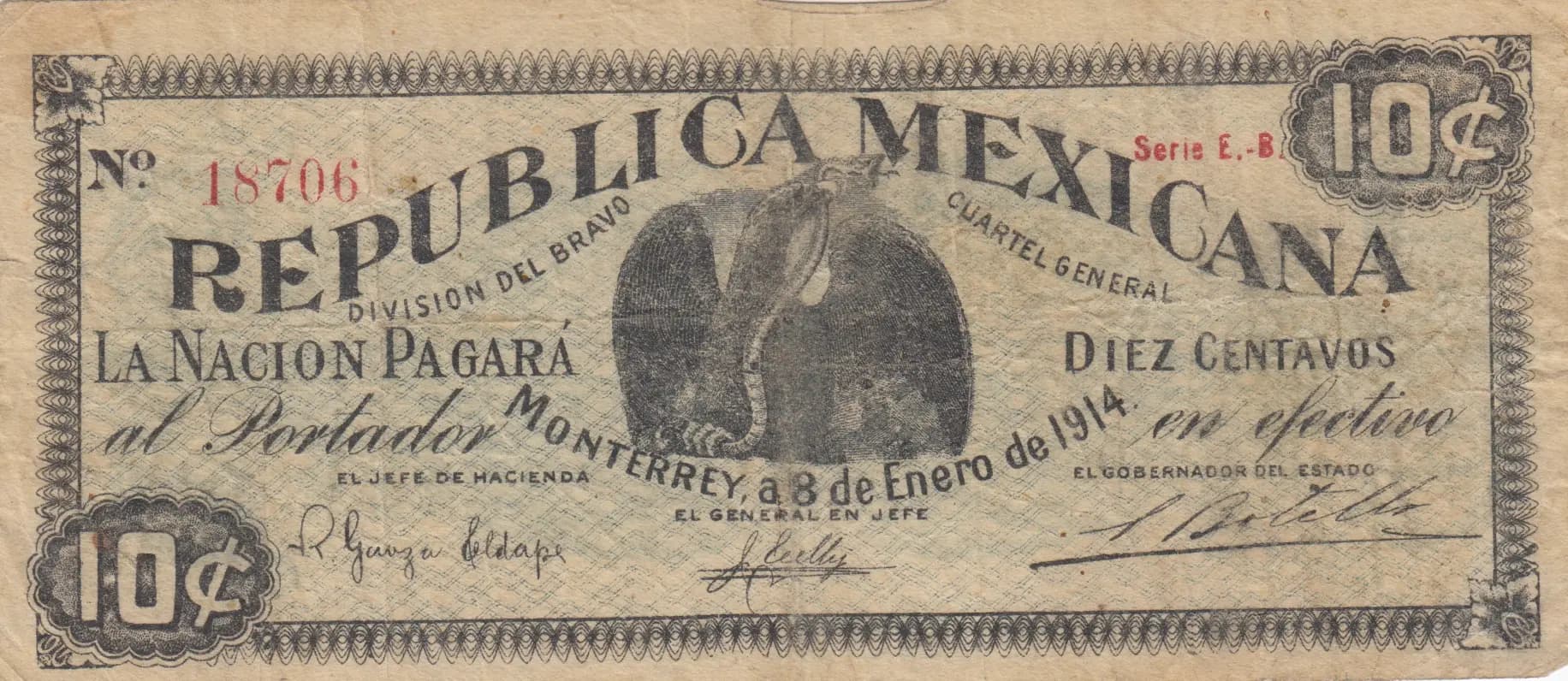
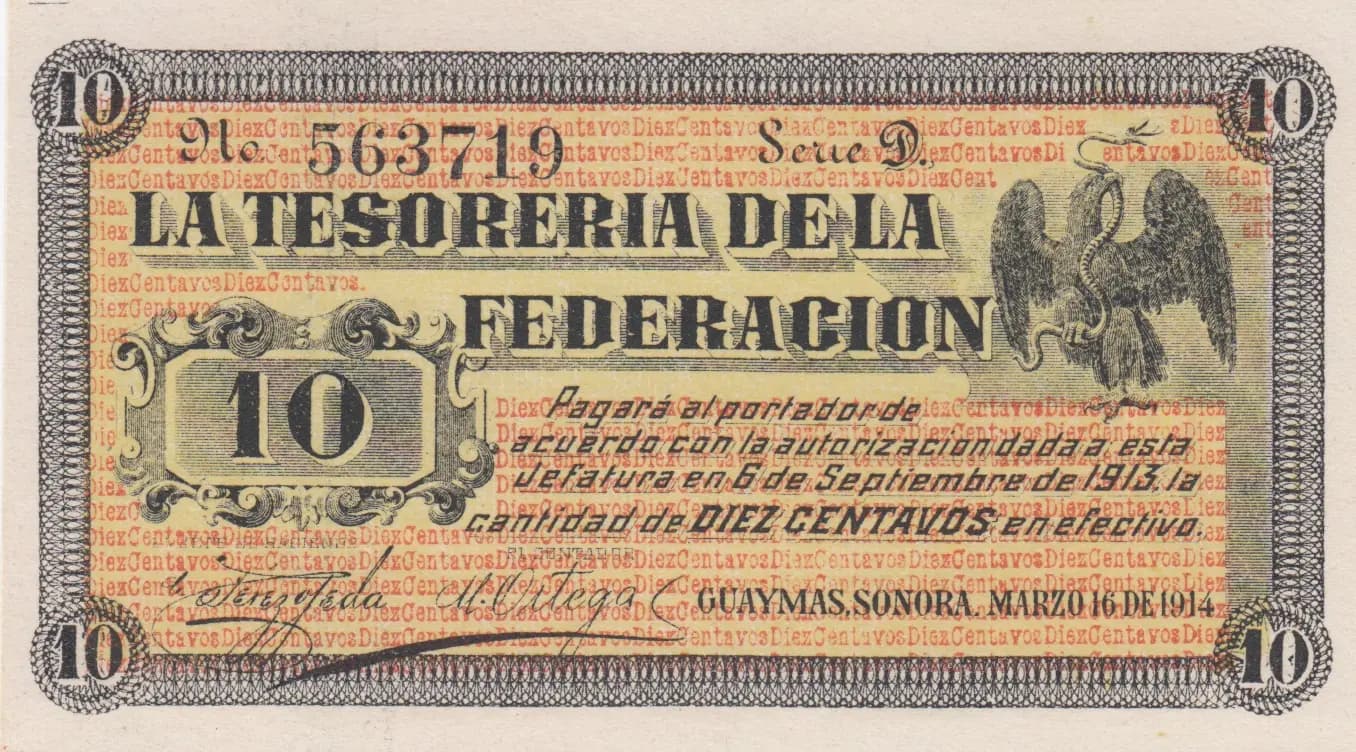
10 centavos 1914
About This Note
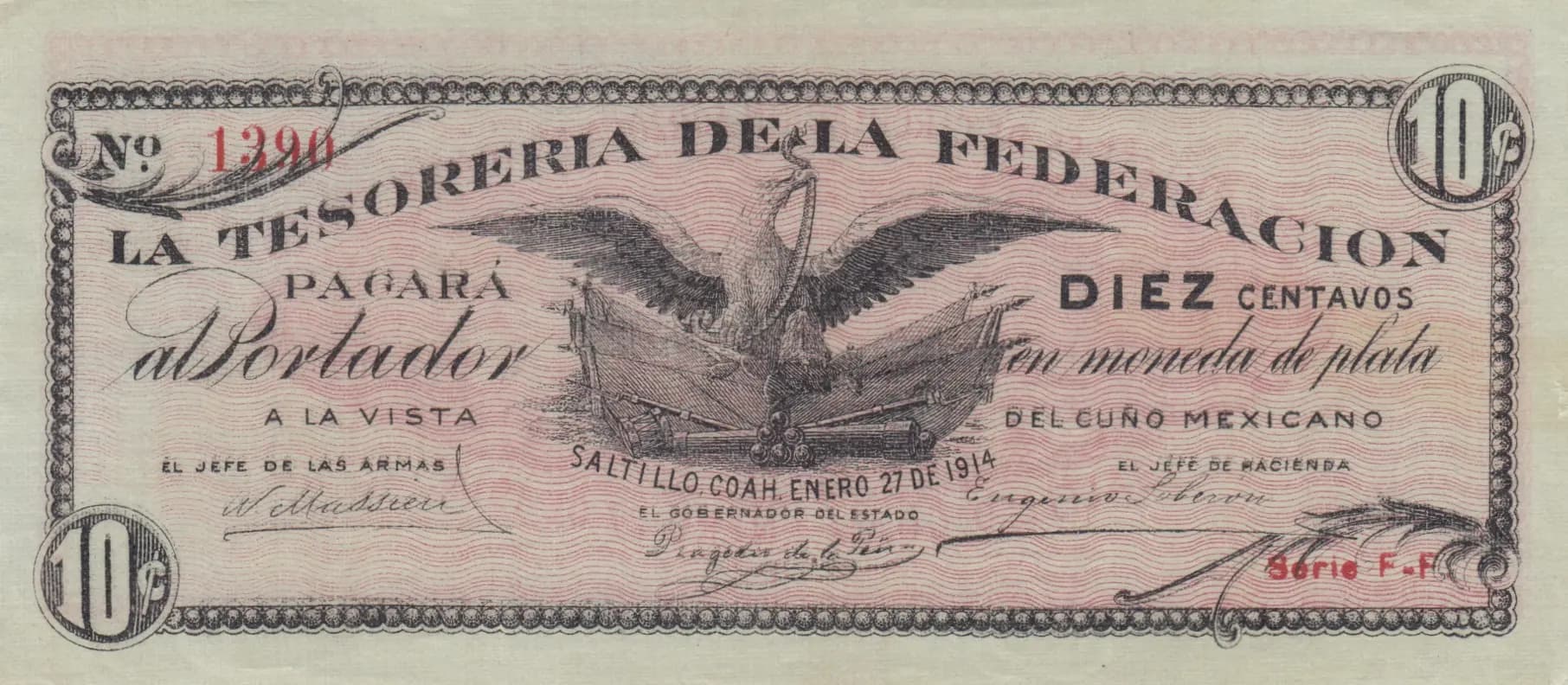
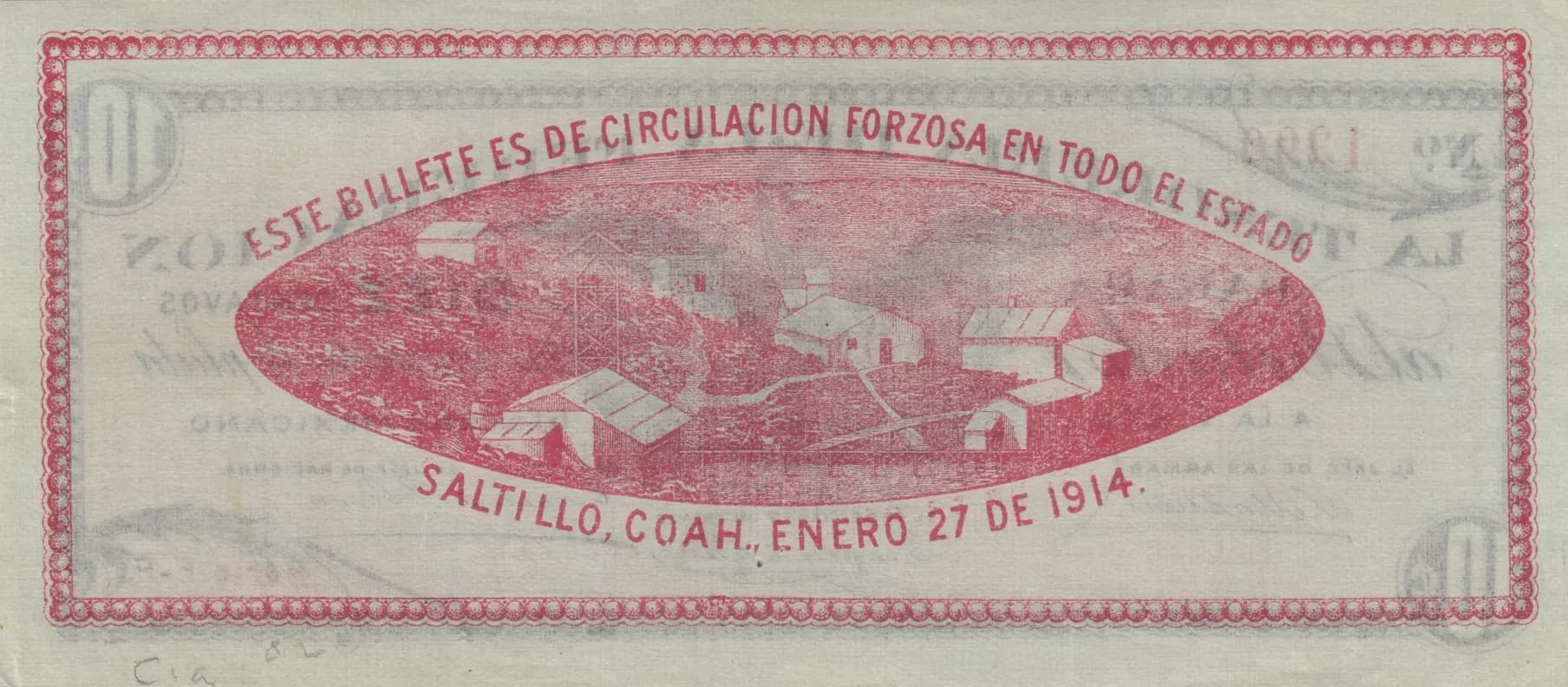
This is an exceptional AU-graded example of a 1914 Tresoreria de la Federacion 10 centavos from Saltillo, Coahuila, featuring a striking central eagle with spread wings on a pinkish-red background. Despite the expected aging characteristics of a 110-year-old banknote—including foxing, staining, and creasing—the note retains strong visual appeal with clear impressions of both the obverse eagle design and the reverse rural agricultural landscape scene. This is a historically significant emergency currency issued during the tumultuous Mexican Revolution period when centralized banking had collapsed.
Common. While these regional Revolutionary emergency issues have become scarcer in high grades due to circulation and loss over time, the 10 centavos denomination from Saltillo was issued in substantial quantities to meet local monetary demands during early 1914. The Pick catalog listing for this note (P-S642) indicates it was a recognized standard issue rather than a limited or recalled note. AU examples do command premiums over circulated specimens, but the note itself is not rare in the broader context of Mexican Revolutionary currency collecting.
Issued on January 27, 1914, during the height of the Mexican Revolution, this Saltillo emission represents a period when state and regional governments were forced to issue their own fractional currency due to the breakdown of federal authority and monetary systems. The inscription 'ESTE BILLETE ES DE CIRCULACION FORZOSA EN TODO EL ESTADO' (This banknote is of forced circulation throughout the entire state) underscores the emergency nature of the issue and the limited geographic validity of the currency. The rural hacienda landscape depicted on the reverse reflects the agrarian-based economy of Coahuila and the revolutionary upheaval affecting Mexico's agricultural sector.
The obverse features a heraldic Mexican eagle with wings displayed horizontally as the dominant central vignette, symbolizing Mexican sovereignty and authority. The eagle is positioned within an ornamental rectangular frame with decorative scrollwork and fine-line border patterns characteristic of early 20th-century Mexican banknote design. Denomination indicators '10' appear in circular medallions in the upper right and lower left corners. The reverse contains an oval-framed landscape vignette depicting a rural Mexican hacienda or ranch complex with farm buildings and agricultural fields, representing the agrarian wealth of Coahuila state. The entire design employs a red-pink color scheme with black typography and is printed on cream-colored paper with fine ornamental borders throughout.
OBVERSE: 'LA TESORERIA DE LA FEDERACION PAGARÁ al Portador A LA VISTA DIEZ CENTAVOS en moneda de plata' (The Treasury of the Federation will pay to the Bearer on sight Ten Centavos in silver currency); 'EL JEFE DE LAS ARMAS DEL CUÑO MEXICANO' (The Commander of Arms of the Mexican Mint); 'EL JEFE DE HACIENDA' (The Chief of Treasury); 'EL GOBERNADOR DEL ESTADO' (The Governor of the State); 'SALTILLO, COAH., ENERO 27 DE 1914' (Saltillo, Coahuila, January 27, 1914); 'Serie F.F.' (Series F.F.); Serial number '1220'. REVERSE: 'ESTE BILLETE ES DE CIRCULACION FORZOSA EN TODO EL ESTADO' (This banknote is of forced circulation throughout the entire state); 'SALTILLO, COAH., ENERO 27 DE 1914' (Saltillo, Coahuila, January 27, 1914).
This note was produced using intaglio/engraving printing methods, evidenced by the fine-line work visible in the decorative borders, the detailed rendering of the eagle's feathers, and the sharp impression of typography. The ornamental border patterns and landscape vignette show the characteristics of hand-engraved plates typical of early Revolutionary-era Mexican currency. The color scheme (red-pink with black) was applied through multi-pass printing, likely by the Tesoreria de la Federacion's own printing facilities or a contracted Mexican printer, as was standard for emergency state issues during this period.
Series F.F. with serial number 1220 observed on this example. The date is fixed as January 27, 1914 (ENERO 27 DE 1914), establishing this as part of the initial Saltillo emission. The specific series designation 'F.F.' may indicate a particular printing run or series block, typical of Mexican state currency organization during the Revolution. No known overprints or significant varieties are evident on this specimen; it appears to be a standard printing from the initial 1914 issue.