75 mark 1922
About This Note
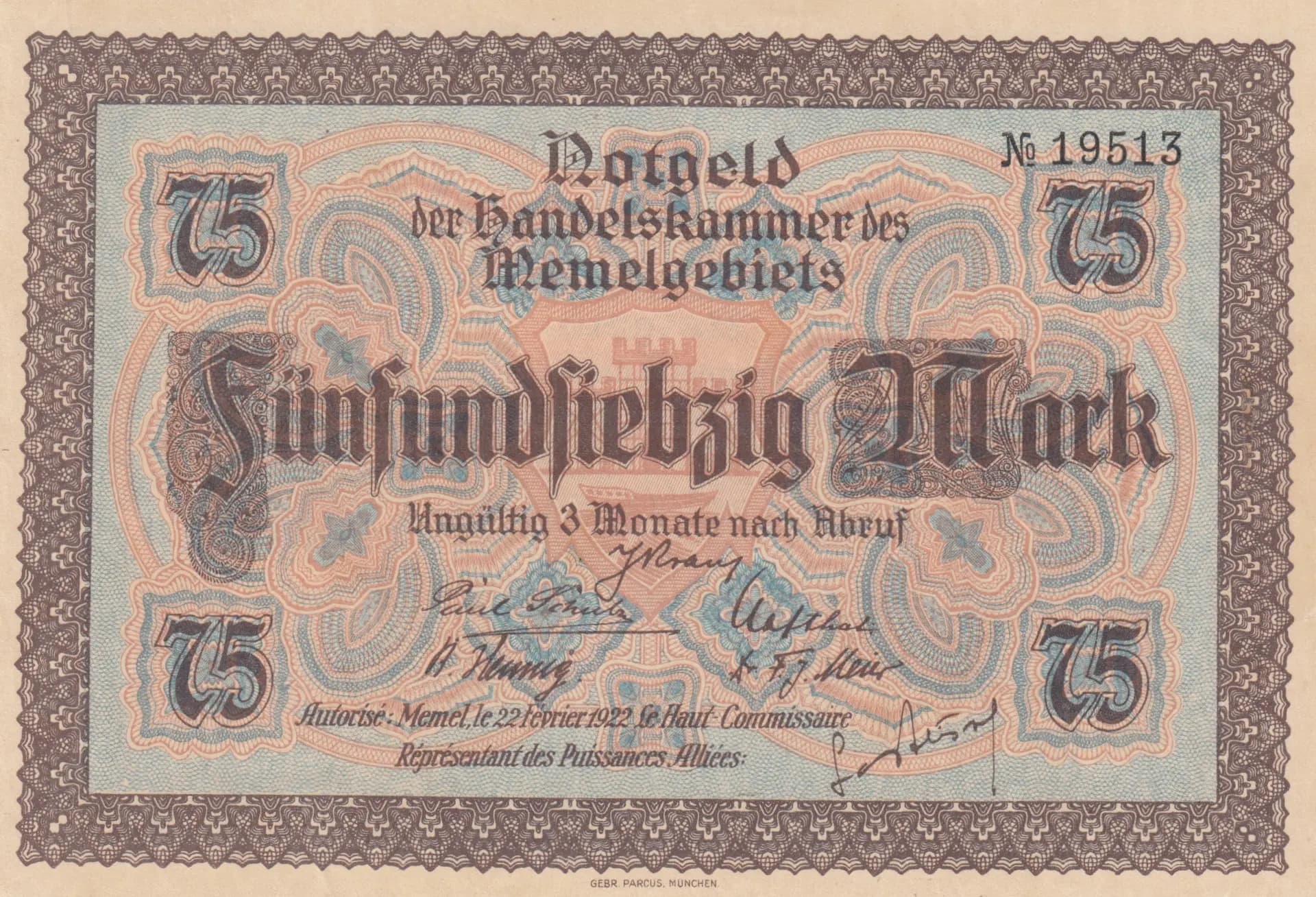
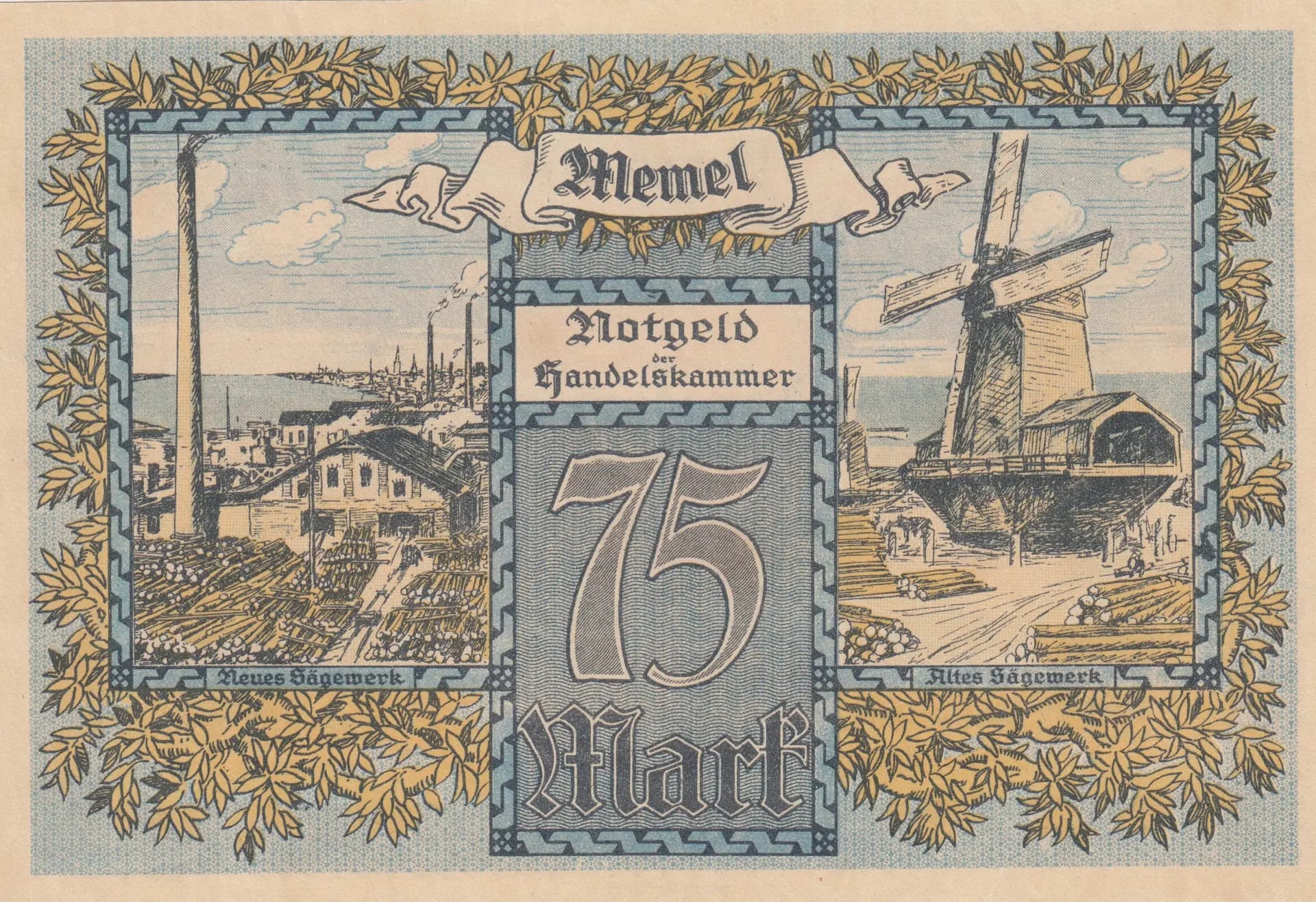
This is a 75 Mark Notgeld note issued by the Handelskammer (Chamber of Commerce) of the Memel region on 22 February 1922, catalogued as Pick P-8. The note features ornate Art Nouveau-style decorative borders with intricate geometric patterns on the obverse and a striking dual-scene vignette on the reverse depicting industrial and rural Memel (industrial smokestacks and the 'Neues Sägewerk' contrasted with a traditional windmill landscape). In AU condition, the note exhibits light wear with visible handwritten signatures across the face, consistent with historical circulation of emergency currency, while the reverse remains well-preserved with vibrant colors and crisp engraving details.
Common. Memel Notgeld from 1922, while historically interesting and appealing to regional and emergency currency collectors, were produced in substantial quantities by the Handelskammer during the post-war period when multiple denominations were issued. The Pick P-8 75 Mark denomination is regularly encountered in the collector market. The AU condition grade and serial number 19513 do not indicate a rare variant. These notes typically trade at modest prices, reflecting their availability.
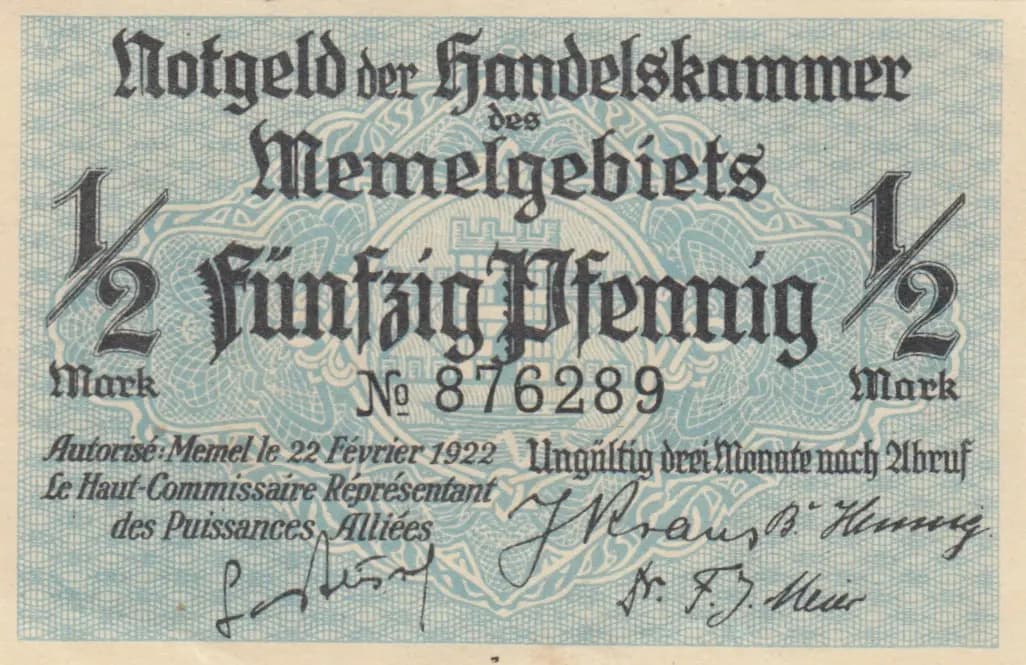
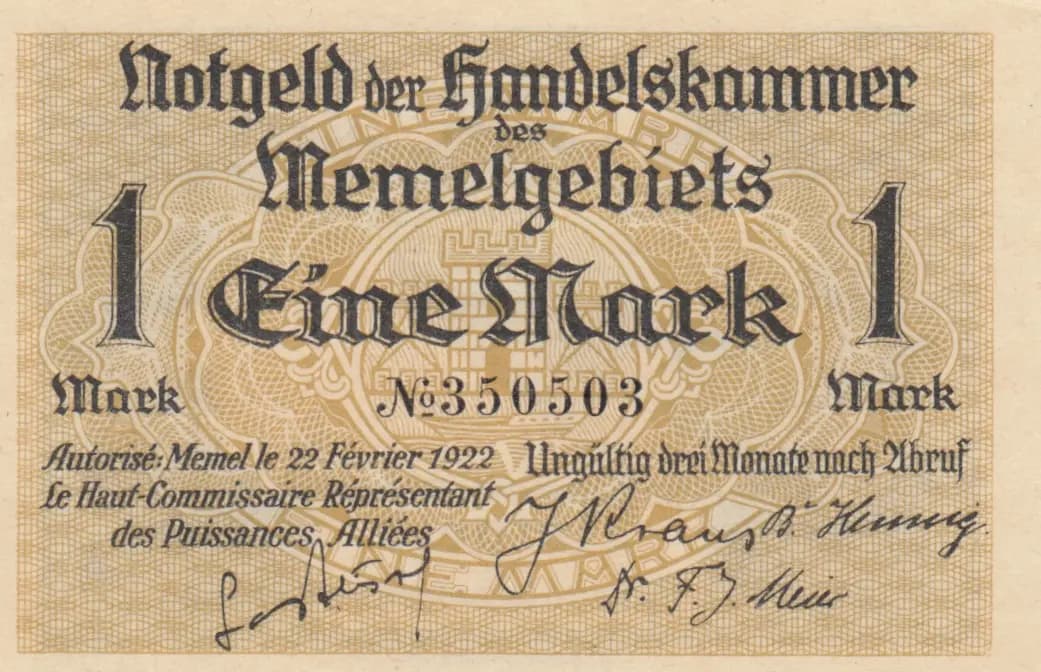
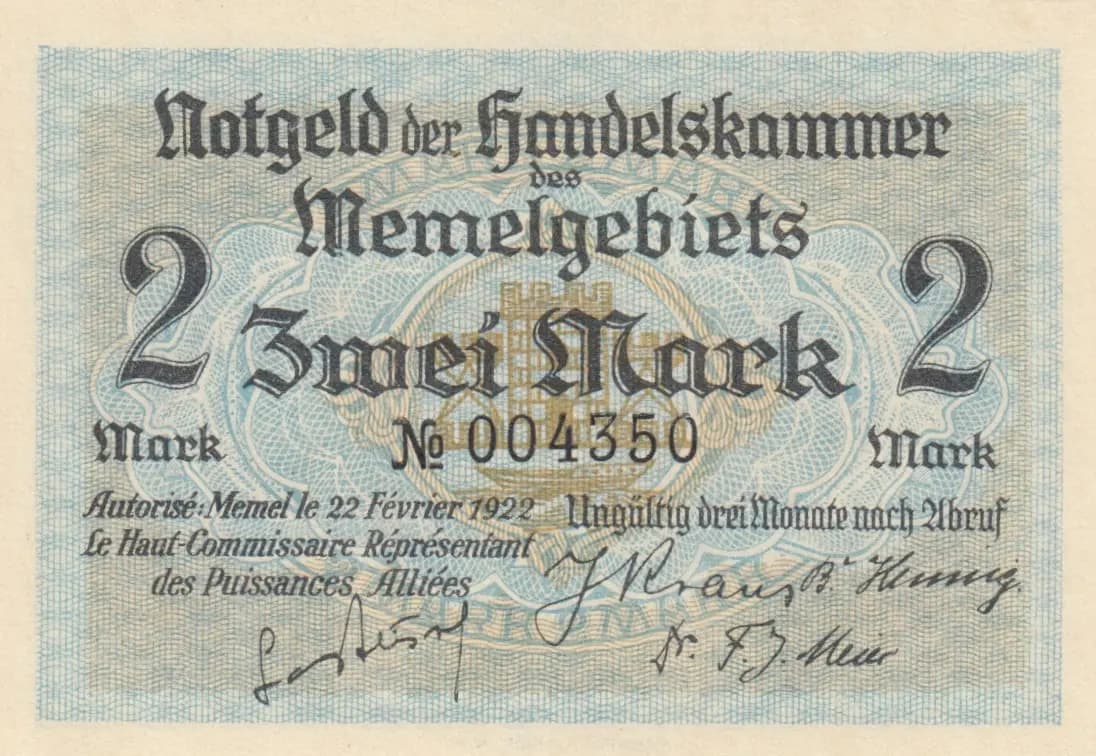
This Notgeld was issued during the post-World War I period when Memel (Klaipėda) was under League of Nations administration following the Treaty of Versailles, with the note specifically authorized by the 'Repräsentant des Puissances Alliées' (Representative of the Allied Powers). The dual imagery on the reverse—contrasting the 'Neues Sägewerk' (new industrial sawmill) with the traditional 'Altes Sägewerk' (old sawmill) and rural windmill—reflects Memel's economic transition and dual character as both an industrial port city and agricultural region during this period of regional uncertainty. The 3-month validity clause and Chamber of Commerce issuance underscore the temporary, emergency nature of this currency issued when conventional money was scarce.
The obverse features a classical emergency currency design with deep ornamental borders incorporating geometric and floral guilloché patterns in brown and purple tones, with light blue-green central panel. Large Gothic-style '75' numerals occupy all four corners. The center displays the formal text and dual signatures from authorized officials. The reverse showcases a sophisticated engraved vignette depicting Memel's economic character: on the left is an industrial cityscape featuring multiple factory buildings, manufacturing facilities, and tall smokestacks representing modern industrial development (labeled 'Neues Sägewerk'); on the right stands a picturesque rural landscape with a traditional Dutch-style windmill and agricultural fields (labeled 'Altes Sägewerk'), symbolizing the region's agrarian heritage. These contrasting scenes are framed by an ornate border with golden leaf and scroll motifs. The banner at top and text at bottom reinforce the denomination and issuing authority. The design successfully conveys Memel's identity as a region balancing industrial progress with traditional pastoral economy.
{"frontSide":{"notgeld":"Notgeld (Emergency money)","issuer":"der Handelskammer des Wemelgebiets (of the Chamber of Commerce of the Wemel/Memel region)","denomination":"Fünfundsiebzig Mark (Seventy-five Mark)","validity":"Gültig 3 Monate nach Abruf (Valid 3 months after call/demand)","dateIssued":"Ausfertigung 22 februar 1922 (Issued 22 February 1922)","loanReference":"Anleihe Memel (Memel Loan)","serialNumber":"No 19513 (Number 19513)","authority":"Repräsentant des Puissances Alliées (Representative of the Allied Powers)","printer":"GEBR. PARCUS. MÜNCHEN (Gebr. Parcus, Munich)"},"reverseSide":{"region":"Memel","documentType":"Notgeld (Emergency money)","issuer":"der Handelskammer (of the Chamber of Commerce)","denomination":"75 Mark","industrialSite":"Neues Sägewerk (New Sawmill)","historicalSite":"Altes Sägewerk (Old Sawmill)"}}
Intaglio engraving (copperplate/steel plate engraving), as evidenced by the fine line work, detailed guilloché patterns, and crisp definition of the landscape vignette with its characteristic sharp lines and tonal gradations. The printer Gebr. Parcus of Munich was a well-established security printer in Bavaria known for high-quality intaglio work on currency and bonds. The ornamental borders and fine detail work are characteristic of premium Notgeld production from established printing houses during this period.
The specific variety is identified by serial number 19513 and the date of 22 Februar 1922. The Handelskammer issued multiple denominations of Notgeld in 1922, and this note may be part of a series. Known varieties of Memel Handelskammer notes include different denominations (reportedly including 50, 75, and 100 Mark denominations) and potentially variant signatures from different authorized officials. The handwritten signatures visible on this example represent authentic authorization marks from Handelskammer representatives and may vary between individual notes. No overprints or surcharges are evident on this example.