50 pfennig 1920
About This Note
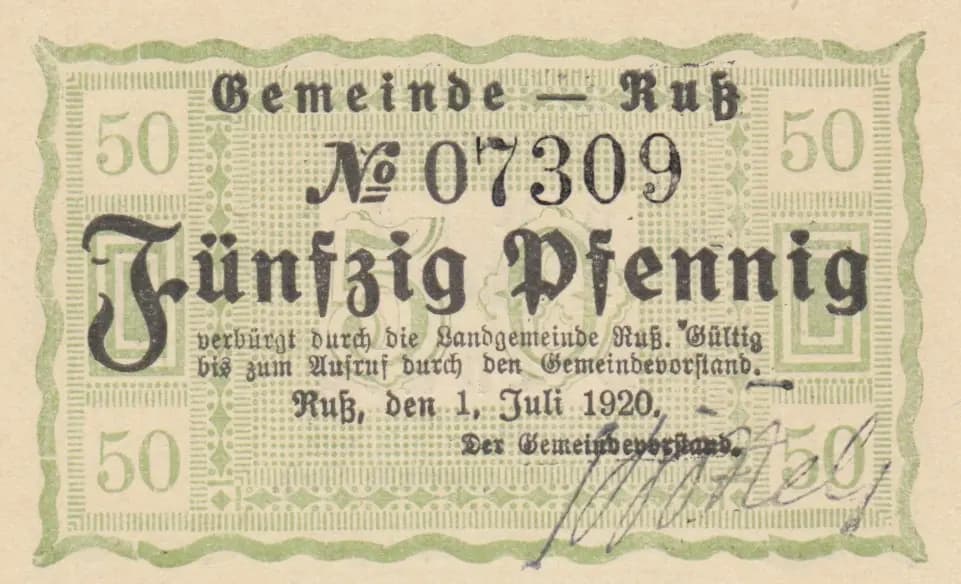
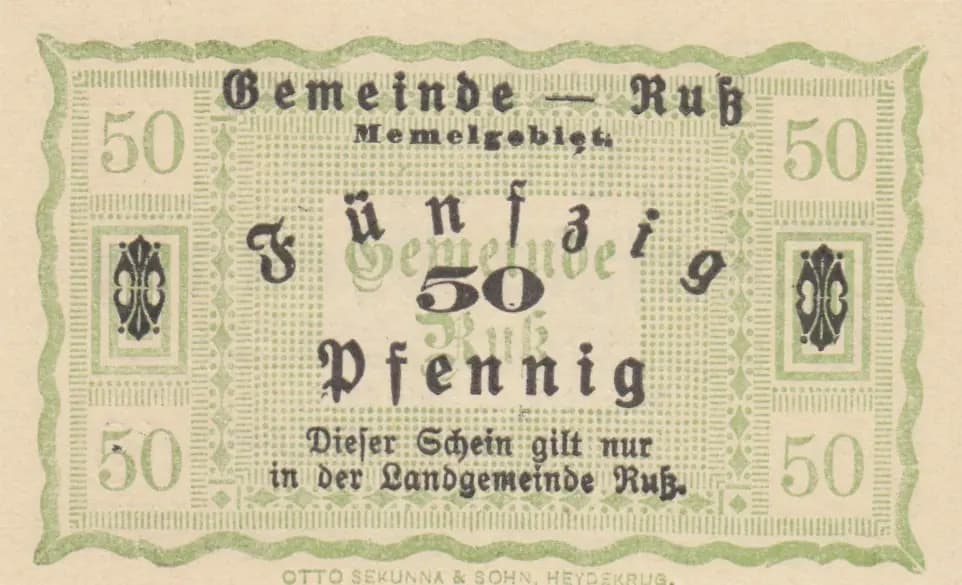
This is a 50 Pfennig notgeld (emergency currency) issued by Gemeinde Ruß in the Memel Territory on July 1, 1920, serial number 07309. The note features a cream-colored background with green decorative borders and denomination numerals, printed in gothic/fraktur typeface with ornamental emblems on the reverse. Despite being cataloged as UNC in the Pick reference, the visual evidence shows significant circulation wear including heavy creasing, folds, and what appears to be handwritten marks or date stamps, suggesting this example is actually in circulated condition rather than uncirculated.
Common. Notgeld from the Memel Territory, particularly municipal issues from small communities like Ruß, were produced in modest quantities but are nonetheless readily available to collectors today. The Pick catalog lists this as 'unlisted,' which often indicates it is a minor local variant rather than a scarce or valuable issue. The visible circulation wear and handwritten marks suggest this note saw actual use in commerce, and multiple examples have survived. No specific mintage restrictions, recalls, or short-lived issuing authority characteristics apply that would elevate rarity. Market demand for Memel notgeld is modest compared to major German regional issues.
This notgeld represents the post-World War I emergency currency period in the Memel Territory, a strategically important region that was detached from Germany following the Treaty of Versailles and placed under League of Nations administration from 1920-1923. Local municipalities like Ruß issued their own small-denomination notes to address severe currency shortages during this transitional period. The printer's mark indicating Otto Sekunna & Sohn of Heydekrug demonstrates the use of local Lithuanian printing resources for these temporary currency measures.
The note employs a simple but dignified design typical of German Notgeld from the post-war period. The front features the denomination '50' in large green numerals positioned in the top left and right corners, with the municipality name and validity conditions centered in black gothic lettering. The back repeats the denomination and adds regional identification ('Memelgebiet'), and features two identical ornamental emblems or heraldic coat-of-arms designs flanking the center text—these appear to be decorative municipal seals rather than portraits or specific landmarks. The cream/beige paper stock with green decorative borders frames all text, and the gothic/fraktur typeface reinforces the German administrative character of the document. No portraits or geographical landmarks are depicted; the design focuses entirely on legal validity text and municipal authority.
FRONT SIDE: 'Gemeinde — Ruß' (Municipality - Ruß); 'Fünfzig Pfennig' (Fifty Pfennig); 'verbürgt durch die Landgemeinde Ruß. Gültig bis zum Aufruf durch den Gemeindeverstand.' (guaranteed by the rural municipality Ruß. Valid until called by the municipal administration.); 'Ruß, den 1. Juli 1920' (Ruß, July 1, 1920); 'Der Gemeindeverstand.' (The Municipal Administration); Serial number '№ 07309'. BACK SIDE: 'Gemeinde Ruß' (Municipality Ruß); 'Memelgebiet' (Memel Territory); 'Fünfzig Pfennig' (Fifty Pfennig); 'Dieser Schein gilt nur in der Landgemeinde Ruß.' (This note is only valid in the rural municipality of Ruß.); 'OTTO SEKUNNA & SOHN, HEYDEKRUG.' (printer's attribution).
This note was produced using letterpress (relief) printing, evidenced by the crisp black gothic typeface impression and the consistent green border and numeral application visible in the images. The printer attribution 'OTTO SEKUNNA & SOHN, HEYDEKRUG' indicates a local commercial printing operation in Heydekrug (modern Šilutė, Lithuania) rather than a security printer. The two-color process (green and black on cream stock) was typical for municipal notgeld of this period, with green ink selected for decorative elements and denomination numerals to enhance security and visual distinction.
Serial number 07309 is recorded on this example. The specific date of issue (1. Juli 1920 / July 1, 1920) may represent a distinct printing variety if other dates exist, though the visual analysis does not indicate date variations are known for this Pick number. The printer attribution 'OTTO SEKUNNA & SOHN, HEYDEKRUG' appears consistent with the recorded issuer. No overprints, security threads, watermarks, or signature varieties are evident from the visual analysis. This note represents a standard emission without documented varieties in the Pick catalog system.