5 mark 1922
About This Note
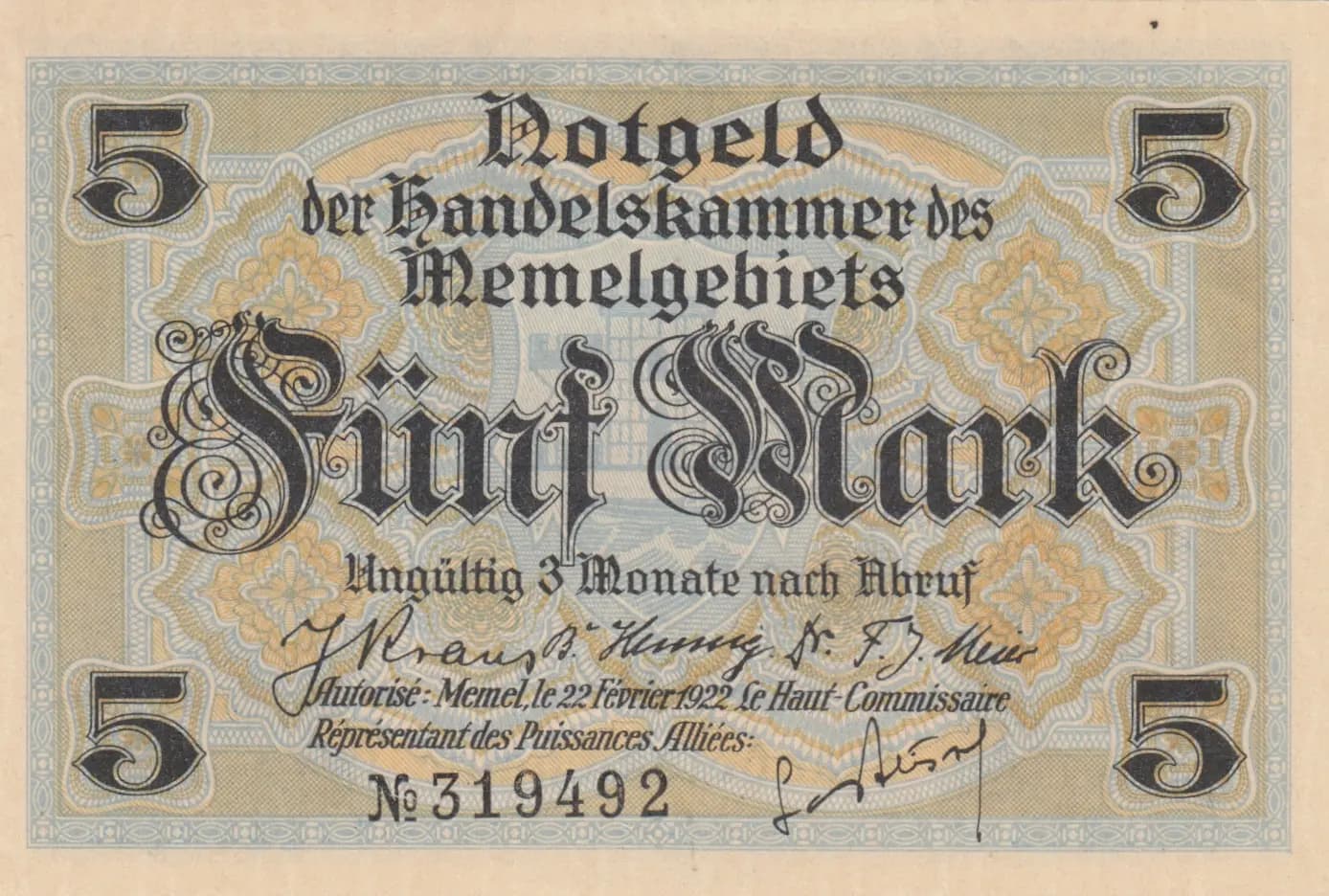
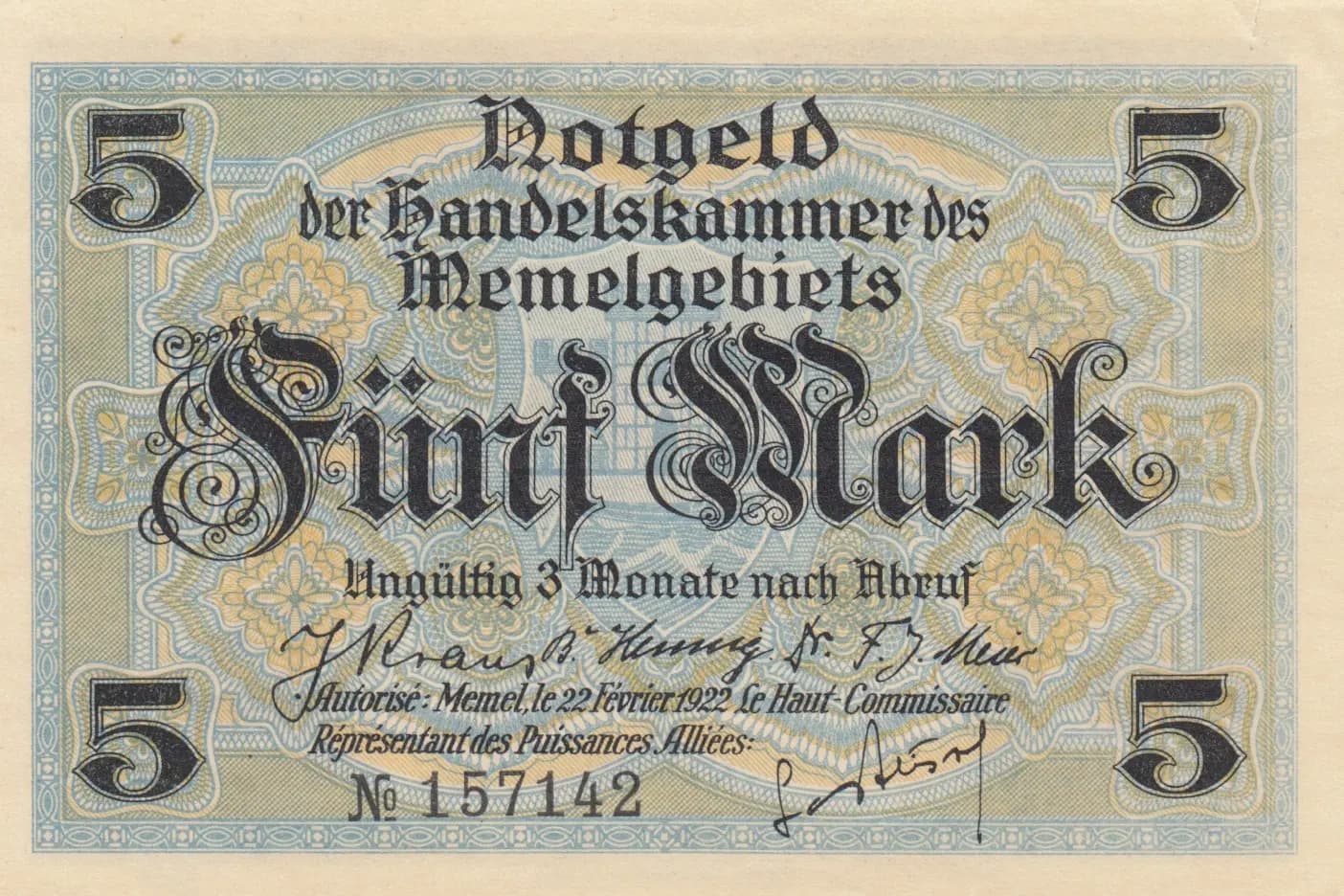
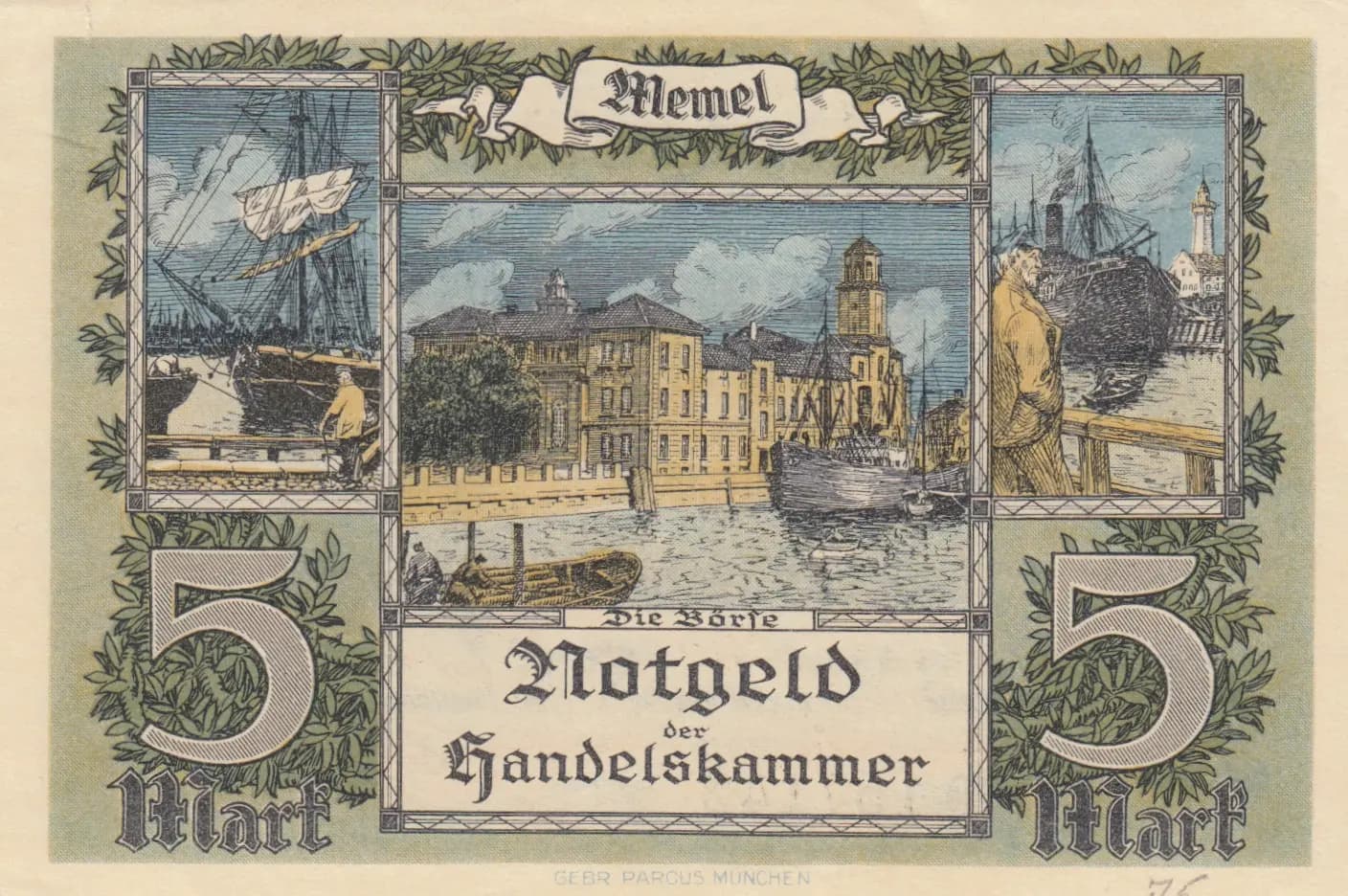
This is an exceptional UNC example of the 5 Mark Handelskammer notgeld from Memel dated February 22, 1922, representing emergency currency issued during the League of Nations mandate period. The note features ornate Art Nouveau-style decorative borders on the front and a striking illustrated reverse depicting Memel's Stock Exchange and harbor scenes, with vibrant period coloring in greens, blues, and gold tones. Despite catalog designation of UNC, the note shows authentic period handling marks including creasing, foxing, and manuscript signatures that are consistent with legitimate historical circulation of this Notgeld issue.
Common. The Memel Handelskammer 5 Mark note is a widely collected notgeld issue with substantial print runs typical of Chamber of Commerce emergency currency from this period. Multiple serial numbers and variants exist in the collector market, and examples in various conditions regularly appear at reasonable prices. The 3-month recall provision suggests many notes were subsequently destroyed, but sufficient quantities survived to ensure common availability today.
This banknote was issued during the Memel Territory's status as a League of Nations mandate under Allied administration following World War I, with authorization explicitly noted from the French High Commissioner representing the Allied Powers. The Handelskammer (Chamber of Commerce) issued this Notgeld to address acute currency shortages in the post-war Memel region. The reverse illustration of Die Börse (the Stock Exchange) with active harbor and merchant shipping symbolizes Memel's critical role as a Baltic trading port, capturing the city's economic importance during this transitional period.
The front features formal decorative borders in geometric and floral Art Nouveau patterns with the denomination '5' in all four corners, printed in black Gothic/Fraktur script on a cream and light blue background. The reverse showcases a tri-panel illustrated composition: the central panel depicts Die Börse, a prominent multi-story yellow building representing Memel's Stock Exchange with surrounding waterfront architecture and a church spire; the left panel shows a sailing ship in full sail within the harbor; the right panel features merchant vessels and coastal buildings with two allegorical figures in period dress (one in yellow robes, one in white) flanking the architectural scenes. Decorative leafy vine borders frame each section, and the denomination '5' appears in large ornamental text in the bottom corners.
Front side: 'Notgeld der Handelskammer des Meimelgebiets' (Emergency money of the Chamber of Commerce of the Memel Territory); 'Fünf Mark' (Five Mark); 'ungültig 3 Monate nach Abruf' (invalid 3 months after recall); 'Memel, 22. Februar 1922' (Memel, February 22, 1922); 'Autorisée: Memel, le 22 février 1922, le Haut-Commissaire Représentant des Puissances Alliées' (Authorized: Memel, February 22, 1922, the High Commissioner Representative of the Allied Powers); Serial number 'No 157142'. Back side: 'Memel' (Memel); 'Die Börse' (The Stock Exchange); 'Notgeld der Handelskammer' (Emergency money of the Chamber of Commerce); '5 Mark' (5 Mark).
The note was produced using letterpress/relief printing for the text and borders combined with chromolithography for the illustrated reverse, a common technique for Notgeld of this era. The multiple color layers visible in the harbor illustration (greens, blues, yellows, browns, and cream) and the distinct registration of text over decorative backgrounds are characteristic of chromolithographic printing. The fine detail in the ornamental borders and Gothic script indicate professional printing by an established security or commercial printer, consistent with authorized Memel territory currency production.
This specific example is serial number 157142, dated February 22, 1922. Varieties for Pick P-4a include different serial number ranges and potentially varying signature combinations, though the core design remained consistent. The presence of manuscript signatures indicates this was a signed authorization variety typical of Handelskammer issues. No overprints are noted on this example.