5 mark 1922
About This Note
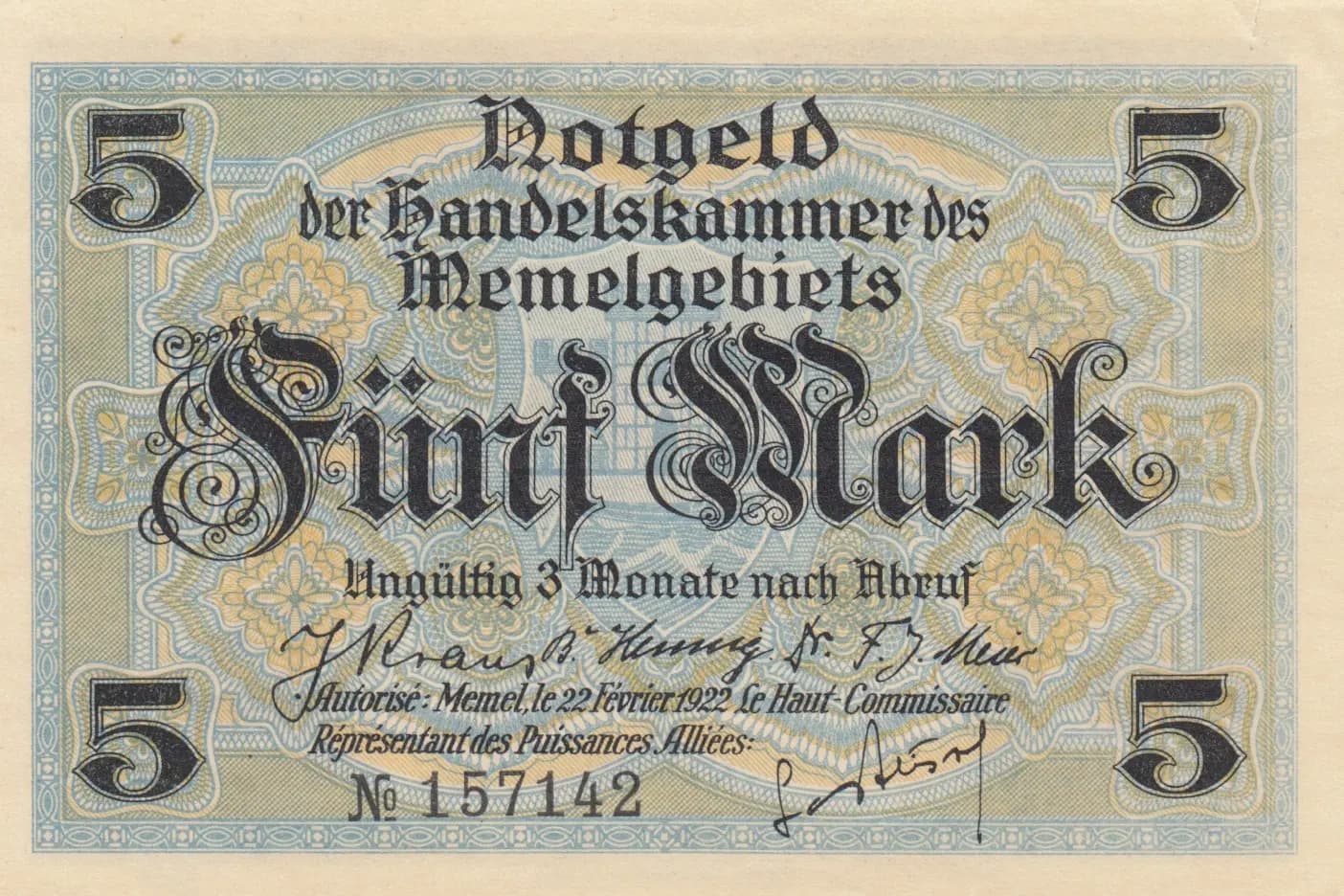
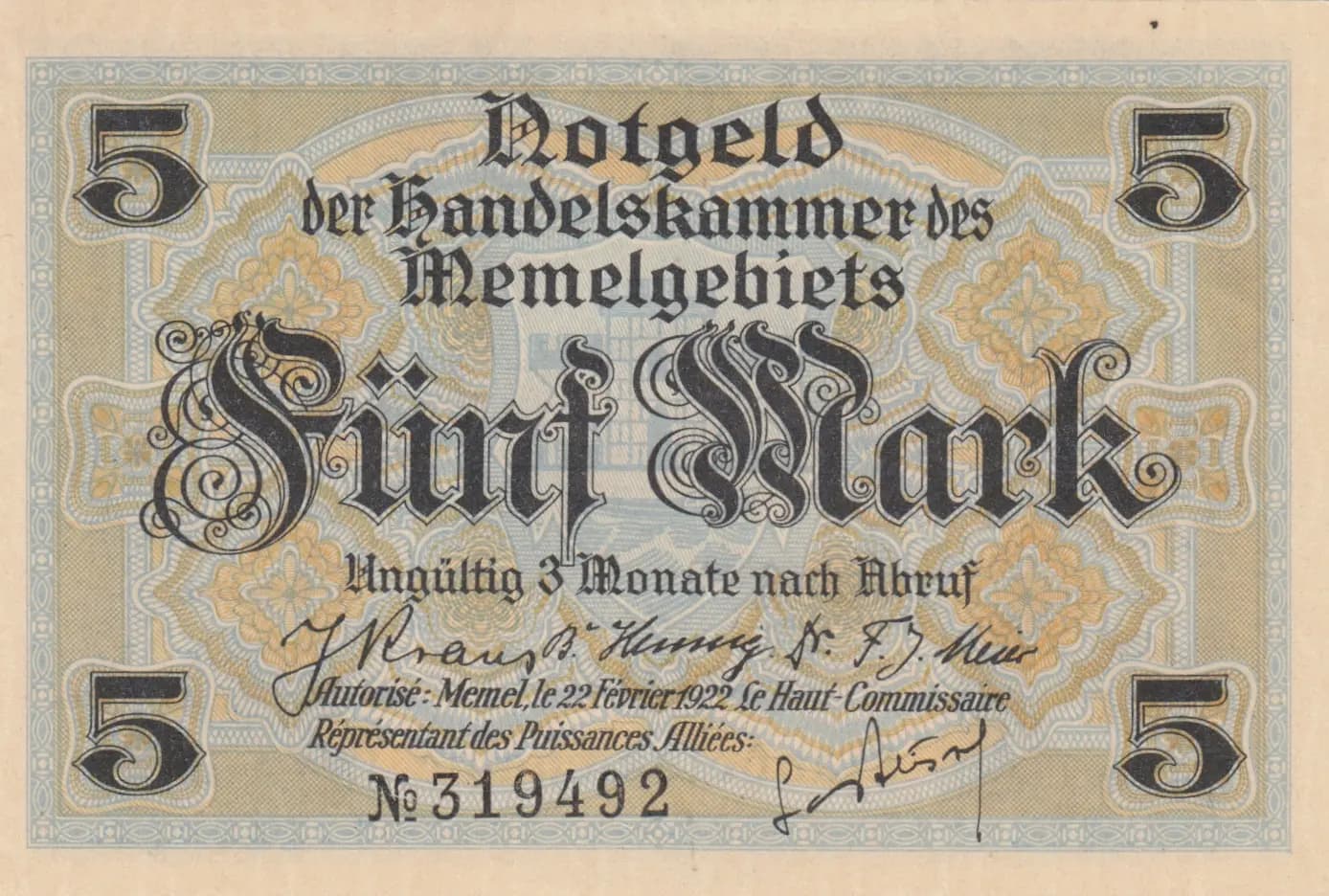
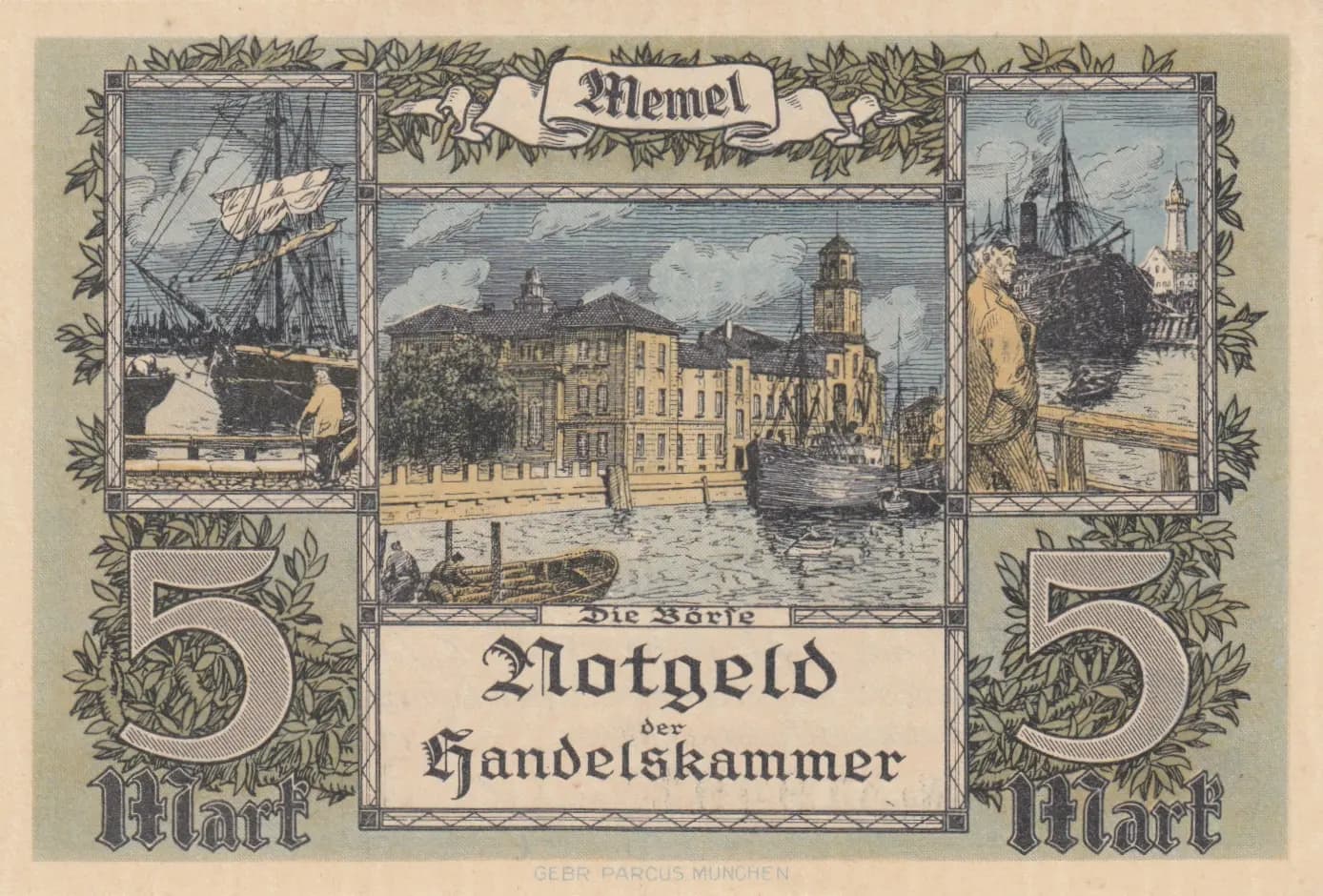
This Memel 5 Mark note from 1922 is an exceptional example of early Weimar-era emergency currency (Notgeld) issued by the Handelskammer during the period of League of Nations administration. The obverse features elegant geometric ornamental borders with Gothic typeface and French/German bilingual authorization text dated February 22, 1922, while the reverse showcases a detailed engraved illustration of Memel's historic waterfront with church spires, sailing vessels, and merchant architecture. In UNC condition, the note displays only light age-related discoloration and minor creasing consistent with preservation of a 100+ year old historical document, with all inscriptions and imagery remaining crisp and clearly legible.
Common. This is an emergency currency (Notgeld) issue from the Memel Territory's brief administrative period (1922-1923). While historically significant, such notes were typically issued in substantial quantities to meet circulation demands during the post-war period. The Pick catalog lists this as P-4b, indicating multiple varieties and sufficient surviving examples to establish pricing and grading standards in the philatelic market. UNC examples are desirable but not exceptionally scarce.
The Memel Territory, strategically located on the Baltic coast between Germany and Lithuania, was placed under League of Nations administration following World War I's Treaty of Versailles. This 1922 issue authorized by the French High Commissioner (Représentant des Puissances Alliées) represents the transitional period when the region's Chamber of Commerce maintained monetary authority. The reverse illustration of 'Die Börse' (The Exchange) and the maritime imagery reflect Memel's historical importance as a major Baltic trading port, with its distinctive church spires and harbor infrastructure central to regional commerce.
The obverse displays a formal certificate-style layout with symmetrical decorative corner ornaments featuring geometric patterns in tan and light beige tones, characteristic of early 20th-century German official documents. The reverse features a professional engraved illustration of Memel's historic commercial center, specifically the Stock Exchange building ('Die Börse'), flanked by maritime figures (sailors or commerce representatives) within decorative vine-leaf border panels. The main vignette depicts the city's waterfront with multiple church steeples dominating the skyline, merchant vessels under sail, and multi-story historical trading buildings along the harbor—all rendered in muted blue-green, cream, and black tones that evoke the region's maritime mercantile heritage. The denomination '5' appears prominently in large numerals at both bottom corners on the reverse.
FRONT: '5' (denomination in top corners); 'Notgeld der Handelskammer des Memelgebiets' (Emergency money of the Chamber of Commerce of the Memel region); 'Swiff Slonk'; 'Ungültig 3 Monate nach Abruf' (Invalid 3 months after call); 'T.Mauld-Lemory fr. F.D.Keller' (signatures/credits); 'Autorisé: Memel, le 22 février 1922 le Haut-Commissaire' (Authorized: Memel, February 22, 1922 the High Commissioner); 'Représentant des Puissances Alliées:' (Representative of the Allied Powers:); '№ 319492' (serial number). BACK: 'Memel'; 'Die Börse' (The Exchange); 'Notgeld der Handelskammer' (Emergency money of the Chamber of Commerce); '5 Mark' (denomination and currency); 'GEBR PAROUS MUNCHEN' (Gebr. Parous printing house, Munich).
The note was produced using combined intaglio (engraving) and letterpress printing techniques. The detailed waterfront vignette and ornamental borders on the reverse were executed via intaglio engraving, which creates the characteristic depth and fine line work visible in the architectural details, sailing vessels, and decorative vine patterns. The text components, particularly the Gothic/blackletter typeface on the obverse and denomination numerals, were printed via letterpress. The printing was executed by Gebr. Parous (Gebruder Parous), a respected Munich printing house, as indicated by the imprint 'GEBR PAROUS MUNCHEN' on the reverse.
This specimen is identified as Pick P-4b, the second known variety of the 5 Mark Memel Handelskammer note from 1922. The specific variety can be distinguished by serial number 319492 and the signatures present (T.Mauld-Lemory fr. F.D.Keller). The authorization date of February 22, 1922, and the French High Commissioner authorization line are consistent with issued notes from the official series. The 3-month validity clause ('Ungültig 3 Monate nach Abruf') is a distinctive feature of this emergency money issue.