50 mark 1922
About This Note
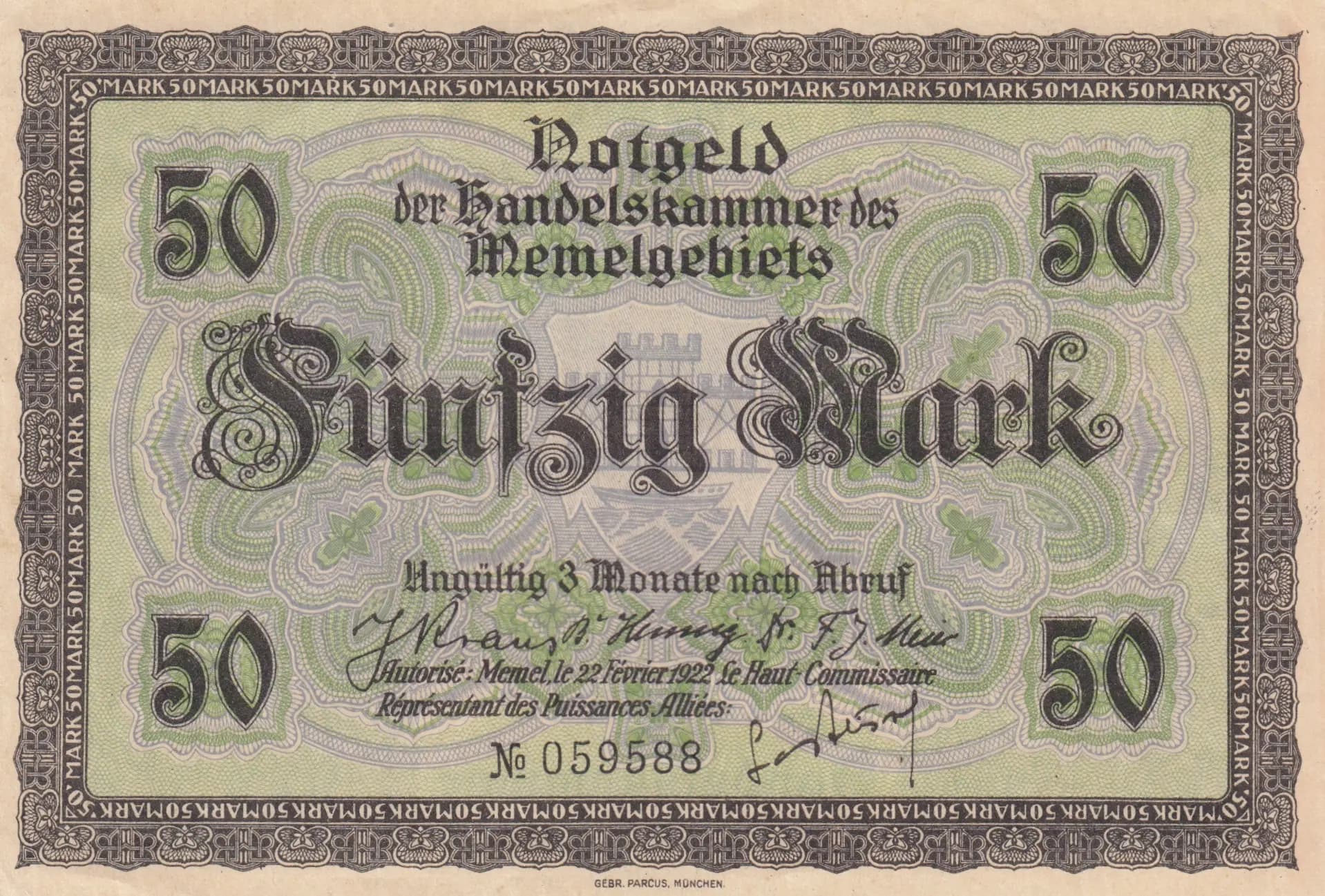
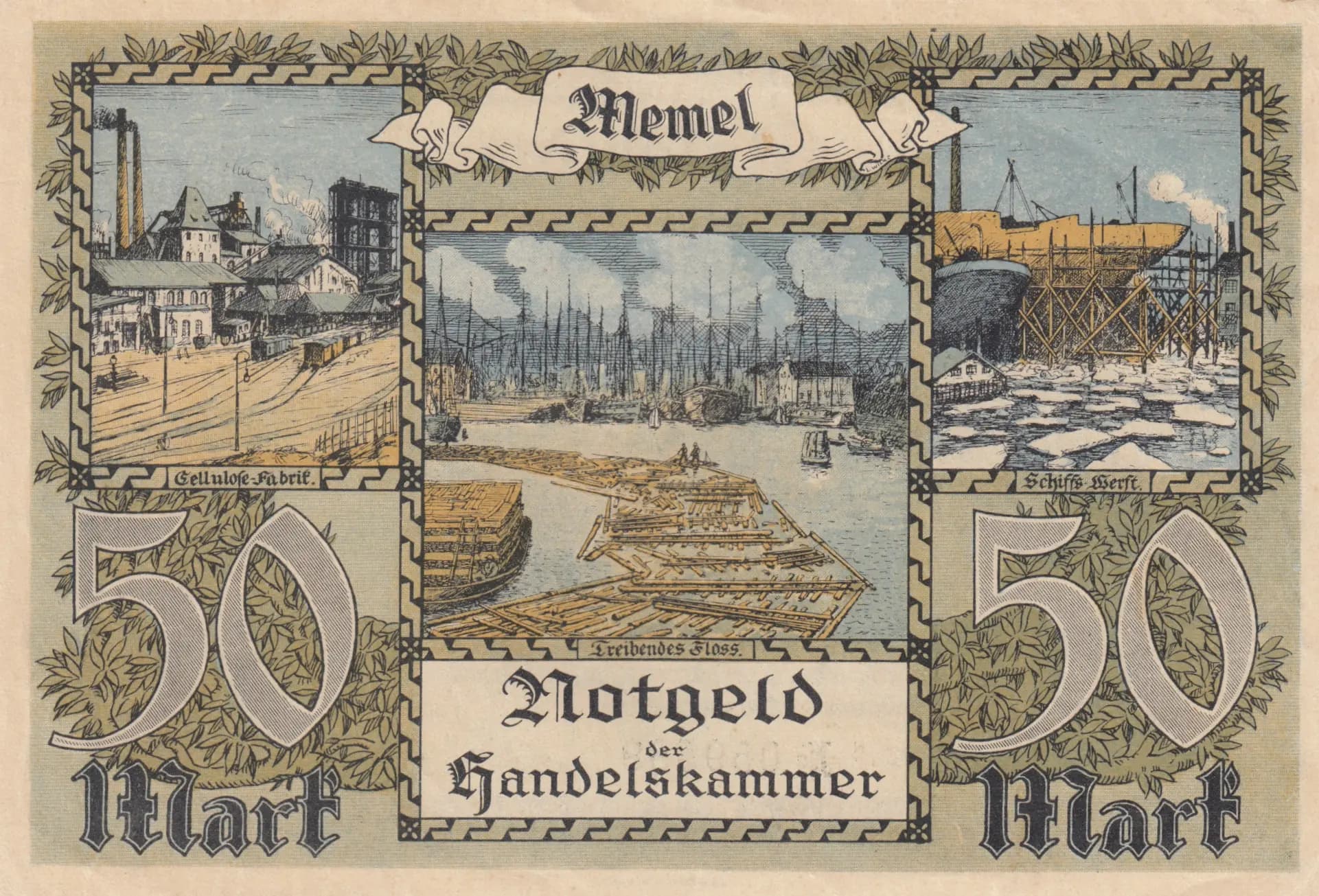
This is an AU-graded 50 Mark Notgeld issued by the Handelskammer des Memelgebiets (Chamber of Commerce of the Memel Region) on February 22, 1922. The note features exceptional artistic design with ornate Gothic typography on the obverse and three detailed industrial vignettes on the reverse depicting the region's key economic sectors: cellulose manufacturing, timber processing, and shipbuilding. Despite its 1922 vintage, the note displays minimal wear with good color retention and fine line engraving detail intact, making it an attractive example of interwar German emergency currency.
Common. The Handelskammer des Memelgebiets issued Notgeld across multiple denominations and series during 1922, with this Pick-7 50 Mark denomination being a standard issuance. While Memel Notgeld has specialized collector interest, the 50 Mark denomination was produced in sufficient quantities to remain readily available in the numismatic market. The AU condition grade and the printer attribution do not significantly alter the overall common status of this issue, as many examples have survived in good to excellent condition.
This Notgeld was issued during the post-World War I period when the Memel Territory was under League of Nations administration, as evidenced by the French authorization inscription from the Allied High Commissioner dated February 22, 1922. The reverse vignettes reflect Memel's critical role as a Baltic industrial and trade hub, showcasing the cellulose factories, extensive timber operations, and shipyards that sustained the region's economy during the economically turbulent early 1920s. The emergency currency designation underscores the monetary instability and shortage of circulating currency that plagued Germany and its territories following the war and hyperinflation.
The obverse features a masterfully engraved design with ornate Art Nouveau and Gothic Revival elements. An intricate repeating border of 'MARK 50' text frames the entire note in elaborate Gothic blackletter typeface, with the denomination '50' positioned in all four corners in large ornate lettering. The center displays fine geometric patterns in green and cream tones with decorative flourishes and scrollwork. A faint castle or fortified structure appears as a watermark-style element in the center background, likely representing Memel's historical fortifications. The reverse presents three separate engraved vignettes depicting the region's economic foundations: the left panel shows the Cellulos-Fabrik (Cellulose Factory) with industrial buildings and smokestacks; the central larger panel displays the Treibendes Schloss (Floating Lock) or timber-laden landscape, illustrating Memel's vital timber export industry; and the right panel depicts the Schiffe-Werft (Shipyard) with active ship construction, vessels under scaffolding, and maritime activity. Each vignette is framed with decorative foliage and ornamental borders. The color palette combines cream, blue, brown, green, and yellow-gold tones across the design.
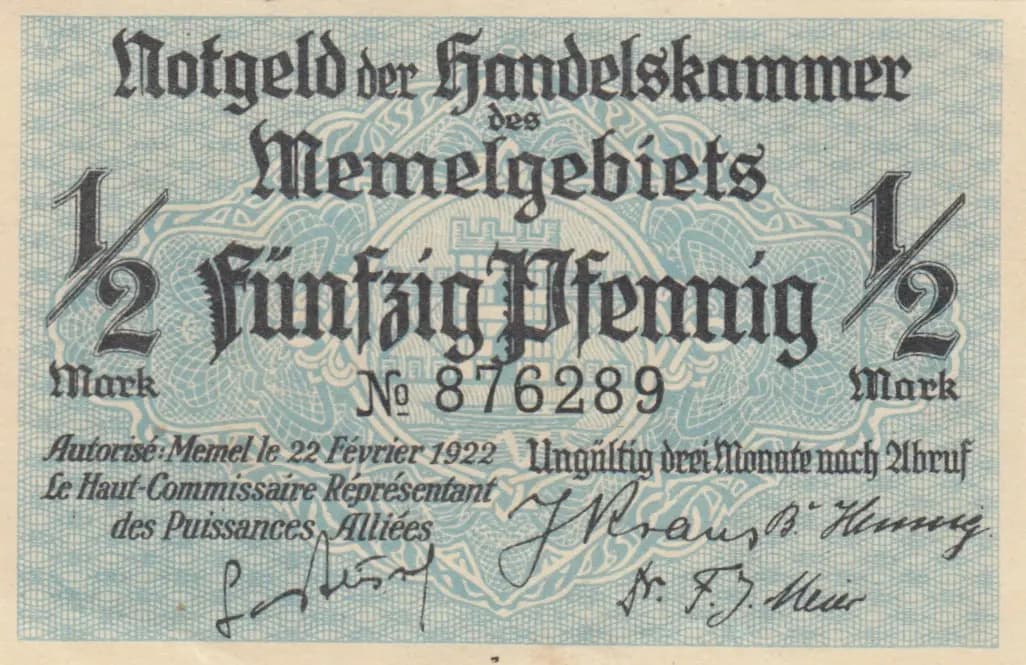
FRONT SIDE: 'MARK 50' (repeated border inscription); 'Notgeld der Handelskammer des Memelgebiets' = 'Emergency money of the Chamber of Commerce of the Memel Region'; 'Gültig 3 Monate nach Abruf' = 'Valid 3 months after call/notice'; 'Autorisé: Memel le 22 février 1922 le Haut Commissaire Représentant des Puissances Alliées' = 'Authorized: Memel, February 22, 1922, the High Commissioner Representative of the Allied Powers'; Serial number: 'No 059588'; Printer: 'GEBR. PARCUS, MÜNCHEN' = 'Gebr. Parcus, Munich'. BACK SIDE: 'Memel'; 'Cellulos-Fabrik' = 'Cellulose Factory' (left vignette); 'Treibendes Schloss' = 'Floating Lock' (center vignette); 'Schiffe-Werft' = 'Shipyard' (right vignette); 'Notgeld der Handelskammer' = 'Emergency money of the Chamber of Commerce'; '50 Mark' (appears twice, left and right denomination displays).
This note was produced using fine line engraving on steel plates, a sophisticated intaglio printing method characteristic of high-security currency and Notgeld production in the 1920s. The printer was Gebr. Parcus (Gebrüder Parcus / Parcus Brothers) of Munich, a respected German printing house known for quality banknote and security printing. The complexity of the ornate borders, the detailed industrial vignettes, and the fine line work visible throughout demonstrate the use of multiple engraved plates for color printing. The note exhibits multicolor printing with careful registration of the cream, green, blue, brown, and yellow-gold inks.
Serial number observed: 059588. This specific specimen appears to be from the standard first printing run of the 1922 Handelskammer issue. No known major varieties (such as signature variations, overprints, or date changes) are documented for Pick-7 in standard references. The note was authorized on February 22, 1922, and this date remains consistent across known examples. Collectors should note that Memel Notgeld can occasionally be found with slight variations in printing intensity or color registration due to the hand-pressed nature of early 1920s intaglio production, but no documented catalogue varieties are recognized for this denomination.