20 mark 1922
About This Note
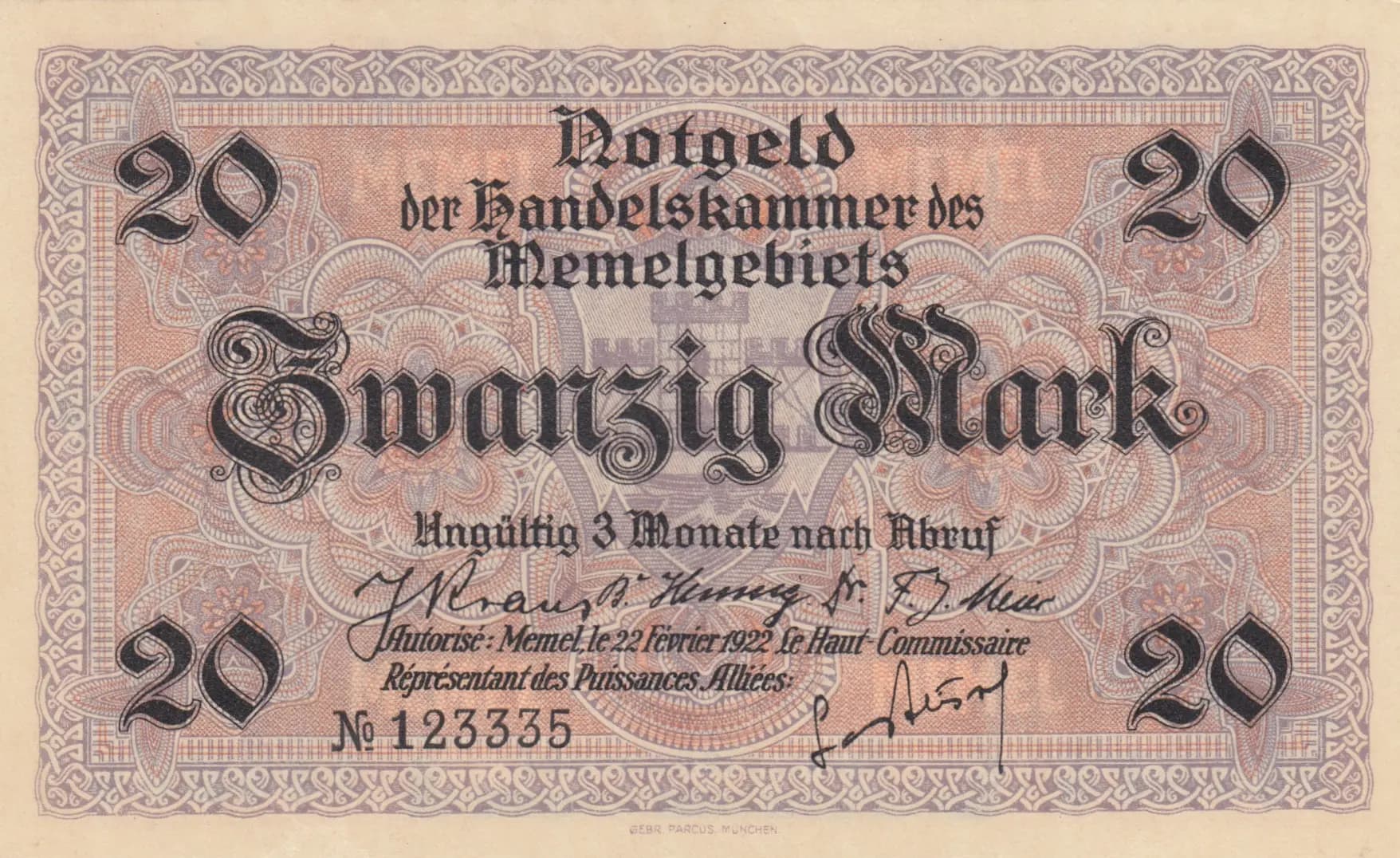
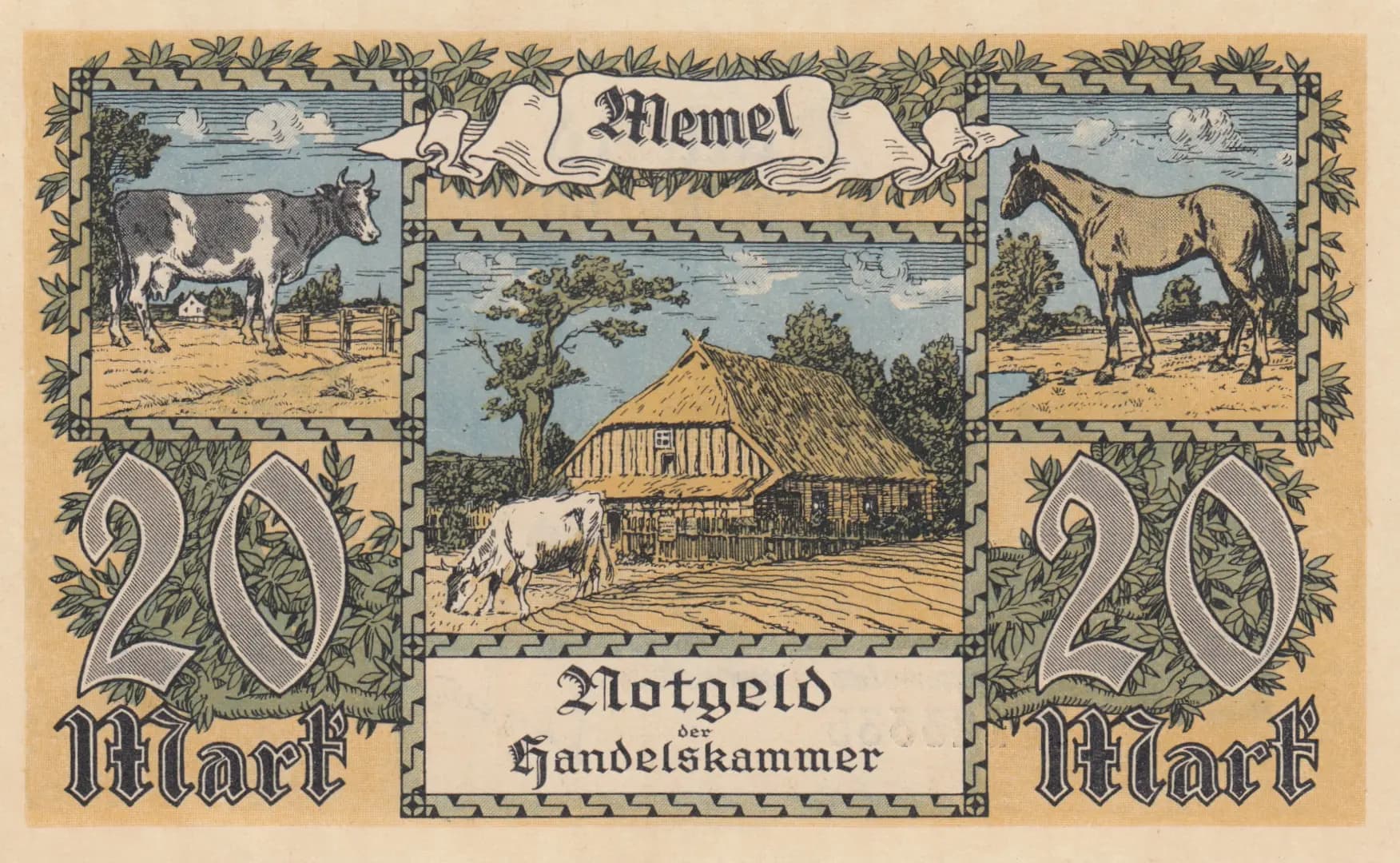
This is a Memel 20 Mark Notgeld note from 1922, issued by the Handelskammer (Chamber of Commerce) during the post-WWI period when the Memel Territory was under League of Nations administration. The note presents in AU condition with excellent preservation of both sides: the front features ornate geometric borders and handwritten signatures of authentication, while the reverse displays charming colored pastoral scenes depicting regional agriculture including livestock and a traditional farmhouse. The bilingual French-German inscriptions and authorization by the Allied High Commissioner reflect the unique international status of the Memel Territory during this brief historical period.
Common. Memel Territory Notgeld from 1922-1923 is generally available to collectors; these emergency currency issues were produced in substantial quantities to meet local circulation needs during the monetary crisis. No specific historical data suggests this note had an exceptionally limited print run or high recall rate that would elevate it to rare status. The Pick catalog's assignment of Pick-6 to this denomination and issuer indicates it was a standard currency issue rather than a special or limited release. The series appears regularly in dealer offerings and collector markets.
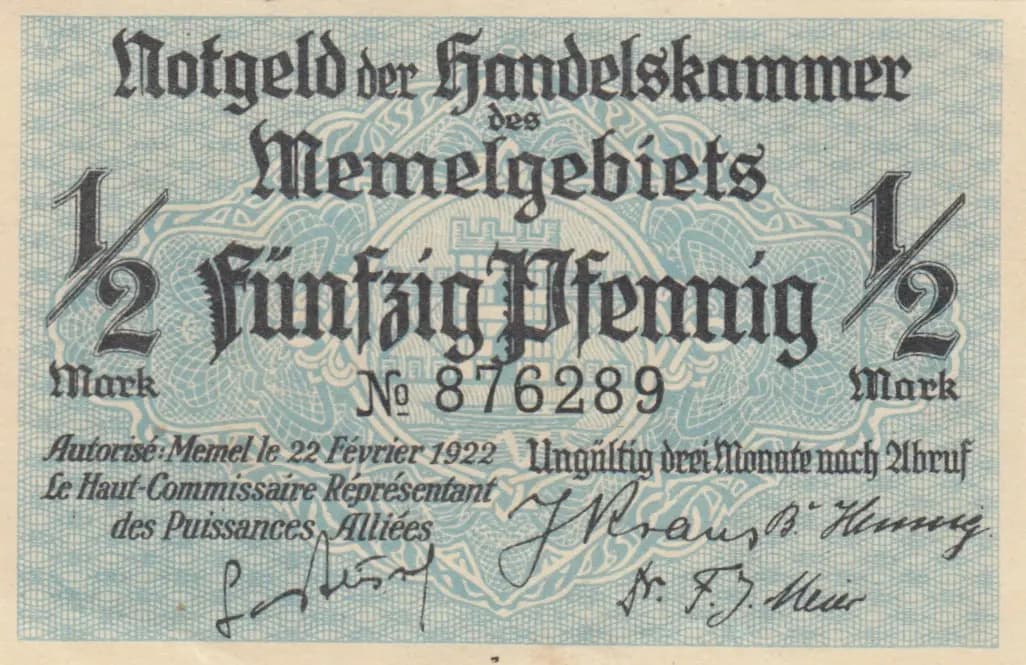
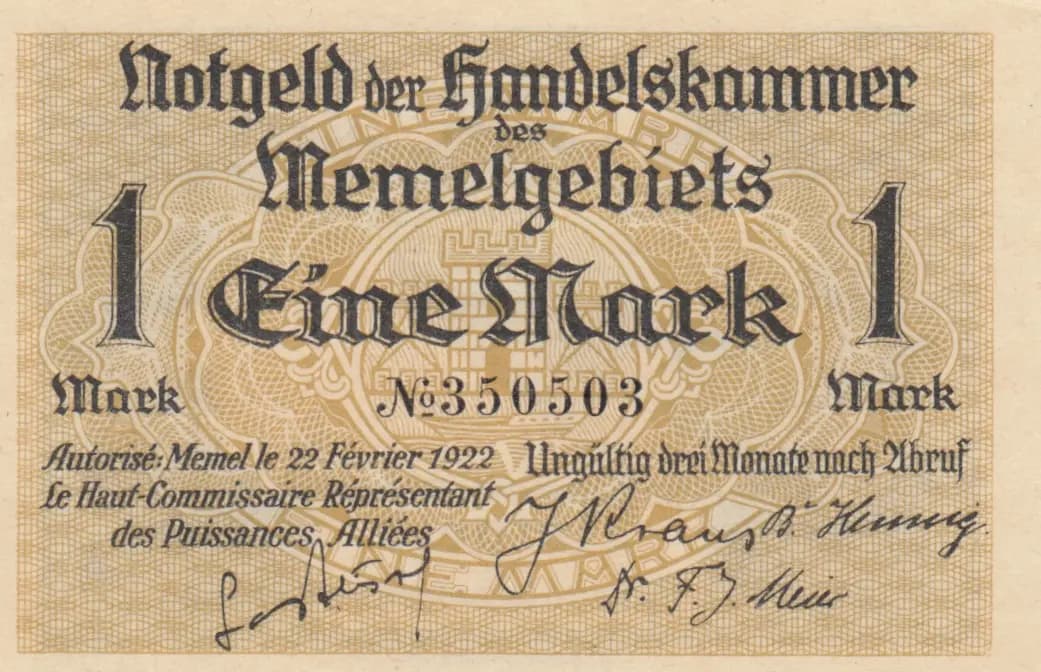
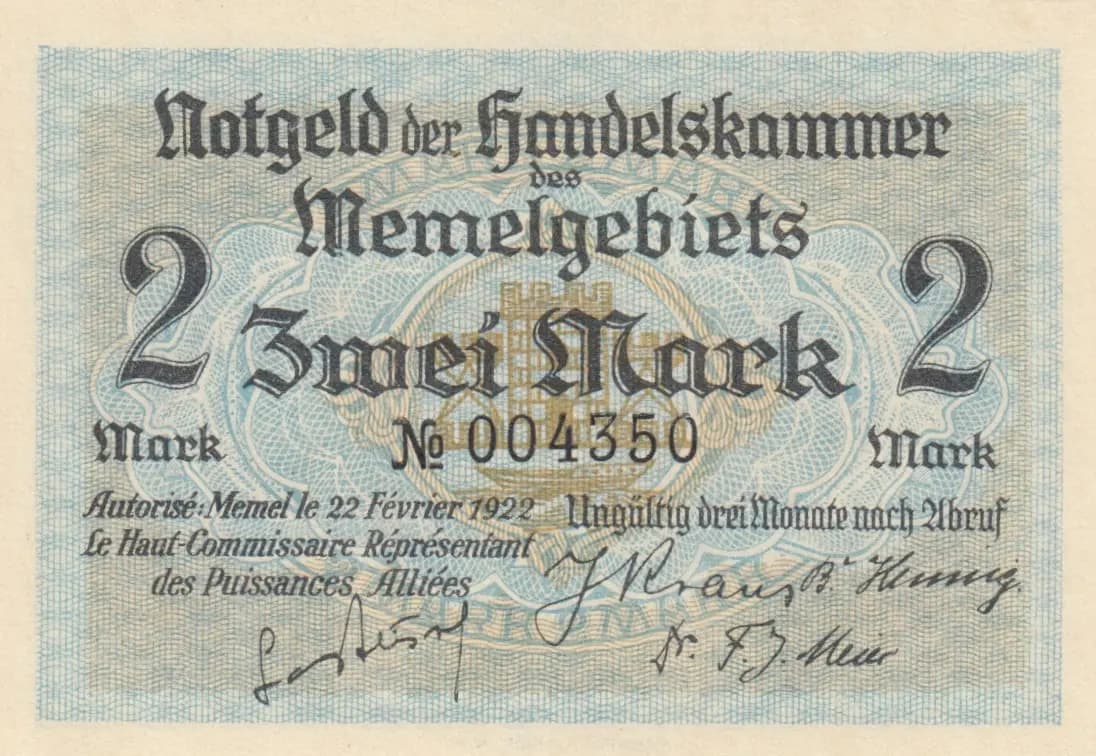
The Memel Territory, returned to Lithuanian control after WWI but administered by the League of Nations under French supervision, required emergency currency (Notgeld) during the post-war monetary crisis of 1922. The pastoral imagery on the reverse—featuring a cow, horse, and traditional farmhouse—emphasizes the agricultural character of the region and its importance to the local economy during this turbulent period. The bilingual French and German text, along with the authorization by 'le Haut Commissaire, Représentant des Puissances Alliées' (the High Commissioner, Representative of the Allied Powers), documents the multinational governance structure that governed Memel between 1920-1923.
This is a two-sided Notgeld design reflecting the economic and cultural character of the Memel Territory. The obverse features an austere, formal design with interlocking Celtic-style geometric borders containing diamond-shaped ornamental elements, executed in black and brown ink on a tan/beige paper stock. Two handwritten signatures in the lower-middle section provide official authentication. The reverse presents a more visually engaging design in full color, divided into three vignettes within decorative leaf-bordered frames: the center vignette displays a traditional rural farmhouse with a pitched shingled roof (representative of Memelland architecture), flanked on the left by a standing dairy cow and on the right by a standing horse, symbolizing the region's agricultural base. The banner at the top inscribed 'Memel' identifies the territory, while large denomination numerals '20' and the word 'Mark' appear in decorative script at bottom corners. The overall composition emphasizes agrarian regional identity rather than state symbolism.
FRONT: '20' (twenty); 'Notgeld der Handelskammer des Memelgebiets' (Emergency money of the Chamber of Commerce of the Memel Territory); 'Swaigzig Mark' (Twenty Mark); 'Ungültig 3 Monate nach Abruf' (Invalid 3 months after call); 'Autorisé: Memel, le 22 février 1922' (Authorized: Memel, February 22, 1922); 'le Haut Commissaire' (the High Commissioner); 'Représentant des Puissances Alliées' (Representative of the Allied Powers); 'No 123335' (Serial number 123335); 'GEHR. PARCUS, MÜNCHEN' (Gebr. Parcus [Brothers Parcus], Munich - printer). BACK: '20 Mark' (Twenty Mark - repeated); 'Memel' (city name/region); 'Notgeld der Handelskammer' (Emergency money of the Chamber of Commerce).
This note was produced using offset/lithographic printing for the colored reverse side and letterpress/typography for the front side text and borders. The printer, Gebr. Parcus (Gebrüder Parcus/Brothers Parcus) of Munich, was a commercial printing firm—not a specialized security printer. The multiple colors on the reverse demonstrate color separation lithography, while the handwritten signatures on the front represent a common authentication method for Notgeld notes issued by regional chambers of commerce. The crisp, well-defined printing quality visible in both the geometric borders and pastoral illustrations indicates professional commercial printing standards typical of Bavarian print houses of this period.
Serial number observed: 123335. The primary variety distinction for this note type relates to signature combinations—the handwritten signatures of Handelskammer officials appear to vary between notes. This example bears two distinct handwritten signatures in black ink positioned in the lower-middle area of the obverse, which is characteristic of chamber-issued Notgeld where different authorized signatories authenticated different batches. No overprints or date variations are apparent in this specimen; the authorization date of 22 février 1922 appears uniform across the issue. Condition varieties may exist (worn vs. AU specimens), with this example grading AU representing excellent preservation status.