10 rupees 1967
Market Prices
16 salesAbout This Note
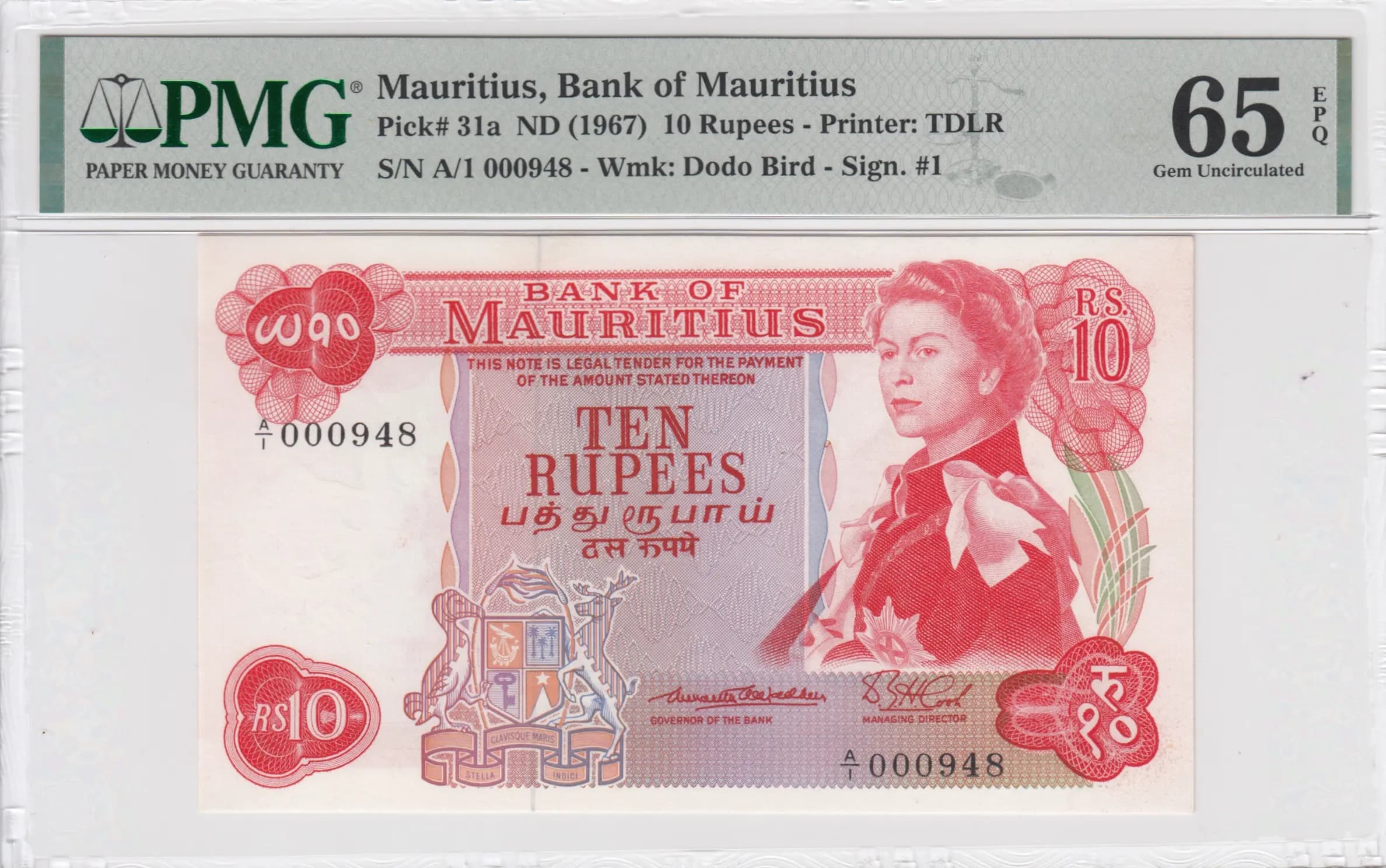
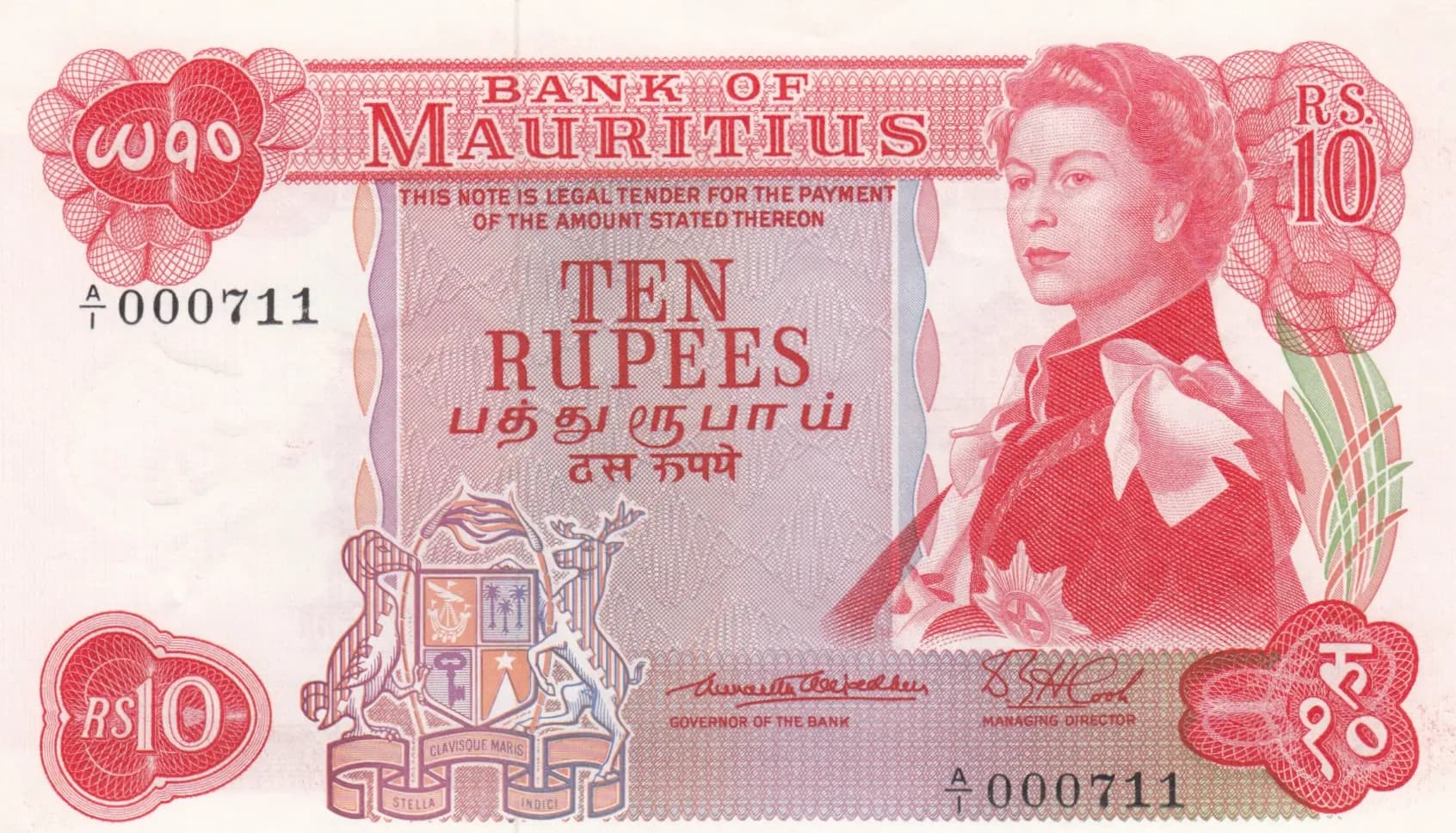
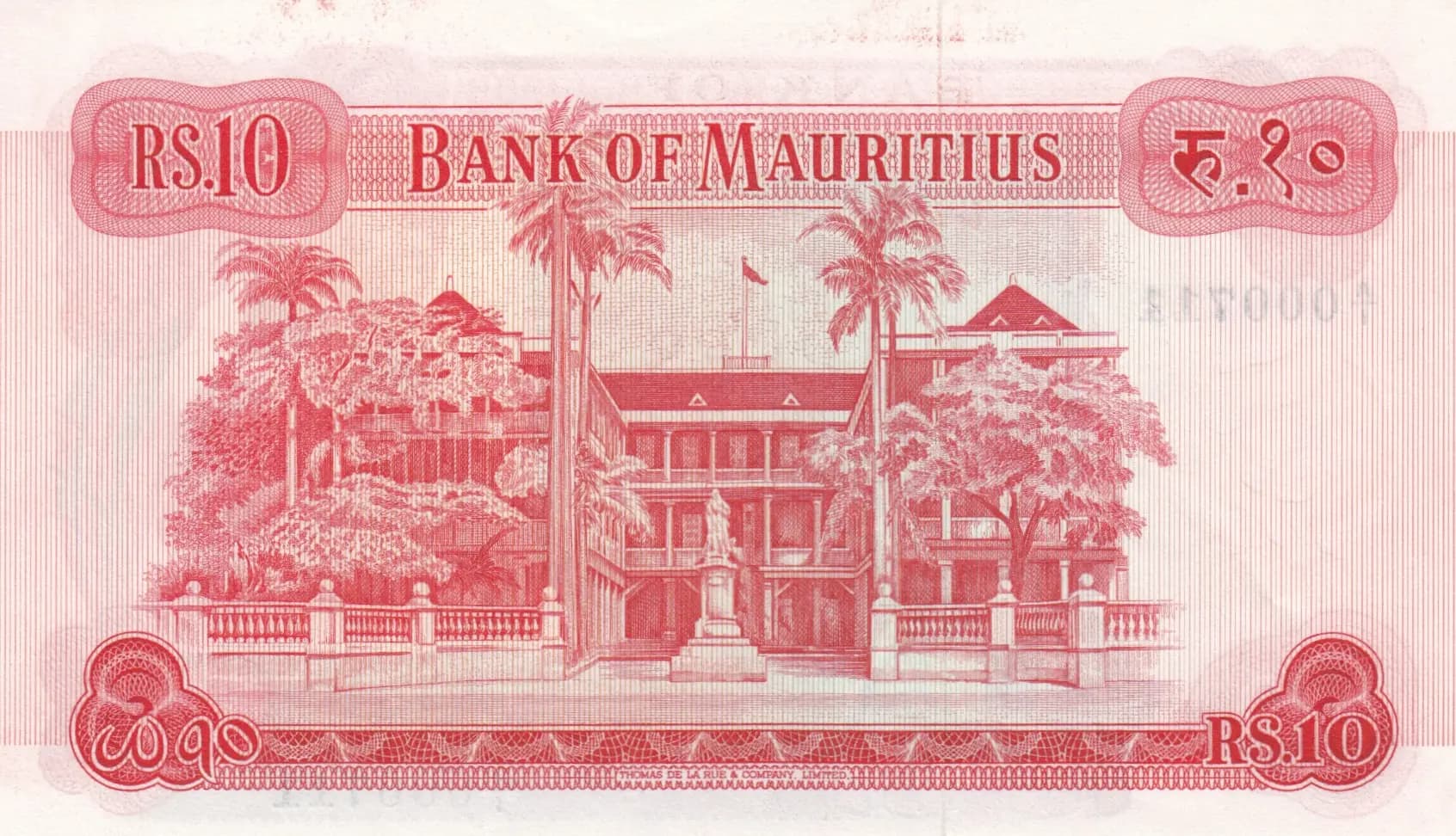
This is an exceptional uncirculated example of the Bank of Mauritius 10 Rupees from 1967 (Pick-31a), featuring pristine condition with sharp printing throughout and no evidence of circulation. The note displays the classic Thomas de la Rue engraving style with Queen Elizabeth II in profile on the obverse and a grand colonial Government building on the reverse, both rendered in distinctive red and pink tones. This early post-independence Mauritian issue represents an important transitional period in the nation's numismatic history and remains highly sought after by collectors, particularly in UNC grades where recent market sales have commanded $130-$282.
Common. Despite its age and appeal, this 1967 issue has regular circulation and catalog availability. eBay market data shows consistent sales activity across multiple condition grades, with UNC examples averaging $62-$282 over recent years, and lower grades commanding under $20. The note was part of a regular issue series with substantial print runs by the newly established Bank of Mauritius. The population of professionally graded examples across multiple variants (P-31a, P-31b, P-31c, etc.) further supports common status.
Issued in 1967, three years after Mauritius gained independence from Britain, this banknote reflects the country's status as a newly sovereign nation while maintaining Commonwealth ties through the portrait of Queen Elizabeth II. The Government building depicted on the reverse—identified as a significant colonial-era administrative structure in Port Louis—symbolizes the island's institutional continuity during this pivotal period. The multilingual inscriptions in English, Tamil, and Hindi reflect Mauritius's diverse population and multicultural identity in the post-colonial era.
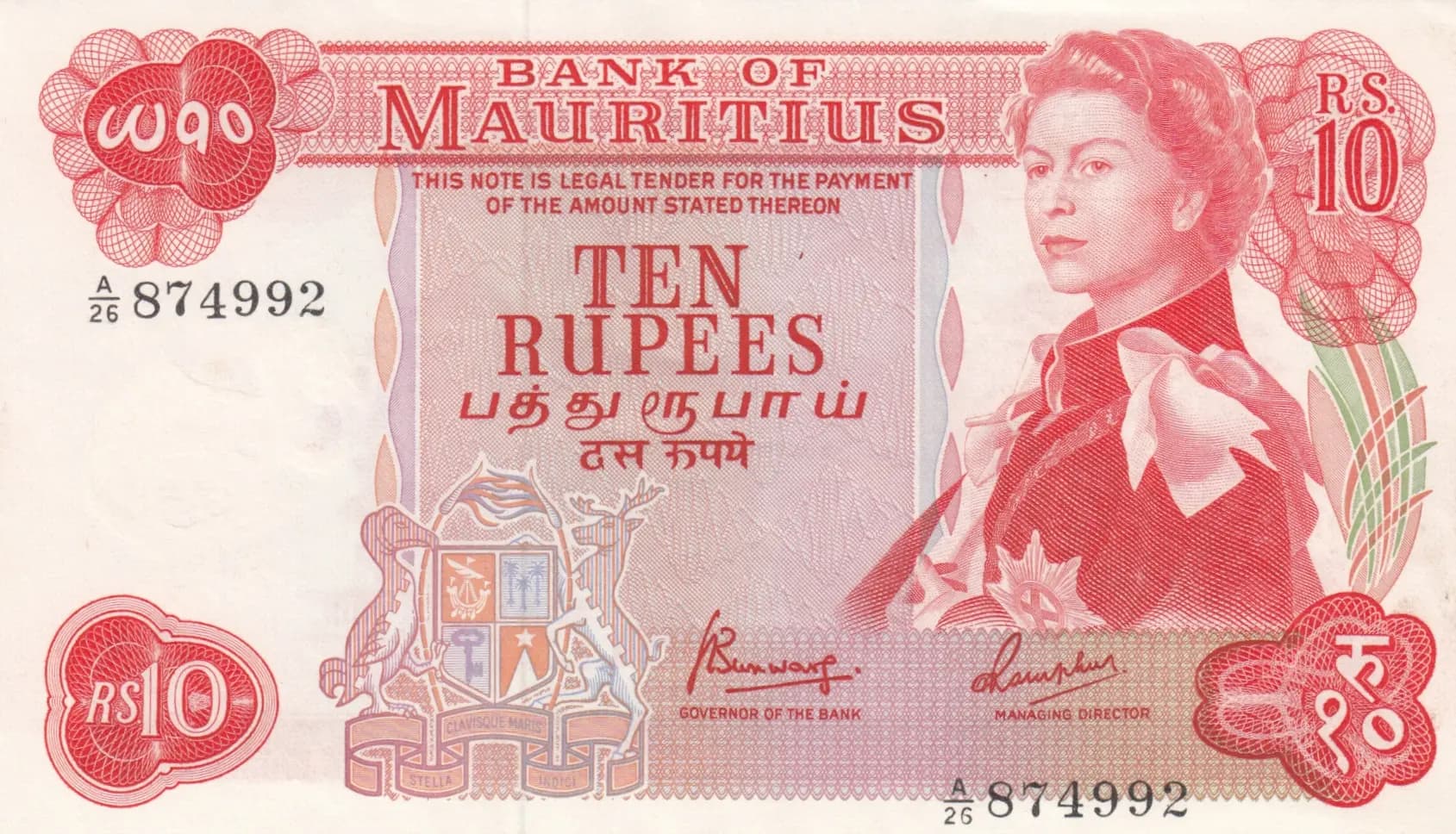
The obverse features a formal portrait of Queen Elizabeth II in left-facing profile, positioned on the right side of the note, rendered in the classical style typical of Commonwealth currency of this era. The coat of arms of Mauritius dominates the center-left, displaying a quartered shield with heraldic supporters (likely a dodo and lion) and a crest featuring a palm tree, symbolizing the nation's sovereignty and natural heritage. Ornate rosette patterns in all four corners and elaborate guilloche work frame the design. The reverse showcases a symmetrical colonial-era Government building in Port Louis with a central entrance, pitched roof with decorative elements, multiple symmetrically arranged windows and doors, and flanking palm trees and tropical vegetation. The architectural style is characteristic of 19th-century British colonial administration centers. Fine line patterns, cross-hatching, and stippling create depth and security throughout both sides.
FRONT: Bank of Mauritius (issuing authority); Ten Rupees / RS.10 (denomination in English and numerals); THIS NOTE IS LEGAL TENDER FOR THE PAYMENT OF THE AMOUNT STATED THEREON (legal declaration); பத்து ரூபாய (Tamil: Ten Rupees); दस रुपये (Hindi: Ten Rupees); GOVERNOR OF THE BANK / MANAGING DIRECTOR (authorization signatures); STELLA CLAVISQUE MARIS (Latin: Star and Key to the Seas - national motto); Serial number A/1000711. BACK: Bank of Mauritius (issuing authority); RS.10 / RS 10 (denomination); DOMES DE LA MARIE (French inscription - architectural reference, possibly referring to decorative domes).
Intaglio engraving, executed by Thomas de la Rue, London—the world's preeminent banknote security printer of the 20th century. The note exhibits sophisticated anti-counterfeiting techniques including fine-line guilloche patterns, complex rosette designs, intricate cross-hatching, stippling, and detailed engraved architectural and heraldic elements. The security features are integral to the design rather than applied separately, a hallmark of De la Rue's approach during this period.
This note is cataloged as Pick-31a, identifying it as a variant within a series of seven documented varieties (P-31CS1, P-31a, P-31b, P-31c, P-31c*, P-31cCS1, P-31s). The specific variety designation P-31a indicates the printer is Thomas de la Rue (TDLR), London. Serial number A/1000711 suggests an early printing sequence. The presence of Tamil and Hindi inscriptions alongside English and French reflects the multicultural composition of Mauritius and helps date the note within the post-1967 independent nation period. No overprints or special markings are evident in this example.